Get to Know Victorian London’s Underbelly a Little Better in From Hell (2001)

One of Victoriana’s headliners will always be Jack the Ripper, a serial killer immortalized in the London newspapers of 1888. A string of murders committed in the East End neighborhoods like White Chapel and Aldgate were attributed to a single person because of the distinctive way he dispensed with his victims. He was sometimes called “Leather Apron” because after he killed he butchered the bodies and left them in the open to be found. These murders predate forensic science so there was never a conviction, only a number of letters (thought to be fraudulent) that were sent to the press and signed Jack The Ripper. One that was not so signed is referred to as “The From Hell Letter” because the writer used Hell as the return address. If you want to check out the original letters you can find them here.

Depp inducing visions
The 2001 Johnny Depp Thriller, From Hell, gives audiences just one possible version of events. In this adaptation of a an Alan Moore graphic novel, Depp is a detective who gets psychic visions of murders. He is based on the real life chief of Scotland Yard, Frederick Abberline who worked the Ripper case. With the help of Robbie Coltrane (Hagrid of Harry Potter fame), Abberline uses his flashes of insight to catch criminals. Unfortunately, Depp must be “chasing the dragon” (ie on opium) in order to get his visions.
 When the prostitutes of London’s East Side start turning up dead, he goes to them and finds a reluctant ally in Mary Kelly (Heather Graham). She and her circle of friends are being targeted by the ruthless killer, but none of them know why. But no matter the danger, these women must work the streets or risk the wrath of a local gang, which puts them at the Ripper’s (total lack of) mercy. Abberline must discover the dark secret that connects them before there are none of them left. Ian Holm (Fifth Element, The Hobbit) and Jason Flemyng (Lock, Stock and Two Smoking Barrels) round out a great cast.
I don’t always like horror films because of the gore, but I felt this movie showed just enough blood to be a Ripper film but relied on good acting while shielding the audience’s view for most of the yuckiest parts. I would call it a thriller rather than a horror movie for just that reason. I haven’t read the graphic novel, but the movie does a great job of weaving conspiracy into a tale of terror.
Steampunk Book Review: League of Extraordinary Gentlemen Vol. 1

Vol 1 Cover art
Steampunk is all about literature, and nowhere else will you find so many Victorian-era characters rubbing elbows as in The League of Extraordinary Gentlemen from Vertigo. The creator, Alan Moore (whose brilliant mind also brought us The Watchmen) and illustrator Kevin O’Neill take their audience on a wild ride which spans several classic works of science fiction and creates a way for them to occupy the same universe.
The story opens with the corpulent Campion Bond (an ancestor of James Bond) who convinces Mina Murray (aka Wilhemina Harker’s maiden name in Dracula, 1897) to go on a recruitment mission on behalf of the British government. She picks up the opium-besotted ex-adventurer Alan Quartermain (King Solomon’s Mine, 1885) with the help of Captain Nemo and his submarine the Nautilus (20,000 Leagues Under the Sea, 1870). After a jaunt into The Strange Case of Dr. Jekyll and Mr. Hyde (1886) for the title character and a school run by notorious fictional dominatrix Rosa Coote to pick up The Invisible Man (1897), the league is ready for action.
They head next to London’s East End, where the nefarious Fu Manchu (referred to only as “The Doctor” for copyright reasons) has stolen a valuable mineral that allows heavier than air flight. He is at war with another crime lord on the West End (none other than Professor Moriarty of The Memoirs of Sherlock Holmes, 1894), and the conflict is on the verge of costing countless lives. Can the heroes beat the bad guys, and the clock, to save the day?
This is a really fun book and I definitely recommend it for fans of Victorian-era fiction. Over the many iterations of the series literally hundreds of literary figures and places grace the pages, so it is kind of like a who’s who of Victoriana. I occasionally have issues with some of the liberties Moore takes with core character traits, but otherwise it is a great display of imagination. As a bonus, if you get the first volume you also get 30 pages of cover art, games, stories and fake historical factoids in the spirit of the Victorian era.
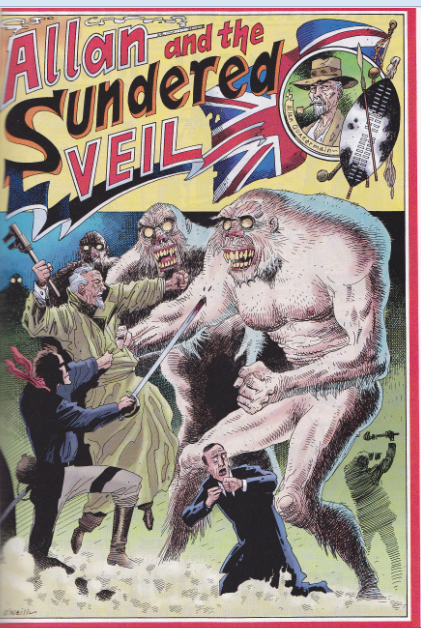
Alan and Sundered Veil
Fair warning, Volume 2 goes darker, dirtier and deadlier, and you can read all about it next week when I review it!
Have you read this book? What did you think?
The Brothers Grimm (2005) Punks Your Favorite Fairy Tales


Brothers Grimm (2005)
Wilhelm and Jacob Grimm released the first volume of their collection of folktales “Kinder- und Hausmärchen” (Children’s and House Tales) in 1812. The first edition included 70 different stories, but after numerous editions the count eventually reached somewhere over 200 (different sources said different things in my research, but mostly between 209-211). If you are looking for the specific fairy tale references, check my Brothers Grimm Fairy Tale Guide.
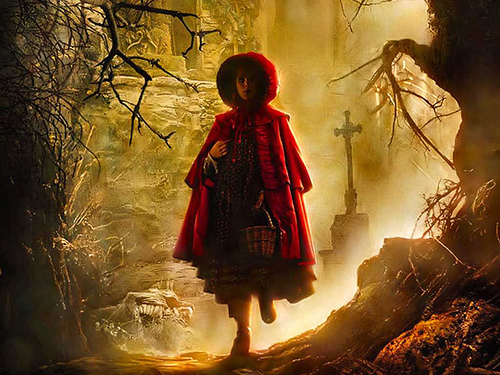
Little Red Riding Hood from a Brothers Grimm advertisement
If you have never read any of the original Grimm fairy tales they are an interesting read. I took a class in college called “Twice Told Tales” and we spent about half of a semester just studying the story of Little Red Riding Hood (Rotkäppchen in the Grimm’s first edition, but actually published first in the 17th century in French by Charles Perault as La Petit Chaperon Rouge). It was fascinating to see what details changed or were added over the centuries (Spoiler: in the original Red is an accidental cannibal and she dies in the end), and believe me when I tell you that any picture-book version you read as a kid was very watered down. I would only recommend reading the originals to children if you want them to have nightmares. You can access English translations of many early fairy tale compilations through the University of Pittsburgh here.

Marbaden concept art by Guy Hendrix Dyas
So, now on to the film. I am a big fan of Terry Gilliam (who wrote and directed Monty Python and the Holy Grail, among other things) and he definitely does not disappoint in this, his first PG13 movie. He actually rewrote much of the Brothers Grimm screenplay, but did not receive credit. If you like to be awed by visual effects and have your heart warmed by a good story, check out another Gilliam creation, The Imaginarium of Doctor Parnassus (2009). Like Van Helsing, Brothers Grimm was filmed in the Czech Republic, both on sound stages and on location.
The story opens with a young Wilhelm Grimm comforting his mother and ailing sister with the promise that his brother Jacob would return soon after selling the family cow. Jacob (who is erroneously portrayed in the film as the younger brother) brings back a handful of beans rather than the much needed cash.

Heath Ledger and Matt Damon as the Brothers Grimm
Next, we see the brothers as adults. Wilhelm is played by Matt Damon and Jacob by the late, great Heath Ledger. (Fun fact, they were originally cast in opposite roles because Gilliam wanted Johnny Depp to play Jacob but thought Depp wouldn’t be a big enough box office draw. This was before Pirates of the Caribbean came out, remember.) The city of Karlstadt is in need heroes to fight a witch that is terrorizing their town and the Grimm brothers arrive to save the day. Too bad for the townsfolk that the witch is a hoax and the brothers are scam artists. Jacob has spent his life collecting folk tales, but Wilhelm is an avid skeptic and is only out to make a buck (or Deutschmark, or whatever).

Marbaden village set
Soon, the brothers are forcibly recruited by an Italian torturer named Cavaldi (a surprisingly funny character played by Peter Stormare) who is employed by the French. During the Napoleonic Wars, Germany was occupied by French forces, who are led by General Delatombe (Jonathan Pryce) in the movie. He tell the brothers of a town called Marbaden and the 10 children who have disappeared. The peasants believe that the children have been taken by a supernatural force living in the dark forest near their homes, but Delatombe believes it is another con artist like the Grimms. He sends them to expose the fake and help bring in an Age of Reason to the foolish bumpkins.

Angelika getting her archery on
When they arrive in Marbaden (accompanied by Cavaldi and a cavalcade of French soldiers) they are told that in order to enter the foreboding forest they need a guide. The only person who can help them is “the cursed one,” Angelika (who is a super bad-ass huntswoman played by Lena Headey). They call her this because her father and sisters have all gone missing and let’s face it, probably because she wears pants and hunts with a bow, and this is the beginning of the 19th century after all.

Marbaden Forest

Evil Queen trying to seduce Matt Damon
Reluctantly, she takes the men deep into the woods which is populated by trees that can move and reveals to them a tall tower with no doors and but a single window at the top. To save the missing children (and their own skins from the French) they must defeat the immortal witch/evil queen (Monica Belluci) who lives there and hope for a happily ever after.
I totally love this movie. Steampunk fans that feel the genre is defined by technology will be disappointed because most of this movie takes place in small, rural villages, but the time period is on the early verge for the genre and fairy tales were certainly read to children in Victorian nurseries. The chemistry between the characters and their development is really compelling (you even end up rooting for the torturer in the end, which is no mean feat!) and the sets and costumes make you feel like you’ve been transported back to the early 1800’s. I don’t usually get nightmares from movies, but there is a scene with a horse that is terrifying, so think hard before watching it with kids under 10 (it is rated PG13 for a reason). The crooked houses and spooky forest set the stage for this fun and sometimes downright frightening film.
Check out some more pics from the film and concept art below, and feel free to leave a comment if you’ve seen this movie or read any really gruesome fairy tales.


Steampunk Book Review: Morlock Night
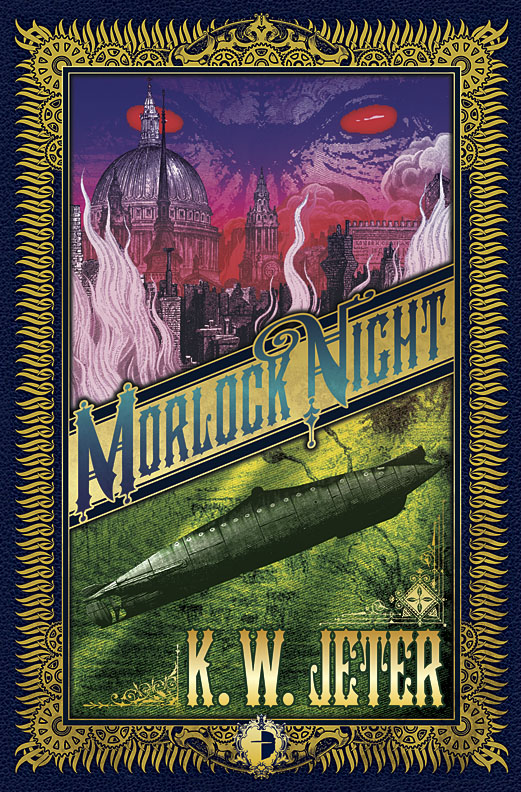
Morlock Night cover art
In case you weren’t already aware, K. W. Jeter was the first person to put the word Steampunk into print. You can find out more about that story here.
Morlock Night was released in 1979 and asks the question “What happened after the events of The Time Machine?” H. G. Wells’ classic tale is told through the vehicle of a dinner party being held by a man known only as “the time traveler.” Jeter’s story picks up right as the party has broken up for the night and the guests are wending their dreary ways home through the London fog.
One of the guests, a Mr. Edwin Hocker, shares his walk and his skepticism with another guest, the mysterious Dr. Ambrose. Hocker is appalled by the turn their conversation takes and finally extricates himself from Ambrose’s company only to be thrown into a nightmare version of his beloved London far in the future. In this world he is confronted by a scenario where the Morlocks, our subterranean future selves, have taken control of the time machine and have invaded the year 1892.
Thankfully this future can still be prevented, and with the guidance of Ambrose, who by the way is the wizard Merlin, Hocker and his compatriot from the future, Tafe, are sent on a series of quests. First, the reincarnation of King Arthur needs to be found and freed from Merlin’s nemesis, Merdenne. But the aging king is in failing health, a condition that can only be stopped by the magical sword Excalibur, the power of which has been diminished through the machinations of Merdenne and his use of the Time Machine.
But even more dire than the ensuing Morlock invasion is the rift in time itself, which is slowly undoing the universe. If Hocker cannot succeed all is lost for not just the human race, but the entirety of existence.
I always enjoy a story with imagination, and Morlock Night certainly fits the bill. Jeter constructs a story that includes Arthurian folklore, Atlantian technology and the time travel paradox that is seen through the eyes of a Victorian gentleman. There was a lot of flag waving for England, but many of Hocker’s biases about class and gender are confronted and changed, which adds the weight of social commentary to a fun story. The combination of disparate elements such as the Morlocks and a submarine stolen from the former residents of Atlantis reminds me of epic tales like Verne’s Mysterious Island, so as long as you go in expecting to suspend your disbelief Morlock Night has a lot to offer.
But, a bit of criticism about the ending. I had already guessed the twist so I was gearing up for an epic climax and was disappointed. The final good vs. evil happens in only a few pages. It felt like Jeter was under deadline or something and just had to wrap it up quick. I am reading his other two steampunk books, Infernal Devices and Fiendish Schemes, and I hope they get to come fully to fruition.
For a complete list of K.W. Jeter’s works, click here.
Steampunk Book Review: The Island of Dr. Moreau

Island of Dr. Moreau cover
The Island of Dr. Moreau was published in by H. G. Wells in 1896. This sojourn into the dark side of medical research was described by the author as “an exercise in youthful blasphemy.”
The story is written as a an account by the late Edward Prendick (the manuscript is said to have been found by his nephew) about his experience as a castaway. Probably the most well-known shipwreck in the Steampunk canon is Jules Verne’s 20,000 Leagues Under the Sea, but the Wells’ tale actually predates it by four years.

1887 Battleship
The narrator is a monied drifter with a background in science. His tale starts with the sinking of his passenger ship, the Lady Vain, and his subsequent week at sea. The other two survivors go into the drink after a scuffle and Prendick is left alone. Later he is rescued by a Dr. Montgomery aboard the Ipecachuanha (named after a root which is the main ingredient of ipecac, a syrup used to induce vomiting. The name is a joke by the captain about how much the boat pitches in bad seas.) The doctor is accompanied by M’ling, whose slow mind and hideous appearance make him a constant target for scorn and bullying aboard the ship. After Prendick attempts to stop the crew from beating M’ling, the corpuscular captain of the Ipecachuanha sends Prendick overboard when they stop to let off Montgomery and his on an uncharted island.
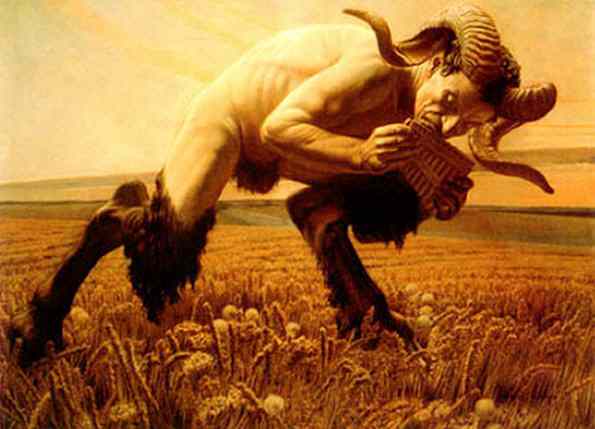
One of the islanders was described as being a satyr, half man and half goat
Montgomery has a variety of strangely elongated workmen under his charge, and together with another English doctor they unload a shipment of animals including a puma and several cages of rabbits. Montgomery makes a slip of the tongue and reveals the other doctor is the notorious vivisecter, Dr. Moreau, who was banished from London society after his work drew public scorn. Prendick soon finds that the good doctor’s work is on-going and they are far from alone on the island.
The anguished cry of Moreau’s newest victim sends Prendick out to explore the island where he encounters a series of strange people. These beast folk have a strict moral code and religious rituals that Moreau uses to control them, but can this fragile cultural ecosystem withstand a new and unplanned addition to the island?
I really enjoyed reading this book. The story moved much better than some of the Victorian-era novels I have read like the painfully slow Dracula. The science of this book revolves around vivisection and skin-grafting, along with complex brain surgery, to create various new forms of human beings. I know that there is a lot of fiction in science fiction, but I found that premise to be a bit flimsy (though according to Wells’ paper “The Limits of Human Plasticity” he thought it was all very possible.) Even so, Wells successfully uses the premise to explore themes like pain and cruelty, and like all good science fiction, ultimately asks readers to think about what it means to be human.
Steampunk Sourcebook: Cephlapods

What is it about our many legged friends that makes them a popular trope in Steampunk?
۞ Monster Cephlapods have been the major focus of several classic works of Science Fiction and Fantasy such as H. P. Lovecraft’s The Call of Cthulu, Jules Verne’s 20,000 Leagues Under the Sea and the 1830 Tennyson poem The Kraken. There is also a Sir Arthur Conan Doyle story called Horror of the Heights that features a flying tentacled monster. In more recent times both the Kraken and Cthulu-like monsters have made appearances in Hollywood blockbusters like Hellboy and Pirates of the Caribbean: Dead Man’s Chest (though you also get a good look at the Kraken after it is death in Pirates of the Caribbean: World’s End).
۞ Their bodies are also reminiscent of complex machines. The long skinny tentacles are like wires or tubes and their movement is powered by water, not unlike steam vehicles. As a bonus their bodies kind of look like they are wearing a helmet and goggles all the time, and if Steampunk had an official symbol I’m pretty sure it would be a pair of goggles (or maybe a gear).
۞ Brian Kesinger, the talented artist behind Otto and Victoria and the book Walking Your Octopus: Your Guidebook to the Domesticated Cephlapod, did an interview for ComicMix.com, and when asked about his choice to draw an octopus as a couture pet he answered:
 “I find octopuses extremely fun to draw. It is a real challenge inventing eight different things for them to do in every image. They are nature’s original multi-tasker and they certainly have captured the imagination of a lot of people. Along with the squid and other Cephalopods, octopuses seem to be a sort of theme animal for steampunk so when I set forth trying to render an image of a high class Victorian lady and her boutique pet the choice was obvious. What was not obvious was how popular Otto has become since I first drew him a year ago. He has inspired fan art, tattoos and I’ve even seen girls cosplay Victoria and conventions around the country! And for that I am so grateful and it keeps me drawing octopus.”
Cephlapods are fascinating creatures that are about as far away from human as you can get.
۞ I used to work at an aquarium so I got a chance to spend lots of time observing octopus and my personal favorite cuttlefish. These invertebrates can move in three dimensions, jetting around the water column and feeding on smaller animals.
They are also totally visually stunning. Undulating tentacles aside, many of them can change color and shape at will, which makes them masters of disguise. Want to have your mind blown? Check out the PBS documentary below for more information about cuttlefish camouflage.
I’ve collected just a sampling of the Steampunk art featuring our many-legged friends out there on the interwebs. In most cases you can get the artist’s name by simply hovering over each image and you can open a gallery of larger images by clicking on any thumbnail. If you see something that is mislabeled or you know who is behind one of my unlabeled entries please let me know so I can give the artist the credit s/he deserves.
Click on any thumbnail to open the gallery of larger images.


Steampunk Book Review: The Strange Affair of Spring Heeled Jack
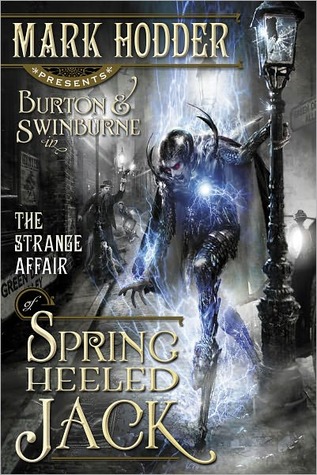
Book cover
I recently moved to a small town, but I had high hopes for the public library because there are two colleges nearby. I had not yet compiled my Steampunk book list, so I went in mostly in search of classic science fiction to get me started on exploring the genre from its roots. But, as I combed the shelves Mark Hodder‘s The Strange Affair of Spring Heeled Jack jumped out at me. I had never heard of the author or Spring Heeled Jack, but calling it a “strange affair,” plus the font on the spine told me I was probably looking at the right time period. I have never realized how much a font could draw me in before and I am so glad I pulled it off the shelf!
The first thing I did before I started to read was look up Spring Heeled Jack. There is a long article about the whole history of sightings here, but basically he was a figure that popped in and out of the public eye during much of the 19th century and into the 20th. He was spotted all over England and eventually made his way to the United States as well. What Mark Hodder does is take all of the historical facts, including names and dates, and builds a new narrative to bring the whole saga together.
In addition to Jack, Hodder also co-opts several of the “Great Victorians” as heroes and villains. The protagonists are Sir Richard Francis Burton and Algernon Charles Swinburne. I was familiar with Burton and his involvement in the debate over the true source of the Nile, but my knowledge ended there. Swinburne was a Victoria-era poet with a taste for the bottle and the teachings of the Marquis de Sade. They seem an unlikely duo but they make an excellent team in this action-packed mystery.
The year is 1861, but the world is filled with things that should not yet have come to pass. Flying armchairs (called rotochairs) help the populace get around and the postal system is composed of foul-mouthed parakeets that have been genetically designed to deliver messages. Queen Victoria was a but a brief blip on the historical radar because she was assassinated only 3 years after becoming queen, leaving the Libertines (who debate whether murder is the ultimate act of individual expression) and Technologists (whose experiments with genetics are way beyond the pale) to vie for social power.
Burton has just finished a night of heavy drinking with some pals and is accosted by a strange man with blue flames framing a devilish face with glowing red eyes. The apparition gives Burton a savage beating all the while warning him to leave the red-eyed man alone. The encounter starts Burton on an adventure that will challenge his mind, body and very sense of self.
I would absolutely recommend this book to anyone who enjoys Steampunk stories. I will definitely be using examples from this novel to help explain the genre to others because there are several re-imagined technologies and “punked” figures from history making appearances. The writing style is engaging and the plot was compelling, so I was very happy to find out there are more books starring this daring duo. You can find a full list with descriptions here.
Next on my reading list: Morlock Night by K. W. Jeter.
Steampunk Sourcebook: City of Ember (2008)


Like The Golden Compass, City of Ember skirts the edge of “true” Steampunk, but I have seen it on several Steampunk movie countdowns (though interestingly not on book lists.)

Streets of Ember
The story centers on two teenagers, Lina Mayfleet (Saoirse Ronan) and Doon Harrow (Harry Treadaway). We meet them on their Assignment Day when their entire future careers get determined by the luck of the draw. Doon is supposed to become a messenger, but he trades that choice job away to Lina in return for a chance to work under the city and gain access to the generator that supplies the lifeblood of Ember: electricity. Because Ember lies deep below the ground, safe from the terror that took place 241 years ago. Without the generator the entire population would be plunged into total darkness and the electric lights mounted all over the city is there only refuge from the abyss beyond.
But lately, the lights have begun to flicker.
Lina is delighted to become a messenger and dives into her duties with gusto. She is the grownup in her tiny family, which consists of a little sister named Poppy with a propensity for putting things in her mouth and a dear (though slightly crazy) grandmother who spends her days taking thread out of clothing and spooling it for reuse (no on has had new clothes for over a century). In the depths of a closet, Poppy uncovers a mysterious metal box that had belonged to a former mayor and proceeds to gnaw on the contents.
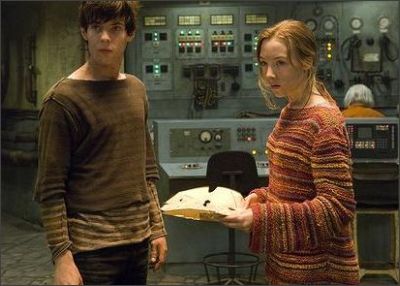
Lina and Doon
Lina recognizes the writing on the pages as coming from the revered and little understood “builders” who created Ember and, with the help of Doon, attempts to recreate the documents from the chewed mess. To their shock and amazement, they seem to be telling of a way out of Ember, and out of the danger of starvation and perpetual darkness. Can Lina and Doon overcome the rampant corruption in their government to discover the truth and lead the citizens of Ember to salvation?
Some fun facts and context:
۞ The movie is based on a novel called The City of Ember that was released in 2003. You can read an interview with the author here about the novel’s tenth anniversary this year.
۞ DuPrau wrote 2 sequels, The People of Sparks (2004) and The Diamond of Darkwood (2008), as well as a prequel called the Prophet of Yonwood (2006) that tells of the cause of the apocalypse that led to the building of Ember.
۞ The City of Ember was made into a graphic novel in 2012 by Niklas Asker.
۞ Harry Treadaway (Doon), most recently appeared in the 2013 Lone Ranger with Johnny Depp. Saoirse Ronan (Lina) has lent her voice as well as her face to several films and is best known for her roles in Atonement and The Lovely Bones.
۞ The film includes a few major changes from the book. First off, giant mutated animals. In the book, Doon keeps a caterpillar to observe it and is utterly fascinated by insects because the people of Ember never see things from above ground. In the film he finds a moth is easily 2 feet across, upping the visual ante but not staying true to the novel. There is also a completely terrifying star nosed mole as large as a hippopotamus that delivers the come-uppence to Ember’s corrupt mayor (played by Bill Murray), which never appeared in the book. Likely this is a reference to the nuclear cause of the apocalypse in the Prophet of Yonwood and mutations that could follow. Personally, I did not like the change, I thought the book was already great without the novelty.
۞ The other big change, which is probably the reason the movie ends up in Steampunk lists and the book does not, is the amount of gadgetry. In the movie, Doon’s father (Tim Robbins) is an inventor and Rube Goldberg type machines cook their breakfast, while in the book he runs a shop populated by old shoe heels and rusty nails. There are also scenes that take place in the huge industrial center under the city, but the tech is all there to create electricity so it is not very Steampunk in the end. But the gritty, dark ambiance and added mechanical gizmos definitely make you feel like you are in the past rather than the distant future.
۞ The set was built in the same shipyard the Titanic was, and many of the interiors that were built were never used in a single shot but add to the depth of the visual story. Check out the clips below the gallery for more windows into the underground city.
Click on the thumbnails for larger images.


 For Whom the Gear Turns