Steampunk Book Review: War of the Worlds

To help me get ready for the H.G. Wells Sourcebook I am going to write for Steam Tour: An American Steampunk in London, I decided to read several of his scientific romances. I read the Time Machine and The Island of Doctor Moreau several months ago, but it is always interesting to read an author’s whole canon in quick succession. My goal is to read War of the Worlds, First Men in the Moon, Tales of Space and Time and The Door in the Wall at minimum before the ezine comes out, but if you think I am missing something even better than what is on that list let me know!
My experience with War of the Worlds was a bit backwards, because I read League of Extraordinary Gentlemen Vol. 2, and the events of that book are closely related to Wells classic tale, and very faithfully adapted it turns out.
Like many of Wells books, this story started as a serial in magazines rather than as a novel from the beginning. The serial ran during 1897 and it was later compiled into a book in 1898. It is divided into two parts, The Coming of the Martians and Earth Under the Martians. The name of the Surrey-based narrator is never revealed, and he tells the harrowing adventure through his eyes as well as through his brother’s account of what happens to London itself when Martians descend and start an invasion.
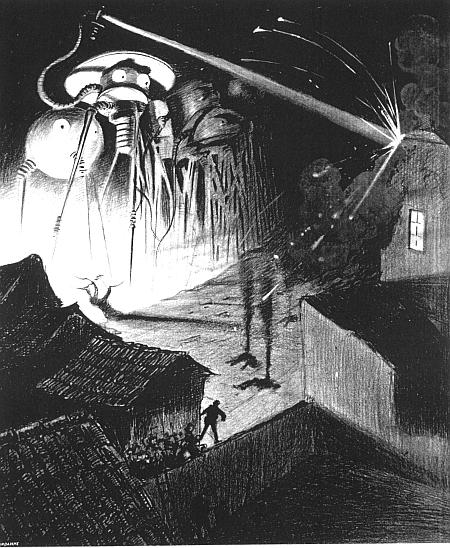 One thing that I love about Wells stories is how much of the scientific knowledge of the times he includes in his tales. For instance, the arrival of the Martians is preceded by strange explosions visible on the surface of the red planet, and it takes the Martian pods several weeks to arrive to the outskirts of London. It then takes over a day for the metal to cool down enough for the pods to open. In the meantime, people have started to gather and even sell refreshments around the first pit where they crash-landed. I love that detail, and I absolutely believe it would happen that way. Soon, the festival atmosphere turns to terror when the Martians assemble their deadly heat ray, our narrator only escaping because he had been sent on an errand and was not in the pit with the scientists who first try to make contact. Through a series of near-misses and some quick thinking, the narrator survives the first wave of attacks by the be-tentacled Martians and their huge fighting machines, and tells the story of (in his view) the apex of society falling to pieces in the face of a cold and calculating enemy. He is surprisingly pragmatic about the whole affair, often likening the human race to insects or rodents who are disturbed by the machinations of people. This is not true of most of the people he meets on his way though, and there are several different kinds of madness worked into the narrative.
This is a tale of invasion, but also of devotion between a husband and wife, which took me by surprise. I have only just started to look at Wells personal life, but he carried on a number of affairs during his second marriage after divorcing his first wife, so the commitment shown by the narrator seems inconsistent with what I know of the author.
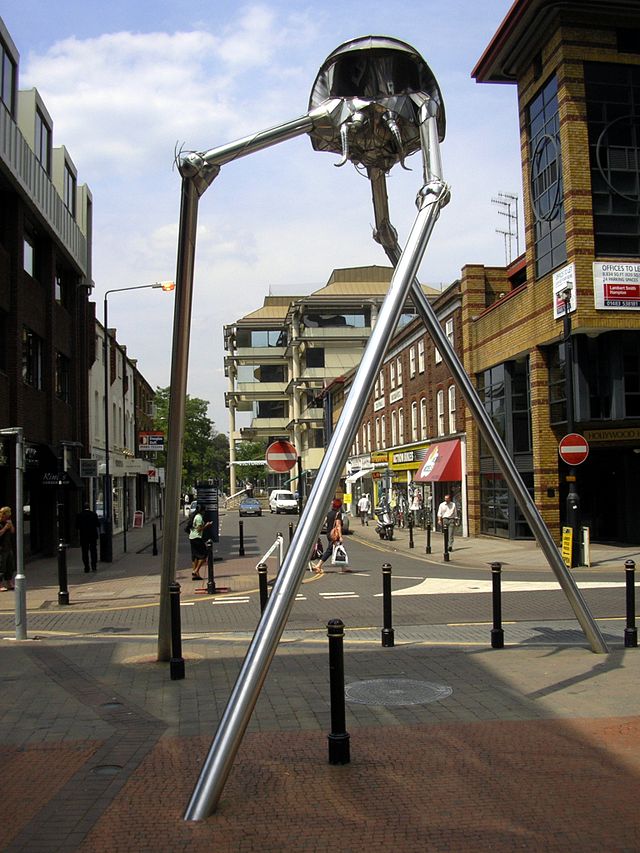 The first time I ever heard of War of the Worlds it was the story of its broadcast on Halloween 1938. The accounts vary, but in the days following several newspapers reported a wave of fearful folks who believed a real invasion was taking place. They opted to present 40 minutes of the hour-long tale as a series of simulated news bulletins, and this coupled with a lack of commercial breaks added to the realism. There was a disclaimer at the beginning of the show, but anyone who tuned in late could have gotten the impression that they were hearing something that was going on in real time. Most likely, the newspaper accounts of a panicked populace were blown out of proportion because of the competition between traditional print media and the new radio technology. (What?! The news was sensationalized? Never!)
I can definitely see why this book has been adapted and re-adapted several times and in different media. The aliens and their technology remains alien and stands the test of time better than say, First Men in the Moon. It is definitely worth a read, not just because it is a classic but because it is a genuinely interesting social commentary that transcends the time in which it was written.
Have you read it or seen a movie version? What did you think?
Steam Tour Featured on StoryWorld
I’m on my way out the door to visit Madame Tussaud’s wax museum here in NYC, but I wanted to share that the writing website Story World interviewed me about Steam Tour!
Steamboy (2004) is an Epic Steampunk Adventure out of Japan


When I first ran across a description for a manga Steampunk movie I admit that I was skeptical. But, I am so glad that I got it through Netflix and gave it a shot because it was incredible!
 The director, Katsuhiro Otomo, is best known for his cyberpunk directorial debut Akira in 1988. I have a great respect for graphic artists and animators, and the creators of this film lend all of the attention to detail and breath-taking beauty to the Victorian era as you could hope for. The settings are primarily the Crystal Palace of the Great Exhibition in London and inside an enormous “steam castle” and they have been rendered with incredible detail.
Otomo takes a few liberties with those pesky historical facts, but you can’t go letting the facts get in the way of a good story 🙂 For instance, Steamboy takes place in 1866, but the Great Exhibition took place in 1851. Likewise you get to see the Tower Bridge totally destroyed, but it was not built until 1894. I recommend you just chalk it up to being an alternative Victorian era and enjoy the ride.
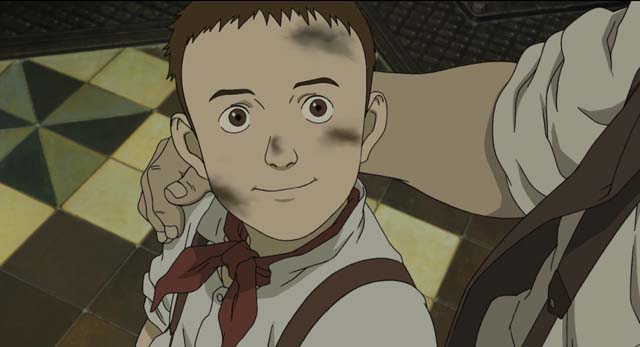 The story centers around a young boy named Ray Steam. He comes from family of talented inventors and has inherited their knack for tinkering. His father, Edward Steam and Grandfather, Lloyd Steam, have been gone for some time working on their inventions, but Ray’s world is turned upside down when his Grandfather sends him a mysterious package with instructions to protect the contents at all costs. Soon after it arrives, representatives of O’Hara Foundation (the wealthy and powerful company that sponsors his family’s work) appear and try to steal it from him. Grandpa Steam gets to Ray in time to tell him of his father’s death and to help him escape the clutches of the O’Hara cronies.

Monowheel from Steamboy
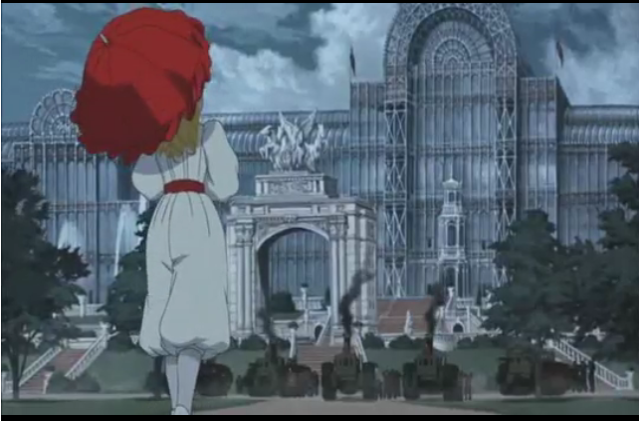 The letter from Grandpa Steam tells Ray to get the steam ball to another inventor, Robert Stephenson. By happy coincidence, Stephenson was on his way to see Ray’s grandfather so he was on the train Ray uses to escape the agents of the O’Hara Foundation. Or, at least that is what they think. But, as the train pulls into the station in London a zeppelin descends and the henchmen use a huge metal arm to capture Ray and take the steam ball to their headquarters at the Crystal Palace. When Ray arrives he finds out that his grandfather lied and his father is still alive and the steam ball is an integral part of a colossal steam-powered castle that is hidden within the walls of the Palace itself.
For a while, Ray works side by side with his father and meets Scarlett, the incredibly spoiled granddaughter of the O’Hara Foundation’s found. Unbeknownst to Ray, his grandfather is being held prisoner inside the steam castle, but he manages to escape. Ray finds him attempting to sabotage the steam castle because he knows its true and nefarious purpose. Ray has to decide where his loyalties lie and whether he is will to be just another cog in his father’s machine.


In case you couldn’t tell, I loved this movie. And don’t give me any of that “I don’t DO anime” or “cartoons are for kids,” because this film can totally stand up against any Hollywood blockbuster simply because it is animated. Illustrators and animators have the freedom to make anything they can imagine actually appear, and the massive scale of this movie would hardly be possible any other way. And never fear, just because it is a Japanese movie doesn’t mean you are doomed to subtitles. Just make sure to change the language setting on the DVD and you can watch the whole thing dubbed in English.
Get to Know Victorian London’s Underbelly a Little Better in From Hell (2001)

One of Victoriana’s headliners will always be Jack the Ripper, a serial killer immortalized in the London newspapers of 1888. A string of murders committed in the East End neighborhoods like White Chapel and Aldgate were attributed to a single person because of the distinctive way he dispensed with his victims. He was sometimes called “Leather Apron” because after he killed he butchered the bodies and left them in the open to be found. These murders predate forensic science so there was never a conviction, only a number of letters (thought to be fraudulent) that were sent to the press and signed Jack The Ripper. One that was not so signed is referred to as “The From Hell Letter” because the writer used Hell as the return address. If you want to check out the original letters you can find them here.

Depp inducing visions
The 2001 Johnny Depp Thriller, From Hell, gives audiences just one possible version of events. In this adaptation of a an Alan Moore graphic novel, Depp is a detective who gets psychic visions of murders. He is based on the real life chief of Scotland Yard, Frederick Abberline who worked the Ripper case. With the help of Robbie Coltrane (Hagrid of Harry Potter fame), Abberline uses his flashes of insight to catch criminals. Unfortunately, Depp must be “chasing the dragon” (ie on opium) in order to get his visions.
 When the prostitutes of London’s East Side start turning up dead, he goes to them and finds a reluctant ally in Mary Kelly (Heather Graham). She and her circle of friends are being targeted by the ruthless killer, but none of them know why. But no matter the danger, these women must work the streets or risk the wrath of a local gang, which puts them at the Ripper’s (total lack of) mercy. Abberline must discover the dark secret that connects them before there are none of them left. Ian Holm (Fifth Element, The Hobbit) and Jason Flemyng (Lock, Stock and Two Smoking Barrels) round out a great cast.
I don’t always like horror films because of the gore, but I felt this movie showed just enough blood to be a Ripper film but relied on good acting while shielding the audience’s view for most of the yuckiest parts. I would call it a thriller rather than a horror movie for just that reason. I haven’t read the graphic novel, but the movie does a great job of weaving conspiracy into a tale of terror.
Steampunk hits the Paralympics: Festival of Flame (2012) Gallery

The 2012 Paralympics closing ceremony featured huge metal vehicles and steamy costumes. I created a gallery of images, plus you can watch the whole closing ceremony including appearances by Rihanna and Coldplay below.

Correfoc, Barcelona 2005
The performance was called The Festival of Flame and it certainly lived up to its name. It reminded me of being in Barcelona in the fall when they have their annual festival, La Merce. I got to experience the correfoc (fire run) with some friends in 2005 and I was the only one to actually brave the sparks and make a run for it. (pictured left) La Merce has been celebrated since 1902 and features fire breathing monster floats, drumming demons and human castles 6 people high.
Festival of Flame


Want to see more steamy vehicles? Check out my vehicle gallery here!


 For Whom the Gear Turns