Hansel and Gretel: Witch Hunters (2013) is Perfect for Your Steampunk Halloween

In my last movie post about an awesome…ly bad Sherlock Holmes flick I introduced the idea of a mockbuster. I think Hansel and Gretel: Witch Hunters may actually deserve to crowned as mockbuster royalty. I found not one, or two, but three other films that came out during 2012-2013 that have something to do, however loosely, with the Grimm’s fairy tale. I watched the trailers for Hansel and Gretel: Warriors of Witchcraft (starring real life brother and sister, wait for it, Fivel and Booboo Stewart), Hansel & Gretel (a nasty-looking horror flick by Asylum Pictures) and Hansel & Gretel Get Baked (a half comedy-half horror stoner parody) and none of them are the least bit Steampunk, so accept no substitutions.
 Hansel and Gretel: Witch Hunters stars Gemma Arterton (Quantum of Solace, Clash of the Titans) and Jeremy Renner (The Avengers, The Bourne Legacy), as well as one of my favorite character actors, Peter Stormare (Brothers Grimm). The original story was published in 1812, but with the delightful mish-mash of technology in this movie it is hard to place it in time.
In the Grimm’s fairy tale Hansel and Gretel’s evil stepmother convinces their father to abandon them in the woods because there isn’t enough food to go around. They find their way back once by leaving a trail of pebbles, but the second time their breadcrumb trail is eaten by birds and they end up at a house made of candy. They defeat the witchy homeowner and when they find their way back to their own dwelling the wicked stepmom has died of unknown causes. Luckily, the kids found gems at the witches’ abode so their money problems are over, and it ends happily ever after (except for the witch and the stepmother, of course).

In the 2013 movie’s version of events, the kids are left in the forest by their parents for an unknown reason, and they still defeat their “hostess of the grossest” but the story doesn’t end there. They discover during their struggle they should “1. never go into a house made of candy and 2. if you are going to kill a witch, set her ass on fire,” but also that they are immune to witch’s spells. They go on to become professional witch hunters and are called to the town of Augsburg to investigate a spate of disappearances. It turns out the local witches are a-brewing a plot to make themselves immune to fire, and they need 12 kids as well as another secret ingredient to do it. In order to find out what really happened to their parents, the siblings must face the Grand Witch Muriel (Famke Janssen) and defeat her before she can carry out her dastardly plot.
In my head I put this movie into the same dark-but-fun category as Van Helsing and Brothers Grimm, but it definitely has a higher gore-factor and earns its R-rating for violence. So if you are squeamish when it comes to blood, you might want to give this one a pass. Of course, that is part of what makes it a perfect movie for your Halloween fright fest 🙂
Tips for Makers: Taming Metal Part 4, “Sketch and Etch”



When I was in college I figured out that the most dangerous room on campus wasn’t what you might expect. It was the print-making lab where I spent a goodly portion of freshman year. There were several large and powerful presses that could crush your fingers, a large box full of sawdust soaked in kerosene from cleaning ink off of metal plates, and my personal favorite, a vat of acid for etching copper plates. Thankfully, you don’t have to use something nearly as corrosive and dangerous as acid to do your own etching.
Etched metal is absolutely gorgeous and oh-so-Steampunk. In short, etching is a process where metal is removed chemically or with electricity. The metal is selectively protected by a resistant medium (called the mask or the resist) and the etching occurs on the exposed metal surface.
The oldest method of etching, called intaglio, is the same one I used for print-making. A metal like copper, zinc or steel is covered with a substance that is resistant to the etching solution and the design is incised into the mask with a sharp tool, leaving some of the metal exposed. Then the plate is bathed in a corrosive solution which “bites” into the metal and leaves lines behind. If you are making a print, you rub ink into the lines, wipe off the plate and use a press to transfer the ink to paper. When making jewelry or other accessories the next step is often to treat the metal to give is the right patina or finish, ie color and shine.
To do etching at home, you don’t have to need much in the way of fancy equipment, just some salt water, batteries and some tape. It turns out that the toner used in laserjet printers is a resistant to some corrosive chemicals used in etching, and it is easy to transfer designs that you have scanned into the computer onto your etched thing-to-be as long as you print onto the right kind of paper. So you can draw whatever you want and print it in black and white, and then presto! you get to see it in metal. Sharpie and sticky-backed vinyl can also be used for your mask.
There is an article in the Steampunk Bible about making awesome etched tins, and the author Jake von Slatt has also posted a great page on the Steampunk Workshop website with pictures. You can check out the tutorial here.
I also found a nice youtube instructional video that focuses on jewelry.
Happy etching!
Looking for more ways to tame metal? Check out parts 1, 2 and 3 of the series.
Tips for Makers: Taming Metal Part 3, “Torch and Scorch”

Even though it is strongly associated with the Industrial Revolution and the World Wars, welding has been around for thousands of years in one form or another. The Bronze Age (in Europe 3200-600 BCE) and the Iron Age (in Europe 800-51 BCE) were both eras shaped by the pounding, heating and joining of metals. But what happened in the Steam era were new techniques with fancy new power sources.
 For a long time, application of fire or hot coals was the only way to get metal to reach a high heat, and together with pressure (ie, hitting it with a hammer) with time and patience you could create weapons and other items that were made of metal fused together (this is called forge welding). But, at the beginning of the 19th century, the electric arc was discovered almost simultaneously in two different countries and shielded metal arc welding and its versatile tool the stick welder were born a short time later. An electric arc, in the simplest terms, is the shape that an electric current takes as it “jumps” from one point to another and ignites the gasses between those two points. This burning gas is hot enough to be considered plasma, which means that it burns extremely brightly, can throw off intense UV radiation, can create noxious fumes that you don’t want to inhale and is extremely likely to make your nice unmarred flesh resemble a roast suckling pig if it makes contact so BE CAREFUL.
During the Taming Metal session at Weekend at the Asylum the panelists didn’t get to spend too much time on any one method, but this was definitely Trevor Frank’s favorite. Stick welders are especially easy to use nowadays because of advancements that keep unwanted gasses from the air out, thus creating a more stable and predictable arc. You definitely must use a mask that covers the full face to protect your skin, eyes and lungs. Frank and others mentioned developing something they called “the welder’s nod” because of deploying their mask with a nod of the head. Plasma burns so bright that the eye part of a welding mask has to be so dark you cannot see what you are about to weld when you have your mask on. So the artist can lift their mask, get their pieces into position and right before they ignite the plasma they give a sharp nod of the head to bring the shield down. But masks have also been coming a long way, and there is now a type that darkens to eye shield the moment the arc is struck, thus saving your neck from all that nodding. There are many different kinds of welding, but for the non-professional, stick welding is a great method that their portability and relative ease of use.
There are some welding methods that use open (and extremely hot) flames in the form of torches. Personally, I have used a cutting torch to do some freehand sheet metal art, but I have never actually done welding myself. So in lieu of giving you bad information, I wanted to provide some links to resources instead.
Instructables- Metal Inert Gas (MIG) welding tutorial
Welding Tips and Tricks website
Tips for Makers: Taming Metal Part 2, “Treat and Heat”

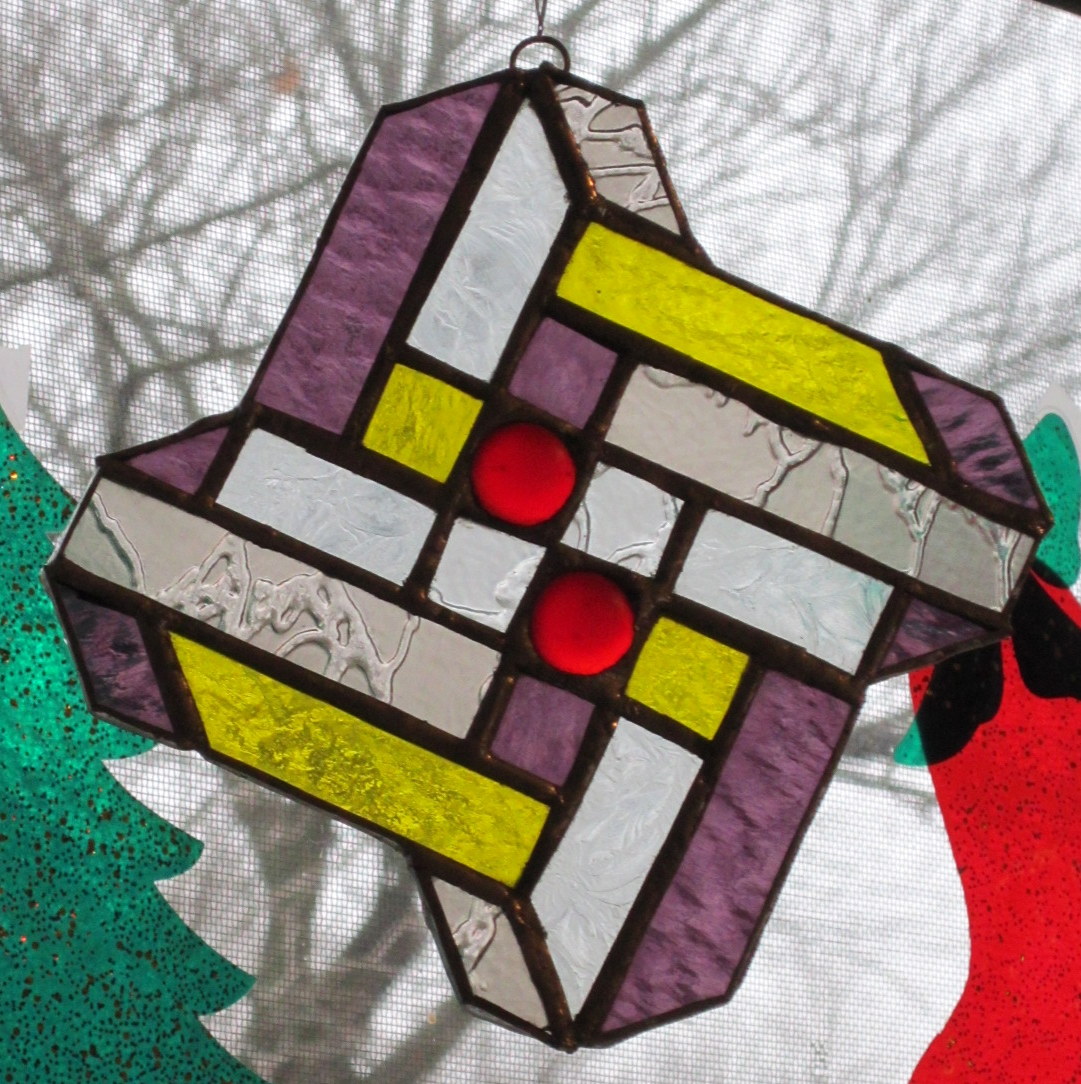
My favorite of the sun-catchers that I have made
Last time I covered some of the kinder, gentler ways to work with metal. In this post, I want to tell you about soldering. This is the metallurgical technique with which I have the most personal experience. I have used it to create silver jewelry and to attach transistors to electrical components like circuit boards, as well as making stained glass sun-catchers and sculptures.
Soldering
- Solder, a metal alloy used to join other metals together, comes in different varieties that have different melting temperatures, and your solder must always have a melting temperature lower than that of what you are joining.
- There is soft solder (melting between 190 to 840 °F) and hard solder (840 °F and above), which is sometimes called ‘silver solder‘. When working with high-temperature solder it is often referred to as ‘brazing.’ When a joint is particularly delicate (ie, joining two very small things or a small thing to a large thing) or the finished item is going to see a lot of wear and tear, it is better to use a harder solder and more acidic flux.
- In some cases, once your solder hardens it may actually be stronger than the materials you are joining. (This is also true of wood glue, by the way. It is usually easier to break the wood that you join than the place where it is joined.)
- Solder is often in the form of wire on a spool that is unwound and cut to the size needed for a particular joint. I have also used soldering solutions where tiny bits of solder are suspending in a liquid (see ‘flux’ below).
- There are two different kinds of tools you can use to melt your solder. A soldering iron is more or less shaped like a fat pen and is held as if you are writing. Be careful with this kind because once gets hot it stays hot as long as it is on. A soldering gun is shaped like a pistol and has a trigger that the artist presses to heat the tip each time. In both of these cases, the tip of the tool comes in direct contact with the solder and melts it so it can flow into the crack between whatever is being joined. When I making circuit boards, I used a hot air soldering iron that was held like a soldering iron but it had an open tip where air was heated and forced through, so the tip never came in contact with the solder itself. This was used with a very low temperature tin solder that has a high rate of conductivity which made it is ideal for electronics. Some hard solders may require a torch instead of an iron or gun.
- Before you can solder, you have to treat the joint with flux. This is a slightly acidic solution that takes away residue left from handling with bare hands, and it facilitates the solder’s flow into the joint. It is only mildly acidic, but if it gets into your eyes it can cause discomfort (trust me, I know from firsthand experience.)
- Safety: It is a good idea to wear gloves when soldering, especially if you are using a soldering iron which stays hot between joints. Stained glass soldering works at a low enough temperature that I have never gotten a blister from contact with the iron, but I have gotten sore, red fingers that last for a couple days. Keep in mind that the longer you have to apply the heat to the solder, the more the surrounding metal will also heat, so you can get burned if you are holding the materials you are joining with bare hands. Also, when flux heats it can sometimes spit like bacon grease in a frying pan, so if you may also want to wear goggles to keep the hot liquid from getting into your eyes.
Tips for Makers: Taming Metal Part 1, “Glues and Screws”
Friends, makers, cosplayers, lend me your ears! (Or eyes as the case would be) I attended several different sessions during my awesome convention experience in Lincoln, including three that were all about making the cool props, costumes, widgets and gadgets that can add that extra zing to your Steampunkery. This is the first installment of a multi-part tipfest for those of you who like to get your hands dirty just in time for Halloween.
I have taken many art classes in my time, and I was a fine arts major in college before I injured my drawing hand too badly to continue. I still minored in Art History though, and to qualify I took one of my favorite classes of all time, Intro to Sculpture. We worked with a variety of materials over the summer, but my absolute favorite was metal. I love it for two reasons: under the right conditions it is totally malleable, and when you are done it is incredibly strong. And shiny of course, let’s not forget shiny 🙂
 At Weekend at the Asylum there was a session called “Taming Metal” that was run by a panel consisting of “Herr Doktor“, Trevor Frank and “Dr Quack.” They started with the easiest way to join two metal pieces together and moved to the more involved techniques as the session went on, and they also touched on some important tools and safety tips, and etching advice. The following bullets are based on my notes that I took during the session.
- Metal can be joined in many ways ranging from “glues and screws” to welding. The stronger the joint you are looking for, the more sophisticated the equipment and the more safety precautions you need to take. There are serious safety concerns when working with torches, both for burns to your skin and to your retina which can result in temporary blindness and serious long-term effects on vision, so NEVER cut corners when it comes to safety. “Metal doesn’t care how old you are, or how experienced you are.”
-

Epoxy often looks like two syringes that are connected.
But let’s start with the easier stuff. Epoxy is more effective than other types of glue for adhering metal to other metal, or metal to other materials. And what is epoxy, you ask? It is usually a combination of two resins that are only mixed at the time you are using them and any extra must be disguarded, unlike glue that can sit on your shelf forever and more or less stays the same (though of course, glues to dry out over time).

- Any time you are going to use an adhesive rather an a screw, solder or welded connection make sure that you rough up your surface. The little scratches left behind by sand paper or steel wool will give your glue more to grip and create a better seal. And to give your glue its best shot, try to find a way to clamp or weigh down the connection point for at least a day or two while the adhesive sets. To preserve the look and texture of the metal while clamping, it is a good idea to put a cloth between your material and the shoes (or holdy-onny part of your clamp) or use a clamp with rubber covering the shoes.
-

A few shapes that nuts can take.
Nuts and bolts are a great way to hold metal together, but you will probably need to drill holes before you start. Dremels and other small, handheld drills can get through most thing sheets of metal, but watch out for shavings that can be sharp. But, it can be hard to find nuts and bolts that are the right color or type of metal (most are shiny, stainless steel like those at the right) to go with steampunk designs, so you may want to pre-rough them up if you are planning to add paint or use rivets instead.

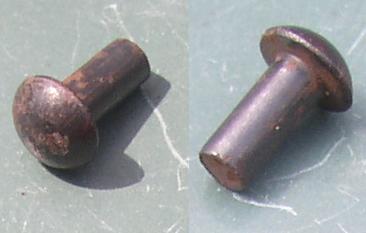
- Rivets are cool and very steampunk. Unlike screws and nuts n bolts, rivets are more or less meant to be permanent fasteners. The look a bit like a screw, but the shaft is smooth. The shaft is put through a pre-drilled (or pre-existing) hole and the tail end get smooshed to create a little barbell that holds your materials in place. If you like the look of rivets but don’t want to take the time or find the right tools for the job, I will give you some advice about how to fake rivets for cheap in my “Creating with Quicksilver” post next week.

Check out Part 2: “Treat and Heat”
Steampunk Movie Review: Sir Arthur Conan Doyle’s Sherlock Holmes (2010)

 That’s right, there was another Sherlock Holmes movie that came out around the same time as the Robert Downey Jr. movie I reviewed last week. Didn’t hear about it? I am not at all surprised.
I am a huge fan of what I call “shitty-good” movies (pardon my language, but it is utterly appropriate!) These are films that you can’t help but laugh at even though they are not meant to be comedies. The Mister and I spend a lot our time wading through the sea of crappy movies out there giving them the old Mystery Science Theater 3000 treatment. That is to say, we crack wise throughout at the terrible special effects, mediocre writing, atrocious acting and blatant continuity errors, often aided by a glass or two of our favorite adult beverages. (If you aren’t familiar with MST3K but you also enjoy terrible old movies, you MUST find them on youtube. They were shot near my hometown in MN and aired until 1999.)
Sir Arthur Conan Doyle’s Sherlock Holmes, which is the first role for Ben Syder (“Robert” Sherlock Holmes. Yes, you read right, apparently his name is really Robert) and also features Torchwoods’ Ianto Jones (Gareth David-Lloyd) as Watson, is just such a movie. It falls firmly into both the mockbuster (a low-budget film piggy-backing the publicity of a better-known movie) and Steampunk camps. I decided to watch it as part of my Halloween Extravaganza this month, both because I am working on my Sherlock Holmes article for Steam Tour: An American Steampunk in London and because it promised me a plot full of monsters. As a Sherlock Holmes film it pretty much failed miserably, but as a movie centered on futuristic technology in the Victorian era it deserves a mention.
The story begins when a sailing ship is taken out by a Kraken-like tentacled monster. In the next scene, we get to see a dinosaur inexplicably interrupt a rendezvous with a lady of the night. So monsters, check. Sherlock is tortured by the fate that befell his brother Thorpe (yep, they didn’t even bother to get his brother’s name right), who became paralyzed after he was shot while trying to foil a bank robbery several years earlier. So ‘punking’ literature, check. After some watered-down deductions, Holmes and Watson (in the least well-fitting waistcoat of all time) find their way to a country estate where they discover the monsters are actually automatons crafted by a thoroughly ticked off Thorpe (Dominic Keating), who is bent on revenge against London, the city that forgot him, and his former partner, Inspector Lestrade. He uses his (okay, pretty awesome) mechanical dragon to wreak havoc on the masses while another automaton delivers a bomb straight to the gates of Buckingham palace. Oh yeah, and there is totally a hot air balloon/helicopter hybrid vs. mechadragon fight scene.

From Asylum Pictures, the makers of classics like Mega-Shark vs. Super Octopus
As I said before, this is not a “good” movie by any stretch, but it is a campy movie with undeniably Steampunk tendencies. This is definitely a popcorn movie, that is, if the shaky camera work they use to signify an action sequence doesn’t make you seasick first.
It is currently available on American Netflix, but can anyone tell me if you can get it in Britain?
Steampunk Book Review: The Monster Hunter (2014)
 Kit Cox, also known in Steampunk circles as Major Jack Union, has a new book out on October 23. I was lucky enough to get an advance copy, and it is the perfect way to kick off my Halloween Extravaganza. Where his first book, How to Bag a Jabberwock: A Practical Guide to Monster Hunting, is more of a a how-to for aspiring protectors of the Crown, The Monster Hunter is a novel about a young boy coming of age amidst the threat of these monsters.
Benjamin Jackson Gaul is half-British and half-Indian, but doesn’t fit in to either place. His only real friend growing up is his mother, whom he loses at the tender age of 12 to a terrifying encounter with a mysterious creature despite her obvious, though unexpected, fighting skills. He passes a year in silence, wracked with guilt and questions that his storybooks cannot answer. He knows if he will ever get to the bottom of his mother’s death he will need to learn more than he can in Ceylon, and when offered a chance to move to England he jumps on it. After almost a year on the sailing ship the Hallowe’en, he arrives in 1885 at the Garden Orphanage in Kent, where a strange illness is affecting the children. With the help of a Gypsy girl and armed with books and good intentions he tries to solve the mystery, and finds out more about his mother’s fate along the way. The most important book he possesses is the journal of Major Jack Union, the older brother of his caretaker Nanny Belle, which paves Ben’s way to becoming the next monster hunter.

Jack Union, Photo: Martin Soulstealer.
For an adult, this book won’t take up much more than one long afternoon, but it will be a fun afternoon! At 200 pages and written in simple language, it is best described as a young adult book. This is in no way meant to be a slight, I love YA fiction, and I am happy to find more of it to add to my Steampunk Book list. The opening chapter is extremely well done and the image of monster attack is very strong in my mind and helps compel the reader onward to find answers with the protagonist. I loved accompanying Ben on his journey across the sea and into the wide world that words and books can open a mind to. I just checked Major Jack Union’s facebook page and he recently announced the completion of his second manuscript in the Adventures of Benjamin Gaul series, so you can also be sure there is more to come. I always love a good series 🙂
The Monster Hunter will be released on Amazon on October 23, but you can already order your copy if you want to get it before Halloween.
Happy Hunting!
Have you ever read anything in the Union-verse created by Kit Cox? I’d love to hear what you think!
Get Ready to Celebrate Halloween all Month Long with ForWhomTheGearTurns!


model: Candace Miller Photographer: Richard Fournier
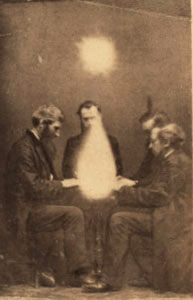
That’s right folks, it’s time for a monster mash. One popular way to “punk your steam” is to add elements of the supernatural to the tales from history, offering explanations that incorporate ghouls such as vampires and werewolves rather than what the history books say, as well creating brand new narratives where monsters play a role. Also, the Victorian era saw the birth of Spiritualism, the belief that spirits of the dead could and often did communicate with the living. All Hallows Eve, which has now been shortened to Halloween, celebrates the creepy and costume, and Steampunk seamstresses and seamsters, make-up artists and makers the world over use it as a chance to showcase their talents and share their knowledge.
1872
Halloween has always held a special place in my heart, and in fact I launched this blog on October 31, 2013, so October is also my countdown the my first blogging birthday. Join me all month long for reviews of Steampunk movies and books that feature monsters and witches, costume construction tips from the sessions I attended at Weekend at the Asylum, LARP-ing games to give you an excuse to dust off your costume early, and other spooky fun surrounding the history of ghost stories and the practices of Spiritualism.
Do you have a scary or supernatural Steampunk story or photos of your Halloween creations that you would like to see appear on this blog? Send them my way at ForWhomTheGearTurns@Gmail.com. I can’t guarantee that I will post everything I receive, but I would love to get some submissions from readers. Make sure that you include the name you would like your creation attributed to as part of your email.


 For Whom the Gear Turns