Saville Row
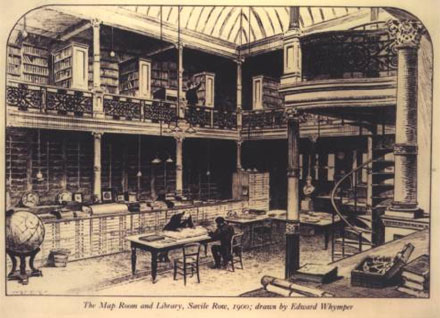
A drawing of the Royal Geographical society interior
In the early days after its construction in the 1730’s, “Saville Street” was home to officers of the British military. The next century it became the first home of the Geographical Society of London (today known as the Royal Geographical Society, RGS), which was granted its Royal Charter under Queen Victoria. The RGS was responsible for financing such notable expeditions as David Livingstone’s sojourn into Africa, which lead to the discovery of the Nile’s source (named Lake Victoria) by Sir Richard Burton and John Speke. The RGS moved its headquarters in 1913, which was also the same year that women were first allowed to join.

This is still the go-to place for bespoke men’s fashion
During the Victorian era, Saville Row become strongly associated with the tailoring trade, and today the street is lined with stores selling natty men’s fashion. On a literary note, Jules Verne gives Phileas Fogg, the hero of Around the World in 80 Days, the address of No. 7 Saville Row. There isn’t a lot to see today, so for me, the most compelling thing about visiting this area ended up being the nearby Burlington Arcade.
The Reform Club

 If you have heard of this site, it is probably because of Around the World in 80 Days. Phileas Fogg’s journey began at The Reform (as it is colloquially named) over a game of cards, and ended in dramatic fashion on the same spot. The Reform was also featured in politically-minded novel entitled Phineas Finn, which was released as a serial by notable Victorian author Anthony Trollope from 1867-1868.
The club was founded in 1832 as a liberal bastion for people to exchange radical ideas in response to the conservative Whig Party that had held power in London for decades. For many years it was the unofficial headquarters for the Liberal Party, and boasts a huge library filled with contributions from its members. Unfortunately, the inside of the club is off-limits to non-members except for select groups that can visit during a special architectural festival in September, and the exterior is nothing special. But, you can see a few photos of the interior on their website.
Steampunk Sourcebook: Around the World in 80 Days

Around the World in 80 Days cover
Fun Facts and Context
- Le Tour du monde en quatre-vingts jours was Jules Verne’s 11th novel, and like many of the time it was first presented in a serialized format before it was compiled into a book in 1873. It was accompanied by the illustrations of Alphonse de Neuville, a French painter known for his depictions of the Franco-Prussian War (1870-1871).
- Verne served in the Franco-Prussian War, and doing research for this book likely served to take his mind off of those events.
- The dates of Fogg’s return to England coincided with the final date of publication for the original serial. Because of this, some readers believed they were reading a real travelogue rather than a fictional story.
- Many people associate a hot air balloon trip with this story, but in fact there was no balloon in the original text. This is likely because the 1956 Disney film added an additional stop in Spain to the tale and the protagonists reached it by balloon. Jules Verne did write about a daring escape by balloon, but it wasn’t until The Mysterious Island was published in 1874.
Timeline and Synopsis of the Story
- September 28, 1872: Bank of England is robbed. 50,000 GBP is stolen. This is the equivalent of four million GBP or 6.2 million USD today.
- October 1, 1872: Phileas Fogg hires Passepartout as his new valet after his old valet gets the temperature of his shaving water wrong. Fogg goes from his home on Savile Row to the Reform Club as usual, and during a discussion about a new stretch of railroad in India he is drawn into a bet with his friends. With the hefty sum of 20,000 GBP (1.6 million today) on the line, he agrees to travel around the world and return at the same time 80 days later on December 21, 1872.
- October 2, 1872: Fogg and Passepartout leave England by train.

- October 9, 1872: After a brief stopover in France, the travelers reach Suez, Egypt and meet Detective Fix for the first time. He is on the trail of the bank robber, and Fogg’s erratic behavior and passing resemblance to the vague description of the burglar make him a suspect. They leave Suez by ship with Fix in tow.
- October 20, 1872: The travelers arrive in Bombay, India, two days ahead of schedule. Passepartout wanders into a temple and is chased out by the monks for not removing his shoes. He arrives at the platform and boards a train bound for Calcutta just in time.
-

From fiked.com
October 22, 1872: Fogg’s train can go no further because the railway is unfinished, despite what the newspapers say. They manage to hire a guide called Parsee and an elephant named Kiouni to carry them on toward Calcutta.
- October 24, 1872: While traveling through the jungle, the travelers encounter a ceremony where a young bride, Aouda, is being prepared to follow her aged husband into death. She cannot struggle because of the influence of drugs, so she is rescued by Fogg and another traveling companion after Passepartout creates a diversion by posing as the deceased man’s body and “rising from the dead” to scare the natives. They escape by means of their trusty elephant and continue to Calcutta.
- October 25, 1872: The travelers arrive in Calcutta with five hours to spare to remain on their original itinerary despite the delay. As soon as they arrive Passepartout is arrested for his transgression in Bombay and both he and Fogg are taken into custody. They use some of Fogg’s considerable cash resources to pay off his valet’s debt and make the noon ship bound for Hong Kong. Aouda continues on the journey because India is no longer safe for her, and she knows of family living in China. Fix, still without a warrant but with high hopes for Britain’s Easternmost colony, tags along in secret.
- November 7, 1872: The travelers arrive in Hong Kong. Unfortunately, Aouda’s family member had already moved away from Hong Kong years earlier. While out getting supplies for the next step of the journey, Passepartout gets news of an earlier departure time for their vessel. Fix still has not received his warrant for Fogg’s arrest and is determined to keep him from leaving British soil. Fix invites Passepartout out for a farewell drink and gets him to try opium. The valet becomes so besotted that he falls asleep and Fogg does not hear about the new travel arrangements. In his delirium, Passepartout says the name of the disembarking ship and is brought there and installed in his master’s cabin. He awakes the next morning to find that he has left his master behind, but determined to rejoin him somewhere along his route and alert him to the danger that Fix represents. Fogg hires a small vessel called the Tankadere to carry he and Aouda to Shanghai to catch the ferry to Yokohama at its next port.
 November 13, 1872: Passepartout arrives penniless in Yokohama, Japan. He seeks for ways to continue his journey to America to intercept Fogg by offering his services to the owner of a traveling circus. He is hired as an acrobat and during his first performance is astounded to see Fogg and Aouda in the audience, having also arrived in Yokohama after flagging down the American vessel in the port of Shanghai. Fix continues to travel with Fogg, who is covering all of his expenses.
- November 23, 1872: Fogg and company pass the 180th meridian, which marks the halfway point of their circumnavigation of the planet.
- December 3, 1872: The travelers reach San Francisco and are caught up in a political rally where Fogg has a confrontation with an American named Colonel Stamp Proctor. Fix steps in to help because he needs Fogg to return to England before he can be arrested. The company boards a train that evening intent upon using the Transcontinental Railway to reach New York.
- December 7, 1872: Fogg runs into Colonel Proctor on the train and a duel ensues. It is interrupted by an attack on the train by the Sioux tribe. Passepartout is taken hostage and Fogg, Fix and Aouda are left behind when the train continues on its route as they attempt to devise a rescue mission. With the help of American soldiers stationed nearby, Fogg retrieves Passepartout and the travelers are forced to continue by way of a wind-powered sledge to Omaha in hopes of catching another train.
- December 9, 1872: Arrive in Omaha and board a train for Chicago.
- December 10, 1872: Arrive in Chicago and board a train for New York.
- December 11, 1872: Arrive 45 minutes late for their steamship from New York to Liverpool.
- December 12, 1872: The party boards a ship bound for Bordeaux with little hope of arriving in London before the December 21 deadline, but it is the only ship leaving with a destination even close to England.
- December 16, 1872: Fogg proceeds to buy the ship from the captain and throw all of the wooden parts into the furnace to fuel their journey. He redirects the ship to bring them to Liverpool, England.
- December 21, 1872: With six hours to reach London in order to win the bet, Fogg and co. arrive in Liverpool. They would have just enough time to beat their deadline, but now that they have finally arrived on English soil, Fix arrests Fogg. It doesn’t take long to find out the real bank robber had been caught during the mad dash around the world, but the short delay is just enough to lose the wager for Fogg. He arrives in London 5 minutes late.
- Actually, December 21, 1872: The party gained an entire day during their journey, but they have yet to realize it. Aouda proposes marriage to Fogg and he heartily accepts. They intend to marry that very day and send Passepartout for the parson. When he arrives at the parson’s door he says he cannot perform the ceremony at that time because it is Sunday and he was busy on church business. Passepartout races back to Savile Row and whisks Fogg away to the Reform Club, where he arrives exactly on time to win the wager.



From wikipedia
References in Steampunk Literature and Other Media
- Philip Jose Farmer wrote The Other Log of Phileas Fogg as part of his Wold Newton Universe. In it, Fogg is the foster child of an alien and Captain Nemo is aligned with another race of aliens. The bet and journey around the world were an elaborate cover story to disguise Fogg’s quest for an alien artefact that would change the tide of the war between the two competing races.
- It has been adapted for film five times since 1919, the most recent being in 2004, where martial arts expert and comedic actor Jackie Chan played Passepartout opposite Steven Coogan (Night at the Museum, Despicable Me 2) as Phileas Fogg in a new adaptation of the novel.
- It has been adapted for television four times since 1972, including a Japanese version where all the characters are animals.
- It was adapted for the stage for the first time in 2001 by Mark Brown. He has also written a sequel for the stage for another Victorian classic in the form of The Trial of Ebenezer Scrooge.
- In 2014, a game called “80 Days” was launched by Inkle Development Company. It is an interactive game that blends the story and retro-futuristic technology.
- Also in 2014, Ben Steele released a version of Around the World in 80 Days (a Steampunk Reimagining) with illustrations by Josh Ross. It includes “lost” content and a board game.
- The International Steampunk Symposium in April of 2015 is going to feature the theme “Around the World in 48 Hours” as an homage to Verne’s work.
Mysterious Island (2005) Both Adds and Subtracts from Verne’s Story

 I caught this quirky two-parter for the first time close to when it first aired in 2005. I wasn’t familiar with the Mysterious Island book, but the premise sounded fun and I was familiar with several of the actors. During my research I found several people who say their favorite rendition is from 1961, but I haven’t had a chance to see that one yet. So during March I will bring you reviews of adaptations in 2005 and 2012.
Quick book synopsis: During the American Civil War, five people escape a POW camp in Virginia by stealing a reconnaissance balloon. They end up crash landing on a tiny island off the coast of New Zealand. Their chances of survival seem bleak, especially with bloodthirsty pirates afoot, but thanks to a mysterious benefactor they create a cozy home for themselves. It turns out that their “host” is none other than Captain Nemo, who has retired the Nautilus and now lives with a single servant on the island. (Note- the chronology of 20,000 Leagues Under the Sea as it relates to this book is problematic. The American Civil War ended in 1865, but 20,000 Leagues takes place in 1866, which means the war would have been over before the events of The Mysterious Island.)
 Now onto the movie. It originally aired on the Hallmark Channel in two, 90-minute parts. This makes it a big commitment for a single evening. In this version, the lead role of the engineer and Union soldier is played by Kyle MacLachlan (Sex in the City, Agents of S.H.I.E.L.D.), and in place of two of the soldier-types they substitute a comely widow (Gabrielle Anwar) and her teenage daughter. They also decided that building up the mystery surrounding Nemo (Patrick Stewart) wasn’t worth their time, so giant CG animals are added to the mix. The pirates, lead by Vinnie Jones (Snatch, Lock, Stock and Two Smoking Barrels) also get a more central role in the plot.

The Nautilus (which is waaaaaaaaay too small)
Though this is technically not a mockbuster because it did not accompany any big-budget release with a similar name, I would file this under that heading in terms of quality. The graphics were probably pretty good 10 years ago when it came out, but look pretty choppy and fake by today’s standards. I actually dug the addition of the monsterous creatures because it added action to what would be a pretty boring film, but my inner geek has to complain for just a second. I am perfectly fine with suspending my disbelief enough to buy into the explanation that the animals got really big because there was radioactive material on the island, I can live with that. But the uber ant was like 20 times bigger than the XL rat. Proportions people! Ok, I am done now.
So, yeah, if you like giant insects and a plot dripping with pirate-itude, then by all means, check this one out (both parts are embedded below). If you are trying to get your hands on a faithful portrayal of Verne’s vision, maybe try to find the 1961 version instead.
Steampunk Book Review: 20,000 Leagues Under the Sea
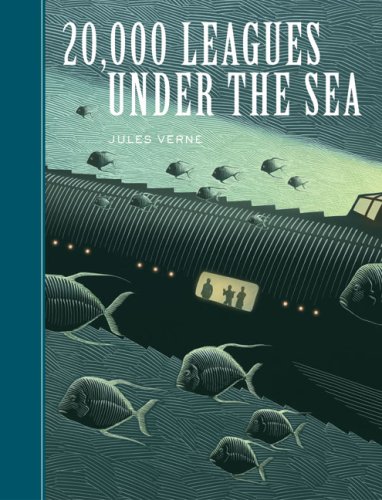 Even if people aren’t a fan of science fiction, chances are they have heard of this book or seen the 1954 Disney movie version. If you read my review of Around the World in 80 Days, you know I am only lukewarm on Jules Verne’s writing style, but I’ve read a few different Steampunk books that use Captain Nemo as a character, so I wanted to go back to the original source to learn a bit more.
It all begins with the mysterious disappearances of various vessels in 1866. Many believe a giant sea creature is behind the attacks, and the narrator, a French marine biologist named Pierre Aronnax, is enlisted to aid in the search while visiting New York. He departs from the United States along with his faithful manservant, Conseil, and together they join a team of explorers including a Canadian harpooner named Ned Land. Shortly after setting out, the intrepid team encounters the creature, only to find it is in fact an incredibly advance submarine captained by one of the most famous figures in all of Steampunk literature, Captain Nemo. The rest of the story details the journey of Aronnax, Conseil and Land as they criss-cross the globe as Nemo’s prisoners.
20,000 Leagues Under the Sea was incredibly well-researched. I used to work at an aquarium, so I probably was able to get a bit more out of it than the average reader, because the narrator, Aronnax, goes into exhaustive detail about the different marine animals he encounters while traveling the seven seas with Nemo. I would like to read it again some day, but this time I would make sure to find an illustrated version. When the story was originally published as a serial in Magasin d’Éducation et de Récréation from 1869-1870 it did not include any illustrations, but since it was compiled as a novel a few years later there have been several illustrated and even a graphic novel version of the tale.
But, this meticulous detail can also be a drag. The Mister and I read this one out loud as we often do with the books I review, and even though I have my science background and he is a Roman historian, we both stumbled over the multitude of Latin names. Though of course it makes sense to use the proper scientific names of species, both for clarity and because the narrator is a marine biologist, it can make the actual reading a bit tedious. We were about halfway through when my brain was just begging for a giant squid to attack. This bit of action comes very late in the book, and gets a lot more attention in movie adaptations than Verne gave it in the text.

The Nautilus as it appeared in the Disney film
Unlike Around the World in 80 Days, where the indefatigable Passepartout can offer a respite from the monotony of travel, there is no comedic relief in 20,000 Leagues. Nemo is an interesting and enigmatic character to be sure, but I think overall it makes for pretty dry reading. The science in this book is sound, so it holds up to time better than Journey to the Center of the Earth, but for me it wasn’t really entertaining enough for the slog through over 300 pages.
March is Jules Verne Month

Portrait of Jules Verne circa 1878
Jules Verne died in March of 1905, so to commemorate his many contributions to the science fiction canon that have inspired myriad interpretations within Steampunk, I am devoting all of March to Verne-themed books, movies, artwork and characters.
Here are few things to look forward to this month:
Steampunk Sourcebooks for Around the World in 80 Days and Jules Verne himself
Reviews of two adaptations of The Mysterious Island
Unveiling a brand new 3D paper illustration by yours truly
Book reviews of two classic Verne tales
and more!
But there is still space in my editorial calendar for a few more things, so feel free to make suggestions! Have you ever dressed as a character from a Verne novel and you’ve got a photo you want to see on my blog? Do you know some fun facts you think others would enjoy? Let me know : )
The Brothers Grimm Fairy Tale Guide (and Drinking Game)

 One of my most popular posts is my review of The Brothers Grimm movie with Matt Damon and Heath Ledger. The original book of stories, Children’s and Household Tales, was published in 1812, and its English translation was read in nurseries during the Victorian period. This is one of my favorite movies of all time, so I have watched it many times with many different people. Across these viewings, a drinking game has emerged according to the references to the Grimm’s fairy tale collection. There a few instances of fairy tale-like phrases and characters that I haven’t been able to find a basis for in the Grimm’s book, so below is a guide both for people who want to play the game or who just want to know what the movie is referencing.
The rules of the game are pretty simple. Every time there is a Grimm’s fairy tale reference, you have to take a swallow of you adult beverage of choice. These references fall into a couple categories:
1. Fairy tale numbers: The numbers 3 (as in 3 wishes), 7 (dwarves) and 12 (dancing princesses) often occur in fairy tales. This film uses 3 and 12 more than once, so each time one of these numbers is mentioned, take a swig.
2. Phrases: Things like “Once upon a time” and “happily ever after” have become synonymous with fairy tales. Other recognizable tropes are “the fairest of them all,” “true love’s kiss,” and “Mirror, Mirror on the wall.” So any time you hear these types of phrases that ring a bell from a childhood tale, swallow away.
3. Direct references: There are tons of verbal and visual references to classic fairy tales throughout the film as well. The writers combine several tales into single characters, so there may be several times to drink stacked on top of each other. These are the ones that I have been able to confirm using a translation of the original text.
- Jack and the Beanstalk- Magic beans are mentioned at least 5 times
- Briar Rose (aka Sleeping Beauty)- one of the first gadgets they use is said to be from Briar Rose’s castle, and later several girls are put into a magically induced sleep after their fingers are pricked.)
- Little Red Riding Hood (cape, “what big eyes you have”, big bad wolf)
- Godfather Death
- Rumpelstilkskin (Jacob mentions an imp whose name they had to guess)
- The Frog Prince (“kiss a frog” mentioned, and kissing a toad in the woods)
- Hansel and Gretel (Hans and Greta)
- Rapunzel (tower with no entrance, long hair used to escape the tower)
- The Juniper Tree (trees that move. You could play that any time you see a tree move you take a drink, or only the first time when Greta is taken)
- Snow White (old crone with an apple, magic mirror)
- Cinderella (Cavaldi calls the brothers this while making them scrub floors, later glass slippers appear on the feet of a kidnapped girl)
- The Goose Girl- the peasants of Marbaden can occasionally be seen herding geese in the film.

Red herrings: There are other fairy tale references that you will recognize, but they were NOT in the original Grimm’s collection. It is up to you if you want to play the game with or without these.
- Bridge Troll (3 Billy Goats Gruff)- This is a Norse tale, first recorded in 1841.
- Horse infected by spiders- There is a terrifying scene where an enchanted horse swallows a little girl with the aid of the spiders who infected it earlier. Though compelling and in the spirit of the dark tales, I couldn’t find any basis for this in Grimm’s collection.
- The Gingerbread Man- in the film, one of the girls is encased in mud and takes the form of a gingerbread man. This story was not published until 1875, so post-dates the Grimm’s collection.
- The Princess and the Pea- In the film, the evil queen is sleeping on a thick stack of mattresses. But, this is a Danish story recorded for the first time by Hans Christian Andersen in 1835.
- “Huff and puff”- Though there are two “big bad wolves” in the Grimm collection, they don’t blow anything down.
- Ravens as minions- There is a tale in the Grimm collection of seven brothers who are turned into ravens, but in the film the evil queen employs them as spies and to carry someone up to the tower window. Ravens were the minions of Odin in Norse mythology, but are not used this way in the German collection of stories.
Did I miss something? Leave a comment below!


 For Whom the Gear Turns