The Brothers Grimm (2005) Punks Your Favorite Fairy Tales


Brothers Grimm (2005)
Wilhelm and Jacob Grimm released the first volume of their collection of folktales “Kinder- und Hausmärchen” (Children’s and House Tales) in 1812. The first edition included 70 different stories, but after numerous editions the count eventually reached somewhere over 200 (different sources said different things in my research, but mostly between 209-211). If you are looking for the specific fairy tale references, check my Brothers Grimm Fairy Tale Guide.
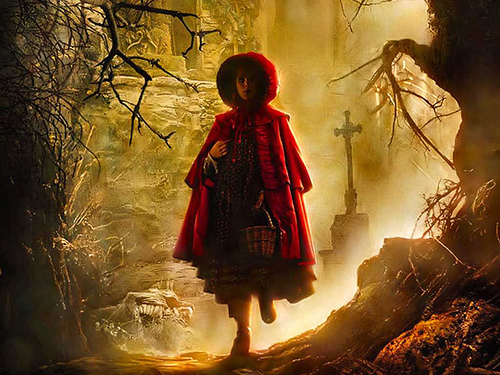
Little Red Riding Hood from a Brothers Grimm advertisement
If you have never read any of the original Grimm fairy tales they are an interesting read. I took a class in college called “Twice Told Tales” and we spent about half of a semester just studying the story of Little Red Riding Hood (Rotkäppchen in the Grimm’s first edition, but actually published first in the 17th century in French by Charles Perault as La Petit Chaperon Rouge). It was fascinating to see what details changed or were added over the centuries (Spoiler: in the original Red is an accidental cannibal and she dies in the end), and believe me when I tell you that any picture-book version you read as a kid was very watered down. I would only recommend reading the originals to children if you want them to have nightmares. You can access English translations of many early fairy tale compilations through the University of Pittsburgh here.

Marbaden concept art by Guy Hendrix Dyas
So, now on to the film. I am a big fan of Terry Gilliam (who wrote and directed Monty Python and the Holy Grail, among other things) and he definitely does not disappoint in this, his first PG13 movie. He actually rewrote much of the Brothers Grimm screenplay, but did not receive credit. If you like to be awed by visual effects and have your heart warmed by a good story, check out another Gilliam creation, The Imaginarium of Doctor Parnassus (2009). Like Van Helsing, Brothers Grimm was filmed in the Czech Republic, both on sound stages and on location.
The story opens with a young Wilhelm Grimm comforting his mother and ailing sister with the promise that his brother Jacob would return soon after selling the family cow. Jacob (who is erroneously portrayed in the film as the younger brother) brings back a handful of beans rather than the much needed cash.

Heath Ledger and Matt Damon as the Brothers Grimm
Next, we see the brothers as adults. Wilhelm is played by Matt Damon and Jacob by the late, great Heath Ledger. (Fun fact, they were originally cast in opposite roles because Gilliam wanted Johnny Depp to play Jacob but thought Depp wouldn’t be a big enough box office draw. This was before Pirates of the Caribbean came out, remember.) The city of Karlstadt is in need heroes to fight a witch that is terrorizing their town and the Grimm brothers arrive to save the day. Too bad for the townsfolk that the witch is a hoax and the brothers are scam artists. Jacob has spent his life collecting folk tales, but Wilhelm is an avid skeptic and is only out to make a buck (or Deutschmark, or whatever).

Marbaden village set
Soon, the brothers are forcibly recruited by an Italian torturer named Cavaldi (a surprisingly funny character played by Peter Stormare) who is employed by the French. During the Napoleonic Wars, Germany was occupied by French forces, who are led by General Delatombe (Jonathan Pryce) in the movie. He tell the brothers of a town called Marbaden and the 10 children who have disappeared. The peasants believe that the children have been taken by a supernatural force living in the dark forest near their homes, but Delatombe believes it is another con artist like the Grimms. He sends them to expose the fake and help bring in an Age of Reason to the foolish bumpkins.

Angelika getting her archery on
When they arrive in Marbaden (accompanied by Cavaldi and a cavalcade of French soldiers) they are told that in order to enter the foreboding forest they need a guide. The only person who can help them is “the cursed one,” Angelika (who is a super bad-ass huntswoman played by Lena Headey). They call her this because her father and sisters have all gone missing and let’s face it, probably because she wears pants and hunts with a bow, and this is the beginning of the 19th century after all.

Marbaden Forest

Evil Queen trying to seduce Matt Damon
Reluctantly, she takes the men deep into the woods which is populated by trees that can move and reveals to them a tall tower with no doors and but a single window at the top. To save the missing children (and their own skins from the French) they must defeat the immortal witch/evil queen (Monica Belluci) who lives there and hope for a happily ever after.
I totally love this movie. Steampunk fans that feel the genre is defined by technology will be disappointed because most of this movie takes place in small, rural villages, but the time period is on the early verge for the genre and fairy tales were certainly read to children in Victorian nurseries. The chemistry between the characters and their development is really compelling (you even end up rooting for the torturer in the end, which is no mean feat!) and the sets and costumes make you feel like you’ve been transported back to the early 1800’s. I don’t usually get nightmares from movies, but there is a scene with a horse that is terrifying, so think hard before watching it with kids under 10 (it is rated PG13 for a reason). The crooked houses and spooky forest set the stage for this fun and sometimes downright frightening film.
Check out some more pics from the film and concept art below, and feel free to leave a comment if you’ve seen this movie or read any really gruesome fairy tales.


Steampunk Book Review: Morlock Night
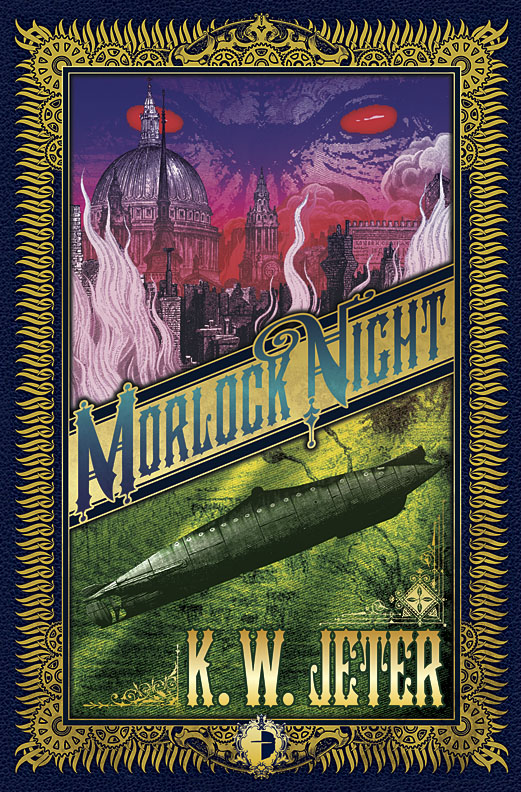
Morlock Night cover art
In case you weren’t already aware, K. W. Jeter was the first person to put the word Steampunk into print. You can find out more about that story here.
Morlock Night was released in 1979 and asks the question “What happened after the events of The Time Machine?” H. G. Wells’ classic tale is told through the vehicle of a dinner party being held by a man known only as “the time traveler.” Jeter’s story picks up right as the party has broken up for the night and the guests are wending their dreary ways home through the London fog.
One of the guests, a Mr. Edwin Hocker, shares his walk and his skepticism with another guest, the mysterious Dr. Ambrose. Hocker is appalled by the turn their conversation takes and finally extricates himself from Ambrose’s company only to be thrown into a nightmare version of his beloved London far in the future. In this world he is confronted by a scenario where the Morlocks, our subterranean future selves, have taken control of the time machine and have invaded the year 1892.
Thankfully this future can still be prevented, and with the guidance of Ambrose, who by the way is the wizard Merlin, Hocker and his compatriot from the future, Tafe, are sent on a series of quests. First, the reincarnation of King Arthur needs to be found and freed from Merlin’s nemesis, Merdenne. But the aging king is in failing health, a condition that can only be stopped by the magical sword Excalibur, the power of which has been diminished through the machinations of Merdenne and his use of the Time Machine.
But even more dire than the ensuing Morlock invasion is the rift in time itself, which is slowly undoing the universe. If Hocker cannot succeed all is lost for not just the human race, but the entirety of existence.
I always enjoy a story with imagination, and Morlock Night certainly fits the bill. Jeter constructs a story that includes Arthurian folklore, Atlantian technology and the time travel paradox that is seen through the eyes of a Victorian gentleman. There was a lot of flag waving for England, but many of Hocker’s biases about class and gender are confronted and changed, which adds the weight of social commentary to a fun story. The combination of disparate elements such as the Morlocks and a submarine stolen from the former residents of Atlantis reminds me of epic tales like Verne’s Mysterious Island, so as long as you go in expecting to suspend your disbelief Morlock Night has a lot to offer.
But, a bit of criticism about the ending. I had already guessed the twist so I was gearing up for an epic climax and was disappointed. The final good vs. evil happens in only a few pages. It felt like Jeter was under deadline or something and just had to wrap it up quick. I am reading his other two steampunk books, Infernal Devices and Fiendish Schemes, and I hope they get to come fully to fruition.
For a complete list of K.W. Jeter’s works, click here.
Be Still My Clockwork Heart

For the most part, I find the valentine heart shape to be overused and cliche in the same way putting the word “dream” on everything is super lame. But, I had faith that there were Steampunk artists out there that would give me some interesting, evocative and beautiful heart-themed art and jewelry to enjoy so in honor of the impending feast of St. Valentine I created this gallery of Steampunk hearts. Most of these lovelies are available for purchase. Click on the thumbnails to open a larger gallery or hover over the them to get the artists’ names (most are from Etsy).


Steampunk Sourcebook: Cephlapods

What is it about our many legged friends that makes them a popular trope in Steampunk?
۞ Monster Cephlapods have been the major focus of several classic works of Science Fiction and Fantasy such as H. P. Lovecraft’s The Call of Cthulu, Jules Verne’s 20,000 Leagues Under the Sea and the 1830 Tennyson poem The Kraken. There is also a Sir Arthur Conan Doyle story called Horror of the Heights that features a flying tentacled monster. In more recent times both the Kraken and Cthulu-like monsters have made appearances in Hollywood blockbusters like Hellboy and Pirates of the Caribbean: Dead Man’s Chest (though you also get a good look at the Kraken after it is death in Pirates of the Caribbean: World’s End).
۞ Their bodies are also reminiscent of complex machines. The long skinny tentacles are like wires or tubes and their movement is powered by water, not unlike steam vehicles. As a bonus their bodies kind of look like they are wearing a helmet and goggles all the time, and if Steampunk had an official symbol I’m pretty sure it would be a pair of goggles (or maybe a gear).
۞ Brian Kesinger, the talented artist behind Otto and Victoria and the book Walking Your Octopus: Your Guidebook to the Domesticated Cephlapod, did an interview for ComicMix.com, and when asked about his choice to draw an octopus as a couture pet he answered:
 “I find octopuses extremely fun to draw. It is a real challenge inventing eight different things for them to do in every image. They are nature’s original multi-tasker and they certainly have captured the imagination of a lot of people. Along with the squid and other Cephalopods, octopuses seem to be a sort of theme animal for steampunk so when I set forth trying to render an image of a high class Victorian lady and her boutique pet the choice was obvious. What was not obvious was how popular Otto has become since I first drew him a year ago. He has inspired fan art, tattoos and I’ve even seen girls cosplay Victoria and conventions around the country! And for that I am so grateful and it keeps me drawing octopus.”
Cephlapods are fascinating creatures that are about as far away from human as you can get.
۞ I used to work at an aquarium so I got a chance to spend lots of time observing octopus and my personal favorite cuttlefish. These invertebrates can move in three dimensions, jetting around the water column and feeding on smaller animals.
They are also totally visually stunning. Undulating tentacles aside, many of them can change color and shape at will, which makes them masters of disguise. Want to have your mind blown? Check out the PBS documentary below for more information about cuttlefish camouflage.
I’ve collected just a sampling of the Steampunk art featuring our many-legged friends out there on the interwebs. In most cases you can get the artist’s name by simply hovering over each image and you can open a gallery of larger images by clicking on any thumbnail. If you see something that is mislabeled or you know who is behind one of my unlabeled entries please let me know so I can give the artist the credit s/he deserves.
Click on any thumbnail to open the gallery of larger images.


Neo-Victoriana at Hom Furniture

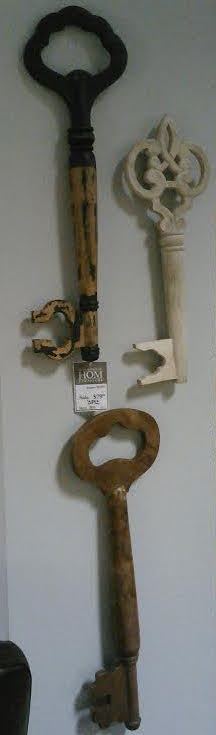
 My parents just bought a townhouse so my mom wanted some help shopping and I was happy to oblige. We went to Hom Furniture and I found a surprising amount of decor that could be considered Neo-Victorian or Steampunk. I took some pictures on my phone of my favorite items. This particular Hom store also had a pseudo-balcony that was lined with cupboards that looked like library shelves so it helped at to the Steampunk feeling due to all the books in the interior design.
This table below and the side table set above really caught my eye.

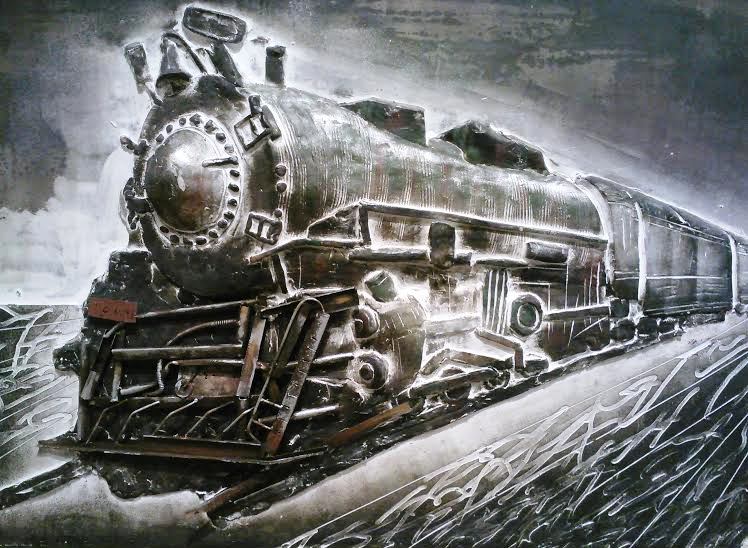
But most of what I found was wall art like the pieces below.




Van Helsing: The London Assignment is an Animated “Diamond in the Rough”


While researching for my Van Helsing Mixes Monsters for Movie Magic post I found out that there was a cartoon short released in conjunction with the major motion picture. Van Helsing: The London Assignment tells the story of what Van Helsing is doing in the days leading up to the start of the film.
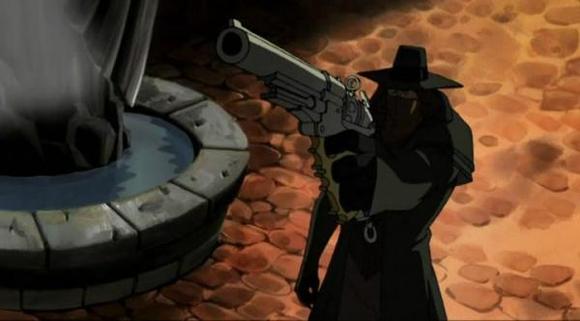
Van Helsing
Van Helsing is on the trail of a vicious London-based murderer who not only kills his lovely female victims, but leaves their bodies twisted and mummified. But even after this string of heinous crimes, the order to which Van Helsing belongs demands that he try to capture the fiend and save his soul from damnation.

Hyde on train
He soon meets the monster, none other than the giant Mr. Hyde who helps Hugh Jackman open the live-action movie. In an interesting twist, Dr. Jekyll is every bit as evil (or even eviler) than his alter ego, but he is doing all in the name of love.
 Years earlier his eyes met those of the young and beautiful Queen Victoria and he believes to that day that she fell in love with him in the same instance. Jekyll uses a potion concocted of the souls of his victims to grant her a new lease on life and with the help of his hellish minions he absconds with her to his fiery layer deep below the city. How will Van Helsing (and Carl the monk, of course) rescue the queen and save the day?
I called this 30 minute short a “diamond in the rough” because a lot of the animation is jerky and reminiscent of Hanna Barbara cartoons (no offense Scooby Doo!) with intermittent flashes of brilliance. The action sequences clearly got more love (or maybe just a bigger budget) than other scenes, which is to be expected, but it was kind of distractingly lopsided. That being said, it is a fun story that made me alternatingly chuckle and say “whoa!” It really felt like a noir comic book come to life, which was cool to see.
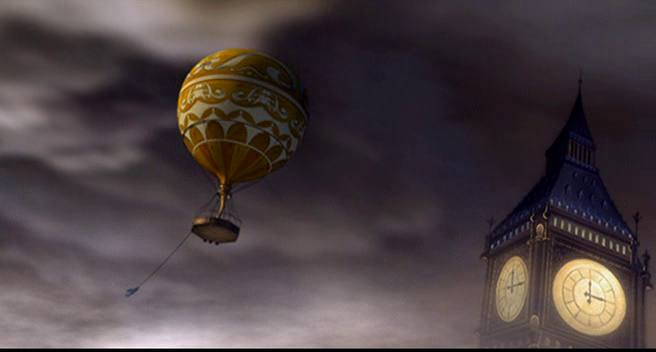
There is a nice documentary in the special features about the making of the live-action movie which is really cool. I learned that both Kate Beckingsale and Hugh Jackman did most if not all of their own amazing stunts.
You can watch the full cartoon through youtube below!


 For Whom the Gear Turns