Get Ready to Celebrate Halloween all Month Long with ForWhomTheGearTurns!


model: Candace Miller Photographer: Richard Fournier
That’s right folks, it’s time for a monster mash. One popular way to “punk your steam” is to add elements of the supernatural to the tales from history, offering explanations that incorporate ghouls such as vampires and werewolves rather than what the history books say, as well creating brand new narratives where monsters play a role. Also, the Victorian era saw the birth of Spiritualism, the belief that spirits of the dead could and often did communicate with the living. All Hallows Eve, which has now been shortened to Halloween, celebrates the creepy and costume, and Steampunk seamstresses and seamsters, make-up artists and makers the world over use it as a chance to showcase their talents and share their knowledge.

1872
Halloween has always held a special place in my heart, and in fact I launched this blog on October 31, 2013, so October is also my countdown the my first blogging birthday. Join me all month long for reviews of Steampunk movies and books that feature monsters and witches, costume construction tips from the sessions I attended at Weekend at the Asylum, LARP-ing games to give you an excuse to dust off your costume early, and other spooky fun surrounding the history of ghost stories and the practices of Spiritualism.
Do you have a scary or supernatural Steampunk story or photos of your Halloween creations that you would like to see appear on this blog? Send them my way at ForWhomTheGearTurns@Gmail.com. I can’t guarantee that I will post everything I receive, but I would love to get some submissions from readers. Make sure that you include the name you would like your creation attributed to as part of your email.
Steampunk Book Review: Phoenix Rising (Ministry of Peculiar Occurrences 1)
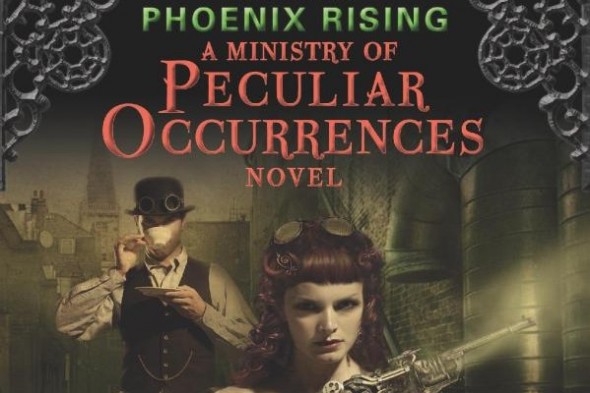
I’ve read a few books lately as part of my research for my Steampunk travel zine that I have only been luke warm about: Around the World in 80 Days, The Other Log of Phileas Fogg and The Difference Engine. So you can imagine my utter joy at finding a book that I can’t say enough good things about, and that book is Phoenix Rising.
Published in 2011 by co-authors Pip Ballantine and Tee Morris, Phoenix Rising is the first of a series that now numbers five novels and several volumes of short stories about the mysterious Ministry of Peculiar Occurrences. It chronicles a newly formed partnership between a Kiwi field agent with a taste for explosives, Eliza D. Braun, and a stiff and proper bookworm/mechanical genius, Wellington Books. Down in the archives of the Ministry, unresolved cases go to languish in the gaslight. That is, until Braun is exiled to those hallowed halls after her, er, enthusiasm (spelled d-y-n-a-m-i-t-e) gets the best of her on a mission in Antarctica to bring back the kidnapped Books. Braun’s former partner was working on something big, and now that case is simply being filed away, something Eliza cannot allow. There is a malevolent power rising in England, and their symbol, the phoenix, seems to be popping up around every turn…
This was a great, action-packed read. There is just the right mix of tension, both sexual and political, and awesome gadgets to satisfy your Steampunk needs. I thoroughly enjoyed the unfolding of the two main characters as they discovered each other, and I look forward to finding out more through their eyes in the next installment, The Janus Affair (check out the trailer below!).
Steampunk Book Review: The Difference Engine

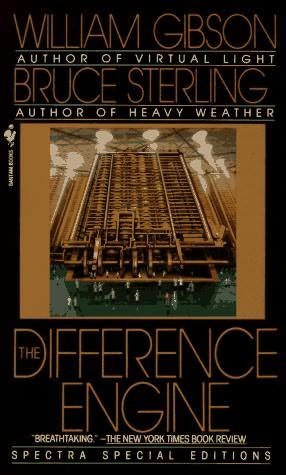 A big part of my Steam Tour is finding out about the historical events and people who influenced the time period reflected in Steampunk books. I love the idea of alternate histories, and many times that is at the core of Steampunk novels, such as The Difference Engine by sci-fi greats William Gibson and Bruce Sterling.
If you are like me and you don’t have a good handle on the real history, I would recommend a quick glance at the wikipedia article about this book before you begin it. There is a great summary there of where and how the alternate history of the novel diverge from real events. I didn’t do this before I started reading and I spent a lot of the book wondering about fact and fiction.

Trial portion of the Difference Engine No. 1, completed 1832
In short, it tells the tale of the trajectory of the world if the computer age came in the 1800’s. The political structures all over the world are deeply effected by Charles Babbage’s completion of his mechanical computers (called Analytical Engines) in 1824, and there are numerous references to a fragmented United States (including a communist Manhattan) as well as historical figures such as Lord Byron, Ada Byron (the “queen of engines”), and Laurence Oliphant in different roles. The English politicial system has been completely dismantled and a meritocracy put up in place of hereditary lordships. The story is mostly told through the eyes of Edward Mallory, a “savant” who discovers the first huge dinosaur bones, giving him the nickname “Leviathan Mallory.”
There were a lot of things I really liked about this book. The descriptive language was excellent and Ned is a great character on whose coattails to ride through the adventure. I loved the shift in politics in response to technology and the parallels between then and now when it comes to the power of information. The authors clearly put a lot of thought into both logically and imaginatively extending the repercussions of the rise of computer technology long before we experienced it in our timeline.
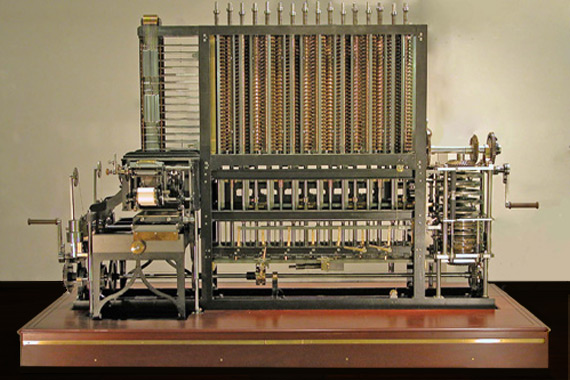
Babbage later designed a simpler difference engine that was not built until the 20th century, on display at the Computer History Museum
On the whole, the story felt a bit fragmented because there are three distinct characters that get followed and the treatment is uneven. The first person you explore this world with is Sybil, and her story comes to an abrupt halt right as it gets really interesting. Then Mallory comes onto the scene and his story is great, but I couldn’t help but wonder where Sybil had gone to. Mallory’s tale comes to a head and he gets what he wants, but he is not actually the agent of change so even though there is a stand-off and big ‘splosions (whoo-hoo!) it felt sort of anticlimactic. Lastly, we trail Mallory’s one-time ally Laurence Oliphant for a little while on his political espionage. Each section was full of wonderful prose, but as a full story it ended up feeling kind of jerky and a bit too long.
That being said, I think it is definitely worth a read for the wonderful writing and imagination of the authors.
Have you read this book? What did you think?
Steampunk Book Review: The Other Log of Phileas Fogg
Whenever I go a-searching for used science fiction books I run across several by Philip Jose Farmer, but I could never find any in his “Wold Newton” series. The books I could find seemed to be all about space travel and other worlds, but his Steampunk books take place in the alternative past right here at home. I eventually had to order The Other Log of Phileas Fogg online, and I was so excited when the new edition arrived at my door, especially because of the sweet airship on the cover. I am sad to report though that the dirigible of the futuristic past does not actually make an appearance anywhere in the story, and that is only one of several letdowns about this book.
I expected this story to be written like a series of journal entries, but rather it is through the lens of an “expert” interpreting a secret journal and often correcting Verne’s story as much as adding missing pieces. But, one thing Farmer does do is give Fogg his missing back-story. According to this book Fogg was the foster son of an alien and learned special abilities, like the trick of controlling his negative emotions, that aid him on his trek and go a long way to explaining the enigmatic Fogg.
For the past two hundred years there has been a secret war waged between two competing alien species and it is being fought right below the noses of the human race. Both sides have lost the ability to reproduce because their numbers are so few and their females dead, so they take in human foster children like Fogg and Passepartout on one side and Detective Fix and Captain Nemo on the other. The aliens have advanced technology to aid their surrogates and according to Farmer this foreign machinery is the origin of Nemo’s Nautilus. Fogg’s dash around the planet has nothing to do with a wager, but is actually in pursuit of a teleportation device that both sides need for their (apparently same) plots of benign sublimation for the human race.
As I said in my review of the original Around the World in 80 Days (read it here), there are many gaps in Verne’s story that are begging to filled and Farmer was certainly endeavoring to do so. Unfortunately, his approach reminded me of the worst kind of fan fiction where a story gets nit-picked apart to such an extent that it stops being fun to read. For instance, Farmer makes a point of saying something should only take 5 minutes when it took Fogg 10, and harps on the fact that Verne never specifically mentions that Fogg carries a watch.
And then, rather than offering interesting explanations or insights from the “other log,” Farmer commits that cardinal writing sin: the rhetorical question. There are sometimes 6 or more in a row! Maybe this is just me, but I was always told that an author should never, ever do this even once without immediately answering it, and even then it is considered lazy writing. Farmer also makes a point of saying that the book is not a novel, but then writes long stretches of dialog that would never have been recorded in a diary and so have no place in the narrator’s interpretation. I also felt that giving all the credit of the technological advancements to the aliens was a disservice to Verne’s characters and the ingenuity of inventors during the Industrial Revolution.
So in the end, I don’t think I’d recommend this book any more than I would the original in terms of pure literary delight, but it is a great example of Steampunk and someone having fun with classic literature of the Victorian era.
Have you read any Philip Jose Farmer? What did you think?
Steampunk Book Review: Around the World in 80 Days
I have been “poorly” as they say here in Britain, meaning that I have been under the weather for a few days, so I didn’t make it into the city yesterday as I had planned. But, with all the trains, planes and automobiles lately I have gotten plenty of reading done in anticipation of my upcoming articles for the ezine, so here is a book review to tide you over until I can start posting about London in earnest.
 I chose to do an in-depth article on Around the World in 80 Days mostly as an excuse to watch the 1956 movie again that I remembered from my childhood, but of course I needed to start with the text itself. I won’t go into a lengthy synopsis here because I will be doing that for my upcoming Sourcebook, so I’ll skip straight to the review.
I really expected to adore this book and it had all the makings of greatness, but all and all I’d say this one isn’t a must-read for a Steampunk or a Jules Verne fan. The voice of the narration is inconsistent and swings between third-person omniscient and totally opaque, especially when it comes to Detective Fix who is pursuing Fogg through his journey on suspicion of bank robbery. I also felt like the action, the real meat of the adventure, was often treated as a footnote with very little description whereas the reader must sit through several pages of Mormon history and detailed itineraries of exactly where their train is stopping. For instance, Passepartout is taken hostage by the Sioux during the trek across America, but all we know if the daring rescue is that Aouda and Fix paced a lot while waiting.
There are definitely gaps that would be fun for an author to try to fill, and indeed Philip Jose Farmer attempted to do just that in his novel The Other Log of Phileas Fogg, which is the next book I will review.
Steampunk Book Review: The Strange Case of Dr. Jekyll and Mr. Hyde
 I have seen several adaptations of R. L. Stevenson’s novella, including an amazing British series called Jekyll that follows one of the not-so-good doctor’s progeny in modern times. One of the amazing parts of the story of this book is how it immediately caught the imaginations of the public and was adapted for the stage within a year of its publication. But I realize recently that I had never actually read the slender tome myself.
Unfortunately, the big reveal that Henry Jekyll (properly pronounced JEE-kill, I recently learned) and Edward Hyde are one and the same is the one part of the tale that is always consistent across all adaptations, so it is impossible for the story to titillate and surprise in the same way it would have been for readers in the 1880s. The idea of a split-personality has long been linked to this piece of literature, and the names of the title characters are part of our vernacular.
BUT, this doesn’t mean the book isn’t worth reading. I really enjoyed Stevenson’s prose, and it is always interesting to return to the source. I surprised to find that in the original that nature of Jekyll’s original “sins” that lead him to want to extricate his two halves from each other are never mentioned, and the details of Hyde’s antics are equally left to the imagination. In order to stretch the story into a full-fledged play or movie the adapters have had to fill in some of these details, which can really alter the tone and nature of Hyde. For instance, in The League of Extraordinary Gentlemen, Hyde reveals to Mina that Jekyll occasionally had ‘impure thoughts’ about boys, and his overwrought Christian guilt made him consider himself a great and terrible sinner when really he was a pretty boring and upright citizen.
In the foreword to the collected works of Stevenson in which I read the mere 60-page novella, Claire Harman recounts a story of Stevenson seeing a theatrical adaptation in 1887. He is all but horrified to see Hyde depicted as “an unbridled womanizer” because, as Stevenson wrote to John Paul Bocock, “The hypocrite [Jekyll] let out the beast in Hyde… who is the essence of cruelty & malice… these are the diabolical in man– not his poor wish to love a woman.”
I found the ambiguity in the story itself very intriguing, and it seems ripe for someone to explore not only the exploits of Hyde during his short life, but Jekyll’s past and his other experiments that are only hinted at in the original. I was also surprised to see that the Hyde of the original story is nothing like the huge monster versions in Van Helsing and League of Extraordinary Gentlemen, but a tiny, young and underdeveloped man who does not have amazing strength, but unbridled passions.
Steampunk Book Review: The Iron Jackal
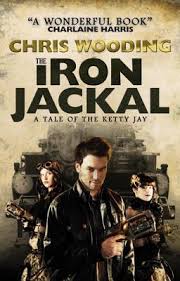
The Iron Jackal Cover
When I started writing For Whom The Gear Turns I thought maybe, just maybe, someday a literary agent would contact me and offer me a free book to read and review. You can imagine my surprise when after only blogging for 6 months it happened! I worried a little that this would color my view of The Iron Jackal (Book 3 of The Tales of the Ketty Jay), especially after the giddy rush I got from opening the package when it arrived. But in the end, it gave me a giddy rush all on its own.
Chris Wooding has been writing the Tales of the Ketty Jay for several years, he is all the way through Book 5 in the UK. But, it was his US agent who contacted me, and told me that they were going to start with Book 3 for the American release on June 1. I was a bit skeptical about starting in the middle of a series, but it meant being dropped into a fully formed and complex world that was a joy to explore and made me even more interested to go back and read the earlier books. There are airship pirates, complicated relationships, daemon-imbued walkie talkies and multi-faceted cultural and political systems that overlap and contradict in a very realistic way. What’s NOT to like?
This tale focuses on the captain of Ketty Jay, Frey, but the story is told through the eyes of the entire crew as they take turns enriching the story with their insights and foibles. It all starts when this rag-tag band is enlisted by Frey’s “its complicated,” Trinica the pirate queen, to steal an artifact of unknown origin and purpose off of a moving train. It reminded me a little of one of my all-time favorite episodes of Firefly, only I really doubt that Frey would ever return the goods like Malcolm Reynolds no matter what they are. In this case, the artifact turns out to be a weapon that seems both ancient and futuristic at the same time, but when Frey lets his ego get the best of him and lifts it from its case the real adventure begins. The weapon pricks his palm and leaves behind the most dreaded of pirate iconography, “the black spot.”
As scary as the Kraken is, I think the daemon that pursues the bearer of the spot in Wooding’s world is even more terrifying. The Iron Jackal is a sinister amalgamation of flesh, machine and the bearer’s darkest secrets and most painful regrets. Frey is haunted by the voice of a man he left to die and the eyes of the woman he abandoned to pursue his life of piracy. But even with his dark past, his loyal crew will stop at nothing to help their captain return the artifact to its resting place to save his life and the family they have built aboard the Ketty Jay. If only they knew where that resting place was…
I would absolutely recommend this book to anyone who is looking for a fun read, but doesn’t mind some moral ambiguity. Frey is by no means a “good guy” by nature, but his Archer-like humor and quest for redemption in Trinica’s eyes make him a very compelling hero. The rest of the crew also gets to be fully-formed people with loves, losses and secrets all their own, so in the end it is really an ensemble piece rather than a story just about Frey. There are some nuances of the political issues that I am sure that I have missed because of not reading the earlier books, but it still definitely holds together as a stand-alone novel and a great place to start exploring Wooding’s work.
My Latest Haul From the Bookstore

Hubby and I were on our way home from getting fingerprinted (part of the Bulgarian visa application) and I spotted a Half Price Books on the map. I had barely said the word “books” before we were turning into the parking lot and turning a totally boring errand into a nice afternoon out.
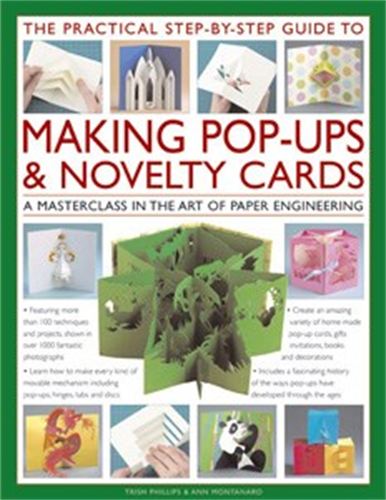 I told my companion to go frolic in the Ancient History section while I perused the art books and I found one that I can’t wait to explore! It is called A Practical Step-By-Step Guide to Making Pop-Ups and Novelty Cards: A Masterclass in Paper Engineering, which is a term that I had never heard before. I have been struggling to find a way to describe the work I do with paper, and I think that is a fitting descriptor. I am really looking forward to finding new ways to make things pop out of my shadow boxes, and the book is full of pictures so it is easy to follow.
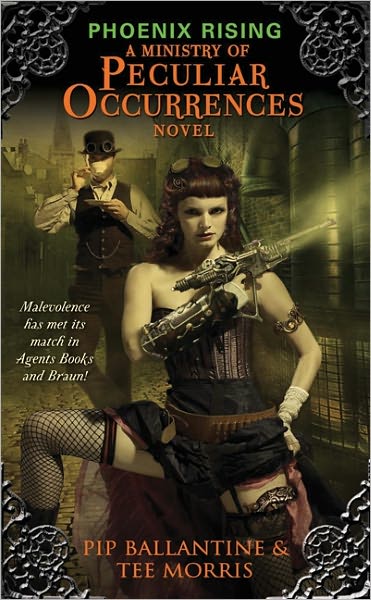 Next, I hit the Sci-Fi section and pulled up my Steampunk Books page to help me comb the shelves for new books. I am happy to report that I got a hold of my first Phillipa (Pip) Ballantine novel, Phoenix Rising, the first in the Ministry of Peculiar Occurrences series.
Sometimes when I go to a bookstore I search alphabetically through my book list, but after the B’s I put down my phone and drifted through the titles, touching the spines. I ended up with two more books to add to my growing list, Devices and Desires, by K. J. Parker and Whitechapel Gods by S. M. Peters
(Has anyone else noticed that authors don’t seem to have first names anymore?)
Devices and Desires is the first in a speculative fiction series called “The Engineer Trilogy.” From what I gather from other reviewers, it takes place in a dystopic land where deviating from the established blueprints can bring a death sentence. At over 700 pages and with warnings of its density echoing in my ears I think I will set this one aside until after I have done my Steam Tour reading.
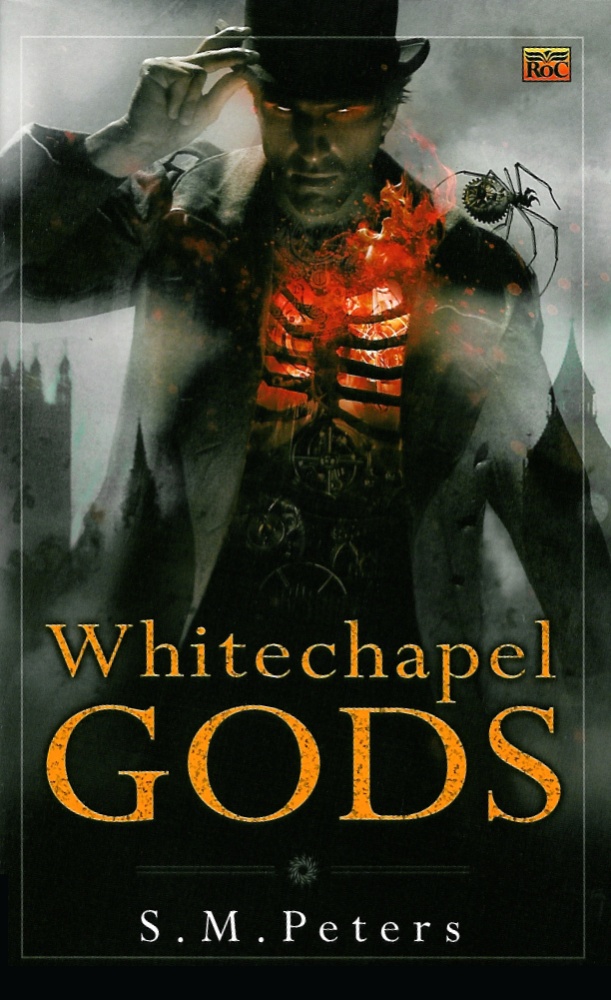 Whitechapel Gods caught my attention of course because of Jack the Ripper. I have started to look into which tours and sites I want to do in order to write my Ripper article for Steam Tour so the neighborhood was on my mind. In S. M. Peters’ novel, Whitechapel has become a walled-off, steam-driven hell for its residents, and chronicles the story of the new resistance.
 When hubby and I reconvened at the cheap DVDs (The Brothers Grimm for $6 :)) he had a wonderful reference book in hand. Lighter Than Air: An Illustrated History of Balloons and Airships. It has wonderful chapter titles like “Clouds in a Bag” and “The Fabulous Silver Fishes” and tons of images of different kinds of flying machines. I am designing a flying machine for my novel right now so this book will be perfect for figuring out how I want it to work.
What’s your newest treasure from the bookstore?


 For Whom the Gear Turns