Victoria and Albert Museum Part 1: Incredible Iron

Some people might think the V&A is not up their alley if they hear the focus is on ‘decorative arts,’ but believe me when I tell you this is not a place where you are going to be inundated with doilies and end tables. Personally, I love the decorative arts because these are the objects that people really did touch, see and experience in their everyday lives, including architectural features. In addition to the fabulous clothing and sumptuous household goods, there is an amazing gallery of just samples of ironwork.
There are still lots of examples of wrought and cast all over London (which will get their own post soon), but these items have often been painted and repainted so many times that the delicacy and detail that can be achieved when working in metal has been totally obliterated. This is not so at the museum, where everything from window grates to railings to candlesticks have been preserved for posterity. If you are a fan of metal, you should definitely make sure you stop by the Victoria and Albert Museum if you are visiting or living in London.
Here is sampling of what I saw when I visited.


Want to Learn About Jack the Ripper? Skip the Tour.


On display at the Museum of London
My original plan had been to sample at least two Ripper Tours while in London, but after running into 6 other tour groups on my maiden voyage, I decided it wasn’t necessary. The groups ranged from 12 members to more like 40, and they all (unsurprisingly) were stopping at the same places. One group was headed up by a vintage bobby, my guide was in waistcoat and hat, and others were dressed in normal street clothes.
I knew there would be at least a couple other groups around but this was nuts, especially considering there was hardly anything to see. That area of London had suffered a great deal during the London Blitz of WWII, so there weren’t really any historic buildings left standing, so the tour meant walking through a long street lined with curry restaurants and maneuvering around construction zones. By about 30 minutes in, the Mister and I were joking that we should have just stopped at the beginning for curry instead.
I was on a tour using what they called “Ripper Vision” and some large historical photographs to try to enhance the experience, but it still fell flat for me. Ripper Vision consisted of a handheld projector that the guide used to show photos of the victims and newspaper stories from the Ripper days, but he couldn’t keep the projector steady so I ended up actually feeling sea sick from all the jerking around and had to look away. The guide was well-versed in Ripper lore, but without any real sites that still looked like they did during the Victorian era, it definitely could have been a lecture in a hall and saved my feet the trouble.
If you want to learn about Jack, I’d say get a book. I’ll be writing a Jack the Ripper Steampunk Sourcebook article for my ezine which will be available around Christmas time, and will not only look at the history and mystery surrounding the murders, but also Jack’s appearances and role in Steampunk so far.
Have you ever read any Steampunk fiction or seen any good movies that featured Jack the Ripper? Do tell!
The Cutty Sark and the English Tea Trade

 It is common knowledge that the Brits love their tea, but it is less common knowledge how this love affair all began. If you are looking for a fun way to explore that history, you should try visiting the good ship Cutty Sark near the waterfront in Greenwich.
The ship itself wasn’t built until 1869, but tea first came to the UK two centuries earlier. Here is a timeline from the Cutty Sark’s exhibits.

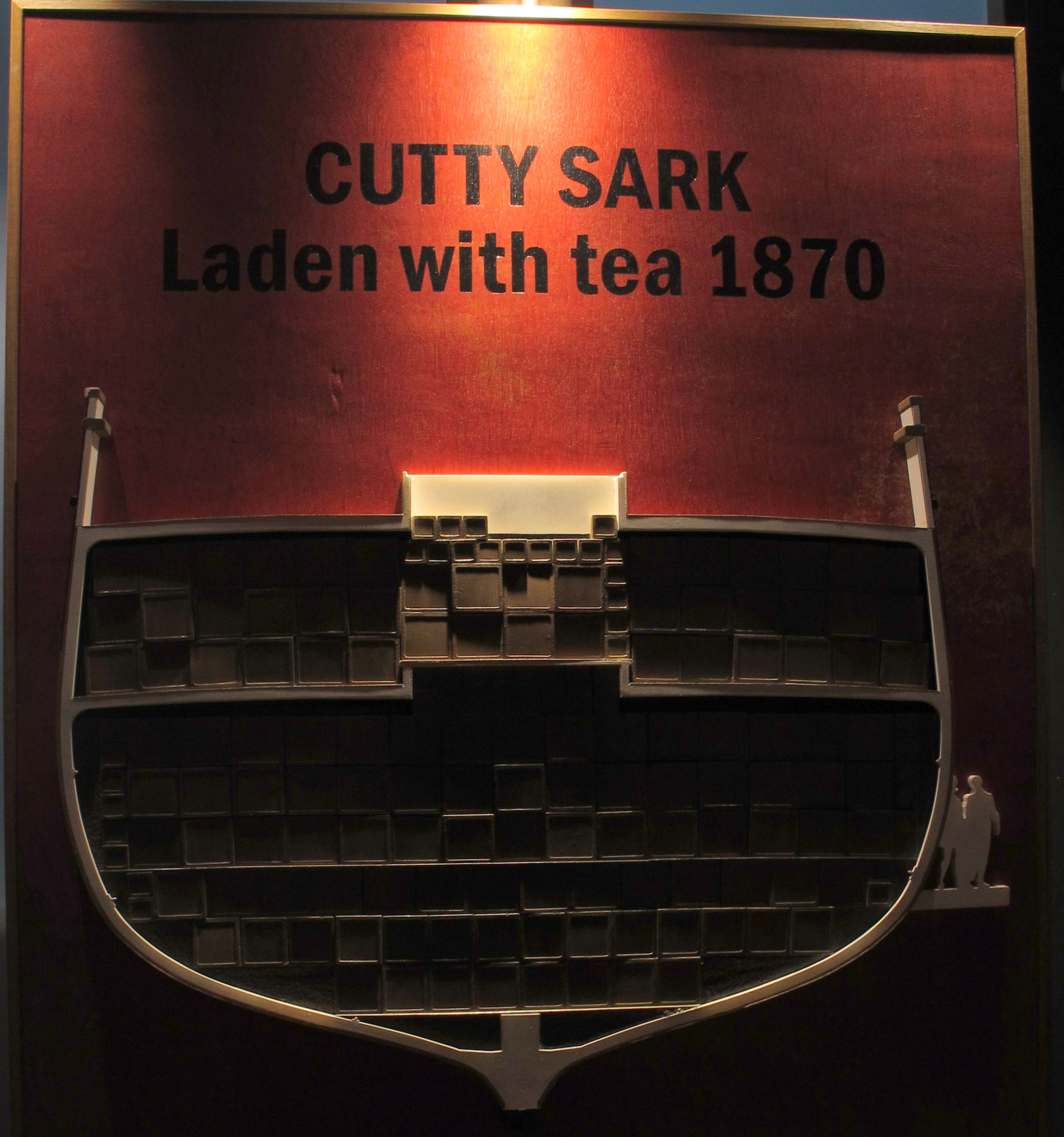 In its heyday, The Cutty Sark was one of the most impressive vessels on the sea, and especially well-suited for transporting tea. The copper hull was not only beautiful, but was especially good at keeping sea water out of the cargo hold. It also had an amazing carrying capacity and was one of the fastest ships on the water.
In fact, it engaged in a historic race in 1872 against another transport called The Thermopylae. Both ships left Shanghai at the same time, and the Cutty Sark took an early lead. Unfortunately, she lost her rudder and had to stop for repairs. The Thermopylae ended up making it to England a full week before The Cutty Sark. This was the only time that both ships left from the same port at the same time, but the Cutty Sark later set a record for reaching Sydney in just 73 days.
I loved visiting the exhibits on the inside, especially the first floor where the interior and the displays were made out of tea crates. There is another gallery the next floor up that has interactive features and videos to help you get into the mindset of a sailor on the ship over its long history. I was also lucky enough to have the perfect weather to explore the deck, which has been restored to its former and shiny glory.


Steampunk Book Review: The Difference Engine

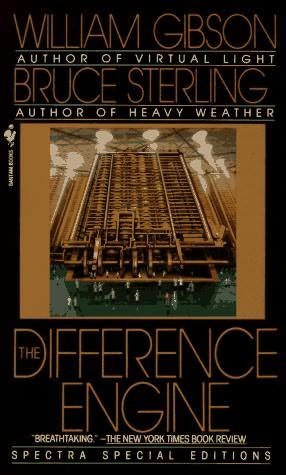 A big part of my Steam Tour is finding out about the historical events and people who influenced the time period reflected in Steampunk books. I love the idea of alternate histories, and many times that is at the core of Steampunk novels, such as The Difference Engine by sci-fi greats William Gibson and Bruce Sterling.
If you are like me and you don’t have a good handle on the real history, I would recommend a quick glance at the wikipedia article about this book before you begin it. There is a great summary there of where and how the alternate history of the novel diverge from real events. I didn’t do this before I started reading and I spent a lot of the book wondering about fact and fiction.

Trial portion of the Difference Engine No. 1, completed 1832
In short, it tells the tale of the trajectory of the world if the computer age came in the 1800’s. The political structures all over the world are deeply effected by Charles Babbage’s completion of his mechanical computers (called Analytical Engines) in 1824, and there are numerous references to a fragmented United States (including a communist Manhattan) as well as historical figures such as Lord Byron, Ada Byron (the “queen of engines”), and Laurence Oliphant in different roles. The English politicial system has been completely dismantled and a meritocracy put up in place of hereditary lordships. The story is mostly told through the eyes of Edward Mallory, a “savant” who discovers the first huge dinosaur bones, giving him the nickname “Leviathan Mallory.”
There were a lot of things I really liked about this book. The descriptive language was excellent and Ned is a great character on whose coattails to ride through the adventure. I loved the shift in politics in response to technology and the parallels between then and now when it comes to the power of information. The authors clearly put a lot of thought into both logically and imaginatively extending the repercussions of the rise of computer technology long before we experienced it in our timeline.

Babbage later designed a simpler difference engine that was not built until the 20th century, on display at the Computer History Museum
On the whole, the story felt a bit fragmented because there are three distinct characters that get followed and the treatment is uneven. The first person you explore this world with is Sybil, and her story comes to an abrupt halt right as it gets really interesting. Then Mallory comes onto the scene and his story is great, but I couldn’t help but wonder where Sybil had gone to. Mallory’s tale comes to a head and he gets what he wants, but he is not actually the agent of change so even though there is a stand-off and big ‘splosions (whoo-hoo!) it felt sort of anticlimactic. Lastly, we trail Mallory’s one-time ally Laurence Oliphant for a little while on his political espionage. Each section was full of wonderful prose, but as a full story it ended up feeling kind of jerky and a bit too long.
That being said, I think it is definitely worth a read for the wonderful writing and imagination of the authors.
Have you read this book? What did you think?
Don’t Miss Longitude Punk’d at the Royal Observatory

 The Royal Observatory is probably best known for being the home of the Prime Meridian, but I went there to check out an amazing Steampunk exhibit dedicated to “the longitude question.” Thousands of seamen lost their lives because they couldn’t be sure where they were when they were in the open ocean, so the British Parliament implemented a competition in 1714 and offered a reward of 20,000 pounds to anyone who could figure out how to calculate longitude when out to sea. Little did the Longitude Board know that it would be 50 years before anyone could find the answer.
The exhibit, Longitude Punk’d, is set up as a series of submissions to this contest and is intermixed with the Observatory’s collection of real and sometimes bizarre submissions. There are many buildings in the Greenwich Observatory complex, and this exhibition takes advantage of the historic Flamsteed House that sits on the grounds. There is normally already a gallery dedicated to longitude in the house, but for now the Steampunks have taken over that gallery as well as several other rooms as well as the courtyard to show their amazing contraptions and costumes.

The Commodor employed kiwi birds to keep him informed about his position.
Throughout the house you can read “The Rime of the Ancient Commodore,” which is a whimsical epic poem about one of the artists’ alter ego and his unique quest for the answer to the longitude question. His theory? Animals know exactly where they are, so if you can learn to talk to animals, all you have to do is ask for directions 🙂 Make sure to take the time to watch the series of short films embedded between display cases to meet the artists and find out the ideas behind their amazing creations.
The exhibit costs 8.50, but you also get admission to the Cutty Sark and the complementary and more serious examination of longitude at the Maritime Museum called Ships, Clocks and Stars any time within a month of your first visit. It will run between now and January 2015, so don’t miss your chance to get punk’d!


But even if you aren’t in town in time for the exhibit, there is a ton to see at the observatory for fans of the Victorian era, and I am going to post soon about their permanent galleries as well so stay tuned.
Steampunk Book Review: The Other Log of Phileas Fogg
Whenever I go a-searching for used science fiction books I run across several by Philip Jose Farmer, but I could never find any in his “Wold Newton” series. The books I could find seemed to be all about space travel and other worlds, but his Steampunk books take place in the alternative past right here at home. I eventually had to order The Other Log of Phileas Fogg online, and I was so excited when the new edition arrived at my door, especially because of the sweet airship on the cover. I am sad to report though that the dirigible of the futuristic past does not actually make an appearance anywhere in the story, and that is only one of several letdowns about this book.
I expected this story to be written like a series of journal entries, but rather it is through the lens of an “expert” interpreting a secret journal and often correcting Verne’s story as much as adding missing pieces. But, one thing Farmer does do is give Fogg his missing back-story. According to this book Fogg was the foster son of an alien and learned special abilities, like the trick of controlling his negative emotions, that aid him on his trek and go a long way to explaining the enigmatic Fogg.
For the past two hundred years there has been a secret war waged between two competing alien species and it is being fought right below the noses of the human race. Both sides have lost the ability to reproduce because their numbers are so few and their females dead, so they take in human foster children like Fogg and Passepartout on one side and Detective Fix and Captain Nemo on the other. The aliens have advanced technology to aid their surrogates and according to Farmer this foreign machinery is the origin of Nemo’s Nautilus. Fogg’s dash around the planet has nothing to do with a wager, but is actually in pursuit of a teleportation device that both sides need for their (apparently same) plots of benign sublimation for the human race.
As I said in my review of the original Around the World in 80 Days (read it here), there are many gaps in Verne’s story that are begging to filled and Farmer was certainly endeavoring to do so. Unfortunately, his approach reminded me of the worst kind of fan fiction where a story gets nit-picked apart to such an extent that it stops being fun to read. For instance, Farmer makes a point of saying something should only take 5 minutes when it took Fogg 10, and harps on the fact that Verne never specifically mentions that Fogg carries a watch.
And then, rather than offering interesting explanations or insights from the “other log,” Farmer commits that cardinal writing sin: the rhetorical question. There are sometimes 6 or more in a row! Maybe this is just me, but I was always told that an author should never, ever do this even once without immediately answering it, and even then it is considered lazy writing. Farmer also makes a point of saying that the book is not a novel, but then writes long stretches of dialog that would never have been recorded in a diary and so have no place in the narrator’s interpretation. I also felt that giving all the credit of the technological advancements to the aliens was a disservice to Verne’s characters and the ingenuity of inventors during the Industrial Revolution.
So in the end, I don’t think I’d recommend this book any more than I would the original in terms of pure literary delight, but it is a great example of Steampunk and someone having fun with classic literature of the Victorian era.
Have you read any Philip Jose Farmer? What did you think?
Steampunk Book Review: Around the World in 80 Days

I have been “poorly” as they say here in Britain, meaning that I have been under the weather for a few days, so I didn’t make it into the city yesterday as I had planned. But, with all the trains, planes and automobiles lately I have gotten plenty of reading done in anticipation of my upcoming articles for the ezine, so here is a book review to tide you over until I can start posting about London in earnest.
 I chose to do an in-depth article on Around the World in 80 Days mostly as an excuse to watch the 1956 movie again that I remembered from my childhood, but of course I needed to start with the text itself. I won’t go into a lengthy synopsis here because I will be doing that for my upcoming Sourcebook, so I’ll skip straight to the review.
I really expected to adore this book and it had all the makings of greatness, but all and all I’d say this one isn’t a must-read for a Steampunk or a Jules Verne fan. The voice of the narration is inconsistent and swings between third-person omniscient and totally opaque, especially when it comes to Detective Fix who is pursuing Fogg through his journey on suspicion of bank robbery. I also felt like the action, the real meat of the adventure, was often treated as a footnote with very little description whereas the reader must sit through several pages of Mormon history and detailed itineraries of exactly where their train is stopping. For instance, Passepartout is taken hostage by the Sioux during the trek across America, but all we know if the daring rescue is that Aouda and Fix paced a lot while waiting.
There are definitely gaps that would be fun for an author to try to fill, and indeed Philip Jose Farmer attempted to do just that in his novel The Other Log of Phileas Fogg, which is the next book I will review.
Wrapping up my Experience at Edinburgh Fringe Fest 2014

In all, the Mister and I saw 10 performances and went to one awesome whisky tasting during our time at Edinburgh Fringe Fest, but I couldn’t devote an entire article to each one. Some things were too short for their own post or fell short in terms of quality, and I didn’t want to devote entire posts to negative feedback. But, by putting everything on my posted itinerary it looks like I am endorsing it all, and I can’t say I’d recommend everything I saw during my week at the Fringe. So here is my final set of reviews for the rest of what I saw in the order that I saw them.
21st Century Poe: Moyamensing
I was excited for this hour-long performance that promised to explore Edgar Allan Poe’s imprisonment in the Moyamensing prison in 1849. Unfortunately, within the first 10 minutes I wished I had been one of the lucky ones who sneaked out while “Poe” was off stage. The entire tale was told at a decibel level that hurt my ears, and even though the one-man show was supposed to be told through several characters, the only thing that changed about the delivery were the hats he wore. I thought that I was going to get a piece of Poe-like story-telling, with suspense and just the right sprinkling of grotesque, but the delivery was off-putting and the story just plain gory.
City of the Dead: Haunted Graveyard Tour
There are a few different City of the Dead tours, and this one takes your group to Greyfriar’s cemetery. I love these kinds of tours and the guide was just as engaging as I’d hoped. There was just the right amount of humor to offset the truly horrific details of Edinburgh’s past and their dealings with their dead. If you like true stories of the darkest pieces of history, definitely check this one out.
Arthur  Conan Doyle Experience
The Arthur Conan Doyle Center is housed in a beautiful Victorian townhouse on a lovely street. The lecture took place in the sanctuary for the Edinburgh Association of Spiritualists, though the speaker was specifically not going to be talking about spiritualism. She focused instead on the time in Conan Doyle’s life that he lived and worked in Edinburgh and focused on trying to tell the audience things they might not already know. Unfortunately for me, I didn’t know much about his life at all to start with, so the lecture felt sort of scattered and there were many times when she started a sentence with “And as you already know” and ended with “so I won’t go into that.” So if you are looking for an intro to this amazing writer’s life, I’d start somewhere else. This was clearly meant for people who already had some background knowledge.
The Center itself is worth a quick look if you are in the area. The upper levels are accessible in all of their Victo rian splendor, and there is a gallery space that is lovely and bright. The Center offers yoga and other practices to enhance your mind-body connection, as well as studio space for artists. I thought there would perhaps be an exhibit or something about the man himself, but alas, there are just books in the gift shop. So don’t plan on spending more than a few minutes there if indeed you go at all for anything besides a lecture.
Dorian
This was a totally different way to present the tale of Dorian Gray from the manner of Victorian Vices. In this version the actors were all in black and white, including their painted faces. They never revealed the portrait to the audience, but used a large canvas on stage that was smeared with “blood” by Dorian’s victims after their deaths or ruination. The show moved far too quickly, even the lines were delivered rapid-fire, so it ended up feeling like the Cliff’s notes version of The Picture of Dorian Gray and lasted maybe 20 minutes total. But the proceeds go to a charity so if you are in the area and have half and hour to kill it is an interesting little show.
Lovecraft’s Monsters
I didn’t actually put this on my formal itinerary because it was an free, non-ticketed event and I wasn’t certain I’d make it there. The small but appreciative crowd assembled inside The Wee Pub in a wonderful little room complete with a beautiful old-timey fireplace and lights. Unfortunately, the large picture window overlooked Greenmarket Square and there was a lot of activity outside. The music of the street musicians really detracted from the tales of horror and made it difficult for the actor to build the kind of suspense that he was going for. David Crawford has a wonderful voice for telling scary stories, and I’d love to see him again in a different setting. He asked for suggestions after the show because he is planning to have some engagements in the US, so maybe you will get a chance.


 For Whom the Gear Turns