Steampunk Sourcebook: City of Ember (2008)


Like The Golden Compass, City of Ember skirts the edge of “true” Steampunk, but I have seen it on several Steampunk movie countdowns (though interestingly not on book lists.)
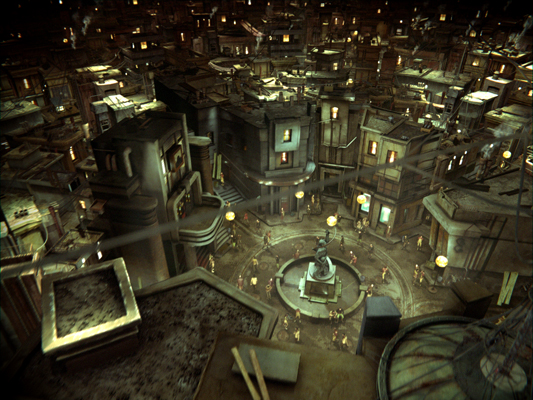
Streets of Ember
The story centers on two teenagers, Lina Mayfleet (Saoirse Ronan) and Doon Harrow (Harry Treadaway). We meet them on their Assignment Day when their entire future careers get determined by the luck of the draw. Doon is supposed to become a messenger, but he trades that choice job away to Lina in return for a chance to work under the city and gain access to the generator that supplies the lifeblood of Ember: electricity. Because Ember lies deep below the ground, safe from the terror that took place 241 years ago. Without the generator the entire population would be plunged into total darkness and the electric lights mounted all over the city is there only refuge from the abyss beyond.
But lately, the lights have begun to flicker.
Lina is delighted to become a messenger and dives into her duties with gusto. She is the grownup in her tiny family, which consists of a little sister named Poppy with a propensity for putting things in her mouth and a dear (though slightly crazy) grandmother who spends her days taking thread out of clothing and spooling it for reuse (no on has had new clothes for over a century). In the depths of a closet, Poppy uncovers a mysterious metal box that had belonged to a former mayor and proceeds to gnaw on the contents.
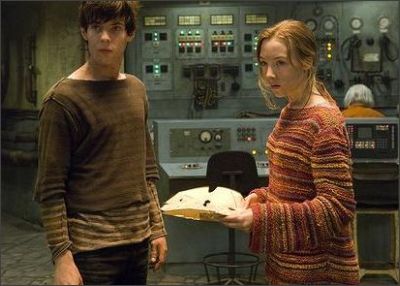
Lina and Doon
Lina recognizes the writing on the pages as coming from the revered and little understood “builders” who created Ember and, with the help of Doon, attempts to recreate the documents from the chewed mess. To their shock and amazement, they seem to be telling of a way out of Ember, and out of the danger of starvation and perpetual darkness. Can Lina and Doon overcome the rampant corruption in their government to discover the truth and lead the citizens of Ember to salvation?
Some fun facts and context:
۞ The movie is based on a novel called The City of Ember that was released in 2003. You can read an interview with the author here about the novel’s tenth anniversary this year.
۞ DuPrau wrote 2 sequels, The People of Sparks (2004) and The Diamond of Darkwood (2008), as well as a prequel called the Prophet of Yonwood (2006) that tells of the cause of the apocalypse that led to the building of Ember.
۞ The City of Ember was made into a graphic novel in 2012 by Niklas Asker.
۞ Harry Treadaway (Doon), most recently appeared in the 2013 Lone Ranger with Johnny Depp. Saoirse Ronan (Lina) has lent her voice as well as her face to several films and is best known for her roles in Atonement and The Lovely Bones.
۞ The film includes a few major changes from the book. First off, giant mutated animals. In the book, Doon keeps a caterpillar to observe it and is utterly fascinated by insects because the people of Ember never see things from above ground. In the film he finds a moth is easily 2 feet across, upping the visual ante but not staying true to the novel. There is also a completely terrifying star nosed mole as large as a hippopotamus that delivers the come-uppence to Ember’s corrupt mayor (played by Bill Murray), which never appeared in the book. Likely this is a reference to the nuclear cause of the apocalypse in the Prophet of Yonwood and mutations that could follow. Personally, I did not like the change, I thought the book was already great without the novelty.
۞ The other big change, which is probably the reason the movie ends up in Steampunk lists and the book does not, is the amount of gadgetry. In the movie, Doon’s father (Tim Robbins) is an inventor and Rube Goldberg type machines cook their breakfast, while in the book he runs a shop populated by old shoe heels and rusty nails. There are also scenes that take place in the huge industrial center under the city, but the tech is all there to create electricity so it is not very Steampunk in the end. But the gritty, dark ambiance and added mechanical gizmos definitely make you feel like you are in the past rather than the distant future.
۞ The set was built in the same shipyard the Titanic was, and many of the interiors that were built were never used in a single shot but add to the depth of the visual story. Check out the clips below the gallery for more windows into the underground city.
Click on the thumbnails for larger images.


A Little Steam With My Comics This Weekend

I am traveling this month to such exotic locales as Michigan and Washington DC, and while I was reading the Washington Post this weekend I ran into two comics that I wanted to post. This first one gave me a nice little chuckle and is from the strip WuMo.

Before Electric Eels
The second had a little Steampunk thrown in. Check out the decked out doggie in the third panel of this Prickly City strip by Scott Stantis.

Prickly City
Van Helsing (2004) Mixes Monsters for Movie Magic


Stephen Sommers, who brought us the special effects-laden reboot of The Mummy in 1999, also lent his imagination (as well as his pen) to create Van Helsing in 2004. Even though both films are almost a decade or more old they are some of my absolute favorites for their combination of action, visual effects and fun.
 Gabriel Van Helsing (played by Hugh Jackman) is a monster hunter with a mysterious past. He is employed by the Catholic church to seek out and destroy evil, but remembers nothing before he was charged with his holy quest. As far as I can tell, the only thing this Van Helsing has in common with the Dutch doctor and do-gooder Abraham Van Helsing of Bram Stoker’s novel Dracula is the name.
The film starts with an homage to classic black and white movies as an angry mob attacks castle Frankenstein in 1887. Sommers’ twist is that the good doctor’s financial backer is none other than Count Dracula. Van Helsing enters the movie with an epic confrontation between him and a truly monstrous Mr. Hyde (of The Strange Case of Dr. Jekyll and Mr. Hyde) on the rooftop of Notre Dame. Later, Van Helsing is charged with slaying Dracula in time to protect the souls of the Valerius family, who vowed they would never rest until the vampire met his demise. With the help of his techno-whiz sidekick, a friar named Carl, Van Helsing travels to Transylvania and to aid the last members of the tragic tribe before nine generations are shut out of heaven.
 Sommers’ creates a plot that incorporates Dracula and Frankenstein’s monster, as well as the Wolfman. He also gives a much larger role to Dracula’s three ‘brides’ (which by the way, are not identified as such in the novel) and they provide some wonderful action sequences as they terrorize the nearby village as flying monsters in order to hunt down Anna Valerius (played by Kate Beckinsale). Though the roots of this movie clearly come from a love of classic horror films, the time, literary characters and gadgets (like a gas-powered repeating crossbow) land it squarely in the Steampunk canon.
There is an animated prequel called Van Helsing: The London Assignment which you can read more about and watch here.
I also recently found out that there is another Van Helsing movie planned, but it is going to be a “reboot” starring Tom Cruise. Check out that story here.
Click on the thumbnails for larger images.


Steampunk hits the Paralympics: Festival of Flame (2012) Gallery

The 2012 Paralympics closing ceremony featured huge metal vehicles and steamy costumes. I created a gallery of images, plus you can watch the whole closing ceremony including appearances by Rihanna and Coldplay below.

Correfoc, Barcelona 2005
The performance was called The Festival of Flame and it certainly lived up to its name. It reminded me of being in Barcelona in the fall when they have their annual festival, La Merce. I got to experience the correfoc (fire run) with some friends in 2005 and I was the only one to actually brave the sparks and make a run for it. (pictured left) La Merce has been celebrated since 1902 and features fire breathing monster floats, drumming demons and human castles 6 people high.
Festival of Flame


Want to see more steamy vehicles? Check out my vehicle gallery here!
Steampunk Sourcebook: Captain Nemo

The enigmatic Captain Nemo made his first appearance in Jules Verne’s science fiction classic, 20,000 Leagues Under the Sea (1870), which takes place in the late 1860s. Little is revealed about the mysterious figure besides his hunger for scientific knowledge and his rejection of imperialism and by extension, most of the world above the ocean. He and his dedicated crew exist “below the law” by rarely stepping foot on dry land and aiding those oppressed by imperialism. In the second novel featuring Nemo, The Mysterious Island (1874), he tells a group of castaways that he is the son of a raja named Prince Dakkar and that he lost his family in the First Indian War for Independence against the British (1857). After the death of his loved ones he goes into hiding and embarks on secret scientific research, culminating in an electric submarine called the Nautilus.
Fun Facts and Context:
۞ Nemo means “Nobody” in Latin
۞”20,000 Leagues under the sea” is often interpreted as the vertical distance down into the depth of the ocean, but it is a slight mistranslation of the french title “Vingt mille lieues sous les mers” where mers (meanings seas, plural) was translated as “sea.” It is meant to indicate the horizontal distance traveled under the water, not the depth of the water. 20,000 leagues is 6 times bigger than the diameter of the planet (each league is 4 kilometers).
۞ In the original manuscript, Nemo was a Polish noble whose family was killed in the January Uprising (1863-1865) by Russian oppressors. Fearing a blow to sales (as well as insulting France’s ally), Verne’s editor asked him to change the character and keep the details shadowy.
۞ Though he is an Indian prince in the final iteration of the novel, Nemo spent most of his formative years in Europe so he speaks with a British accent (he admits to speaking French, Latin and Gerrman as well).
۞ And though he hates the imperialist nature of European nations, the Nautilus is full of treasures from around Europe including an organ which Nemo plays masterfully. There is also a substantial library on board to feed his scientific pursuits.
۞ Nemo has a brief appearance in one more of Verne’s works, a play called Journey Through the Impossible. The play was not published until 1981 after a handwritten copy was discovered in 1978. The first English translation was completed in 2003.
۞ There was a real submarine called the Nautilus, which was designed by an American inventor living in France named Richard Fulton. It was developed in the late 1700s and was powered by a hand crank.
Captain Nemo has appeared in various adaptations of Verne’s novels, but few of these belong in the Steampunk canon. For instance, the 1954 film adaptation is heavily influenced by the style and politics of the era, and some important details are changed (for instance, the Nautilus runs on nuclear power rather than electricity). You can find a full list of Captain Nemo’s appearances here, but for the sake of this post I am focusing on the versions of Nemo that fit firmly into Steampunk.
For instance, Alan Moore’s graphic novels (and the film adaptation) featuring The League of Extraordinary Gentlemen. In this series, Nemo is much more callous, even bloodthirsty, than the original character. Verne’s Nemo saved whales, Moore’s Nemo mows down people with machine guns (Volume 1).
Captain Nemo also appears in The Other Log of Phileas Fogg, a 1973 novel by Philip Jose Farmer. If you haven’t guessed it, this is a crossover novel that takes place in the world of Around the World in 80 Days but incorporates (or rather co-opts) characters from other novels like Sir Arthur Conan Doyle’s Sherlock Holmes series. In Farmer’s account, Captain Nemo is better known in some circles at Professor Moriarty.
Kevin J. Anderson rewrites Captain Nemo’s history (and brings a childhood spent with Jules Verne into the mix) in his novel, Captain Nemo: The Fantastic History of a Dark Genius (2002).
Check out my gallery below for various versions of this Victorian antihero and other steamy sea captains.


Steampunk TV: NBC’s Dracula

I have heard some hemming and hawing about the costumes in NBC’s Dracula because they aren’t “period” enough. Personally, I think that is part of what makes it steampunk rather than a period drama and therefore way more interesting. I watched a special about the making of the Tudors and I think the costumers on Dracula are taking the same approach: It’s not about historical accuracy, it is about making the audience look at clothes and get an impression about the person wearing them. For instance, records about the real Anne Boleyn show that she was on the forefront of fashion in her day, but how do you capture that for an audience that doesn’t know the difference between silk and satin?
So the costume designers made a compromise between authenticity and modern designs to appeal to the audience and give the impression of her changing status as her look evolved. The same goes for music in movies like Moulin Rouge and The Great Gatsby, these aren’t the original songs or even the original genre of music, but the point is to capture the excitement of the time and place and draw the audience into the world of the film.
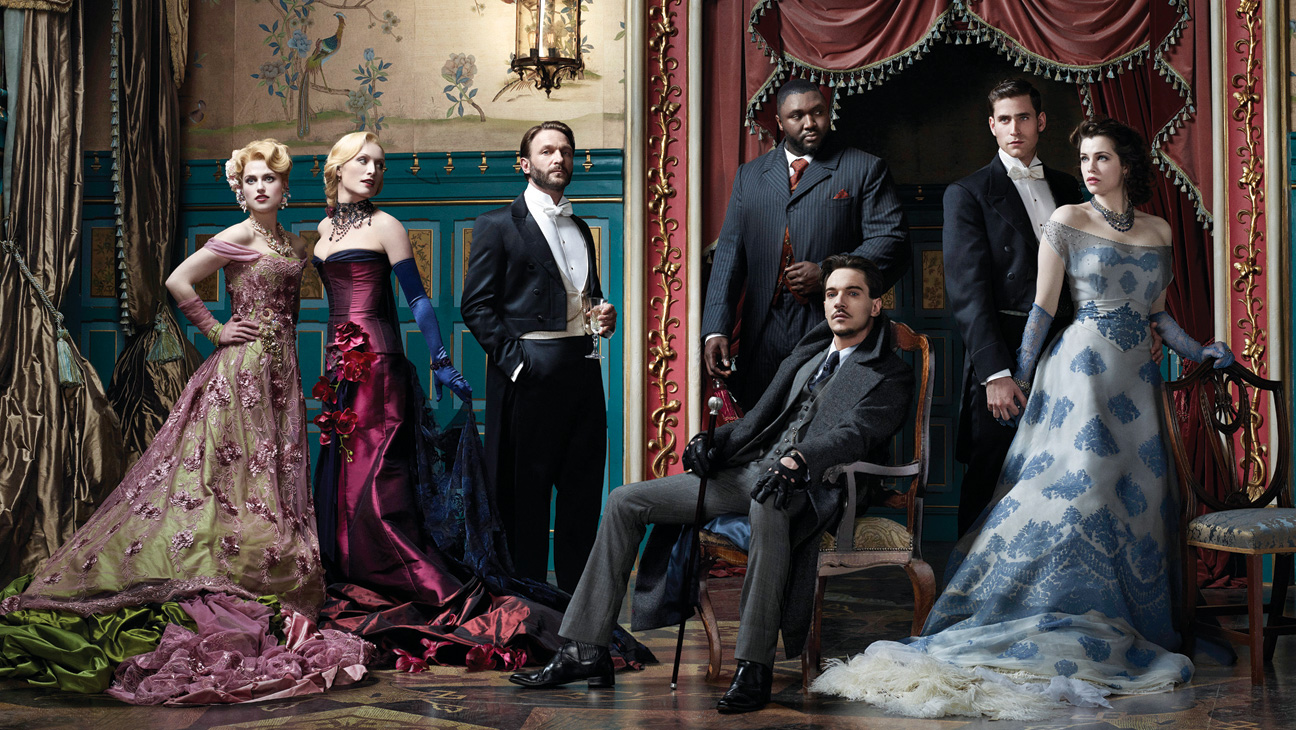
Dracula Cast
And the same goes for NBC’s Dracula. The men’s clothing is absolutely gorgeous and connotes the huge wealth that Dracula and the Order Draco control. Except for during the occasional ball, Mina’s clothes are much plainer than Lucy’s, which brings their different social statuses into focus. Here are some costumes and sets for you to drool over.
-

- Renfield and Harker look great in velvet collars
-

- NBC Dracula
-

- Renfield rocking a suit with a single button closure
-

- Dracula in pin stripes
-

- Lovely ladies of Dracula
-

- NBC Dracula
-

- Harker looks amazing in his blue corduroy suit
-

- Interior of Dracula’s house
-

- Interior of Dracula’s house


 For Whom the Gear Turns