Steampunk hits the Paralympics: Festival of Flame (2012) Gallery

The 2012 Paralympics closing ceremony featured huge metal vehicles and steamy costumes. I created a gallery of images, plus you can watch the whole closing ceremony including appearances by Rihanna and Coldplay below.

Correfoc, Barcelona 2005
The performance was called The Festival of Flame and it certainly lived up to its name. It reminded me of being in Barcelona in the fall when they have their annual festival, La Merce. I got to experience the correfoc (fire run) with some friends in 2005 and I was the only one to actually brave the sparks and make a run for it. (pictured left) La Merce has been celebrated since 1902 and features fire breathing monster floats, drumming demons and human castles 6 people high.
Festival of Flame


Want to see more steamy vehicles? Check out my vehicle gallery here!
Steampunk Sourcebook: Captain Nemo

The enigmatic Captain Nemo made his first appearance in Jules Verne’s science fiction classic, 20,000 Leagues Under the Sea (1870), which takes place in the late 1860s. Little is revealed about the mysterious figure besides his hunger for scientific knowledge and his rejection of imperialism and by extension, most of the world above the ocean. He and his dedicated crew exist “below the law” by rarely stepping foot on dry land and aiding those oppressed by imperialism. In the second novel featuring Nemo, The Mysterious Island (1874), he tells a group of castaways that he is the son of a raja named Prince Dakkar and that he lost his family in the First Indian War for Independence against the British (1857). After the death of his loved ones he goes into hiding and embarks on secret scientific research, culminating in an electric submarine called the Nautilus.
Fun Facts and Context:
۞ Nemo means “Nobody” in Latin
۞”20,000 Leagues under the sea” is often interpreted as the vertical distance down into the depth of the ocean, but it is a slight mistranslation of the french title “Vingt mille lieues sous les mers” where mers (meanings seas, plural) was translated as “sea.” It is meant to indicate the horizontal distance traveled under the water, not the depth of the water. 20,000 leagues is 6 times bigger than the diameter of the planet (each league is 4 kilometers).
۞ In the original manuscript, Nemo was a Polish noble whose family was killed in the January Uprising (1863-1865) by Russian oppressors. Fearing a blow to sales (as well as insulting France’s ally), Verne’s editor asked him to change the character and keep the details shadowy.
۞ Though he is an Indian prince in the final iteration of the novel, Nemo spent most of his formative years in Europe so he speaks with a British accent (he admits to speaking French, Latin and Gerrman as well).
۞ And though he hates the imperialist nature of European nations, the Nautilus is full of treasures from around Europe including an organ which Nemo plays masterfully. There is also a substantial library on board to feed his scientific pursuits.
۞ Nemo has a brief appearance in one more of Verne’s works, a play called Journey Through the Impossible. The play was not published until 1981 after a handwritten copy was discovered in 1978. The first English translation was completed in 2003.
۞ There was a real submarine called the Nautilus, which was designed by an American inventor living in France named Richard Fulton. It was developed in the late 1700s and was powered by a hand crank.
Captain Nemo has appeared in various adaptations of Verne’s novels, but few of these belong in the Steampunk canon. For instance, the 1954 film adaptation is heavily influenced by the style and politics of the era, and some important details are changed (for instance, the Nautilus runs on nuclear power rather than electricity). You can find a full list of Captain Nemo’s appearances here, but for the sake of this post I am focusing on the versions of Nemo that fit firmly into Steampunk.
For instance, Alan Moore’s graphic novels (and the film adaptation) featuring The League of Extraordinary Gentlemen. In this series, Nemo is much more callous, even bloodthirsty, than the original character. Verne’s Nemo saved whales, Moore’s Nemo mows down people with machine guns (Volume 1).
Captain Nemo also appears in The Other Log of Phileas Fogg, a 1973 novel by Philip Jose Farmer. If you haven’t guessed it, this is a crossover novel that takes place in the world of Around the World in 80 Days but incorporates (or rather co-opts) characters from other novels like Sir Arthur Conan Doyle’s Sherlock Holmes series. In Farmer’s account, Captain Nemo is better known in some circles at Professor Moriarty.
Kevin J. Anderson rewrites Captain Nemo’s history (and brings a childhood spent with Jules Verne into the mix) in his novel, Captain Nemo: The Fantastic History of a Dark Genius (2002).
Check out my gallery below for various versions of this Victorian antihero and other steamy sea captains.


Steampunk TV: NBC’s Dracula

I have heard some hemming and hawing about the costumes in NBC’s Dracula because they aren’t “period” enough. Personally, I think that is part of what makes it steampunk rather than a period drama and therefore way more interesting. I watched a special about the making of the Tudors and I think the costumers on Dracula are taking the same approach: It’s not about historical accuracy, it is about making the audience look at clothes and get an impression about the person wearing them. For instance, records about the real Anne Boleyn show that she was on the forefront of fashion in her day, but how do you capture that for an audience that doesn’t know the difference between silk and satin?
So the costume designers made a compromise between authenticity and modern designs to appeal to the audience and give the impression of her changing status as her look evolved. The same goes for music in movies like Moulin Rouge and The Great Gatsby, these aren’t the original songs or even the original genre of music, but the point is to capture the excitement of the time and place and draw the audience into the world of the film.
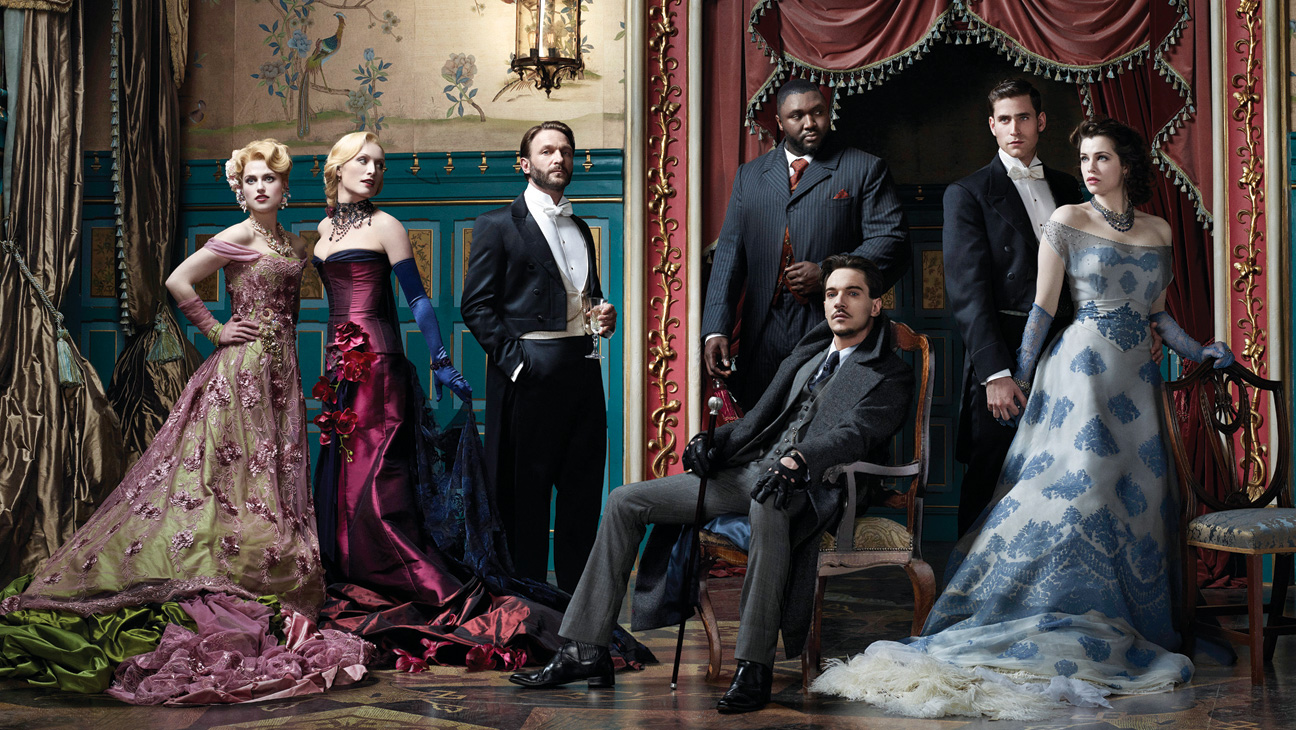
Dracula Cast
And the same goes for NBC’s Dracula. The men’s clothing is absolutely gorgeous and connotes the huge wealth that Dracula and the Order Draco control. Except for during the occasional ball, Mina’s clothes are much plainer than Lucy’s, which brings their different social statuses into focus. Here are some costumes and sets for you to drool over.
-

- Renfield and Harker look great in velvet collars
-

- NBC Dracula
-

- Renfield rocking a suit with a single button closure
-

- Dracula in pin stripes
-

- Lovely ladies of Dracula
-

- NBC Dracula
-

- Harker looks amazing in his blue corduroy suit
-

- Interior of Dracula’s house
-

- Interior of Dracula’s house
Steampunk Sourcebook: The Illusionist
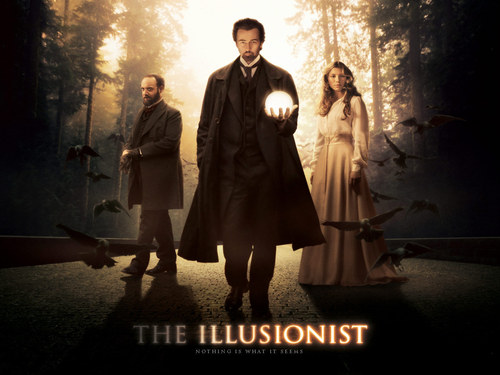
The Illusionist poster
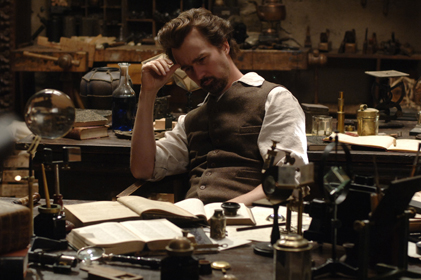
Eisenheim in his workshop
Illusions are all about making an audience believe the impossible. Magicians can accomplish this through sleight of hand, misdirection and clever technology. Innovative and deceptive designs makes the turn of the century magician a great trope of steampunkery. At left, Eisenheim (Edward Norton) is seen pondering in his workshop where this son of a cabinet-maker aspires to and achieves greatness.
Most of this romantic drama centers on the relationship of Eisenheim and his childhood love, Sophie, who is being made to marry the crown prince of Austria. The special effects are beautiful and based on magic tricks that were really performed during the 20th century.
Fun Facts and Context:
۞ The film was based on a story that appeared in a volume of short stories called The Barnum Museum (1990). This was in reference to Barnum’s American Museum, an American attraction of oddities popular in the 1840s-1860s.
۞ The tale is called Eisienheim the Illusionist by Steven Millhauser. You can read the full text here.
۞ The romantic intrigue with Jessica Biel‘s character that drives the film is completely absent from the original story. The police become interested in Eisenheim because of the disappearance of a rival magician.
۞ The film is told from the perspective of Walter Uhl (played by Paul Giamatti), a police inspector.
۞ Giamatti spends most of the film flashing back over his investigation for the benefit of Prince Leopold of Austria (played by Rufus Sewel). Leopold was not a real person, but is based on Rudolf, the crown prince of Austria who died at the age of 30 in 1889. Rudolf had a mistress who died under shadowy circumstances like the Sewel character.
۞ The filmmakers wanted to capture to beauty and awe of watching a master illusionist, so many of most impressive tricks are done with computer graphics to achieve what the Eisenheim of the original story had been able to do. But, you can see a video of a real mechanical orange tree illusion here.
۞ Edward Norton did perform many of his own sleight of hand tricks, but his hands were sometimes portrayed by his double, James Freedman.

Sophie (Biel) and Leopold (Sewel) watching Eisenheim
I’ve created a gallery below featuring images both from the turn of the century and contemporary portrayals of Steampunk magicians and illusions.
Of course, I can’t talk about The Illusionist without giving a shout out to The Prestige. I will do another sourcebook entry for The Prestige in particular, but I wanted to know from you, my readers, which movie you prefer. Weigh in below by commenting on this post and make sure to say why you picked the film you did.
PBS’ The Paradise is Chock-full of Victorian Fashion to Inspire Your Steampunk Designs


(Image from http://www.janeaustenfilmclub.blogspot.com)
One place you can always count on for period pieces and beautifully constructed costumes is the Masterpiece Theater on PBS, and The Paradise is no exception. Set in an 1870s shopping Mecca, this series is a veritable parade of inspiration for Steampunk fashion. The hats alone already have my mind whirring! And as the visionary store owner, John Moray says “how can such beautiful women ever have enough beautiful things?”
Before the Victorian era, all clothing was sewed by hand. The industrialization of the garment industry led to a growing collection of “ready-made” dresses, but the upper class ladies were slow to move away from their couture gowns. This is one of the hurtles that the staff of The Paradise must overcome, and fast-thinking shopgirl Denise is able to make the “hard sell” from the very beginning.
“This isn’t a shop. This is a kind of heaven!” cries one of their customers. Keep in mind there was no such thing as Harrod’s or Macy’s in the form we know it today until the 1890s, so the convention of a store that caters specifically to women and their buying power was all but untapped of at this time.
You can see full episodes on PBS’s website by clicking here and scrolling to the bottom of the page for Episode 1.
I Can’t Describe How Excited I Am For Lantern City- Steampunk Inspired TV Series


I was puttering on Pinterest and I found some art by Justin Yun (pictured above). I was curious to find out more and it turns out it was a piece of concept art for a new TV series, Lantern City.
The project was announced in 2012 and is set to premier in 2014. One of the creators, Bruce Boxleitner,has made a short film describing the concept. The most exciting thing about the series to me is the call to Steampunk artists, designers, artisans and enthusiasts to send in submissions and contribute directly to the show.

As a prelude to the television series, the creators have released an illustrated novel called Rise. Check out this video from Chicago’s C2E2 for a concept film about Lantern City followed by the announcement of Rise.
The only downside I can find is that when they described the overall concept, basically an alternate universe where Steampunk is the way of life, was the basis of my own novel-in-progress, Soaring Heights.
Here’s a description of the plot/history from the Lantern City website:
History of Lantern City
“Lantern City is the southern-most city in Hetra, a world parallel to Earth, and is bordered on the south by the Silver Sea and has the largest river in Hetra, the Faudnice River, running through its heart. The city was always known for its commerce, agriculture, innovation, and trade; because of its isolated geography it never developed a real military power. Lantern City was difficult to travel to by land and it had the ability to control who came in and out of its ports.
Eventually, a band of warlords from the outlands of Hetra conquered the surrounding areas leaving Lantern City as their final target. The onslaught of refugees from the other cities gave the citizens of Lantern City ample warning to protect themselves, However almost no one in Lantern City had minds for military strategy or any real combat experience. This was the perfect opportunity for soldier and entrepreneur Isaac Foster Grey to rise to power and “save” the city from the invaders. To secure the city after the battles for Lantern City’s existence, Grey had a wall built around the city and enacted isolationist policies.
Over one hundred years later, the citizens of Lantern City know little about the rest of Hetra.
Since so few citizens know anything about the history of Lantern City or anything about Hetra, a myth has replaced the actual history. Many of the working class citizens and the members of the Underground believe that a peasant named Nolvan inspired thousands to travel as far south as they could and establish a new and free place called Lantern City. It wasn’t until the Grey Empire tricked the populous and took over that the citizens weren’t free.
Many of the working class are waiting for the next Nolvan to arrive and save them from their fates.”
The cast also looks fantastic. I recognized Raphael Sbarge and Tony Amendola from Once Upon a Time, but of course John Rhys-Davies’ face was immediately familiar as well as Mira Furlan from Babylon 5.

Mira Furlan

Raphael Sbarge

John Rhys Davies

Tony Amendola
Steampunk Sourcebook- The Golden Compass


For die hard fans, His Dark Materials (known as the Golden Compass trilogy in the US), wouldn’t technically fit into the definition of Steampunk.
The series is set in the present/near future so steam power is a thing of the past and the story has nothing to do with Victorian England or an alternate history, but the parallel universe Lyra Belacqua inhabits has some decidedly Steampunk elements to it. The images in this post are all from the 2007 film release of The Golden Compass.

First, England gets “punked.” Lyra lives at Jordan College within Oxford University, which doesn’t exist in our universe. She later travels to an alternative London with dirigibles floating over head and horseless hansom cabs, apparently their answer to the automobile.
The spaces that she inhabits in while in the power of the evil Mrs. Coulter remind me a lot of the work of Alfonse Mucha (1860-1939).
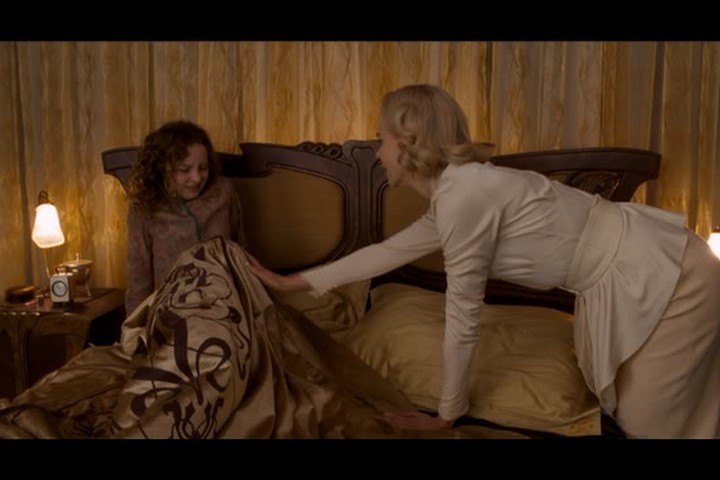

There are also so some fun alternative technologies, for instance, a projector (which they call a spirit projector) that uses glassy orbs to create 3D, moving images of of the mysterious Dust (which is basically powdered sentience). The bad guys also employ “spy flies” which are clockwork insects “with a bad spirit pinned to it” and sent to locate Lyra and her band.
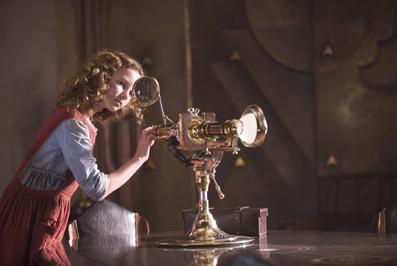

Fun Facts and Context
- The Golden Compass was originally released under the name Northern Lights.
- The trilogy explores contemporary concepts in science such as quantum entanglement (lodestone resonator), dark matter (dust is invisible without the amber spyglass even though in the Golden Compass film they depict it clearly as visible by the naked eye) and human evolution (how did we become “more” than animals? Where did sentience come from?)
- The Golden Compass film stops short of the plot of the first book. The real ending of the Golden Compass is darker and sadder, but I think they stopped where they did in hopes of continuing the trilogy and that needed a more hopeful note.
- Unfortunately, the films of The Subtle Knife and The Amber Spyglass were never made. Many people, including actors in the film, blamed the Catholic church for killing the series. I admit that I watched the movie before I read the books and I couldn’t understand why they didn’t continue and why the church would protest so much. Then I read the books and I totally get it. (Spoiler alert) Even if the story wasn’t overtly about killing god (or at least the one posing as god), there are multiple scenes of a violence against children, like in Citegazze (a city in another alternative universe), that would have been hard to stomach on the silver screen.
Adam Lambert Rocks Steampunk Finery on Glee

http://www.youtube.com/watch?v=YaJ3FLqCEQk
Mere days after I wrote my Steampunk in the Mainstream post I watched the November 7 episode of Glee (Season 5, Episode 4). Adam Lambert shows up as “Starchild,” aka Elliott Gilbert, a golden-throated vision in top hat and tails to join Kurt’s band in NYC.


 For Whom the Gear Turns