Artist Justin Rowe Makes Books Come to Life

And I thought I got really into my books! Check out these amazing book sculptures by Englander Justin Rowe. There are tons more of these on his website. He also recently had his work on display as part of the British Academy’s Literature Week.

The Kraken by Justin Rowe

Shackleton’s Antarctic Adventure by Justin Rowe

Shoot the Moon by Justin Rowe

British Academy Literary Week installation
Steampunk hits the Paralympics: Festival of Flame (2012) Gallery

The 2012 Paralympics closing ceremony featured huge metal vehicles and steamy costumes. I created a gallery of images, plus you can watch the whole closing ceremony including appearances by Rihanna and Coldplay below.

Correfoc, Barcelona 2005
The performance was called The Festival of Flame and it certainly lived up to its name. It reminded me of being in Barcelona in the fall when they have their annual festival, La Merce. I got to experience the correfoc (fire run) with some friends in 2005 and I was the only one to actually brave the sparks and make a run for it. (pictured left) La Merce has been celebrated since 1902 and features fire breathing monster floats, drumming demons and human castles 6 people high.
Festival of Flame


Want to see more steamy vehicles? Check out my vehicle gallery here!
Steampunk Sourcebook: Captain Nemo

The enigmatic Captain Nemo made his first appearance in Jules Verne’s science fiction classic, 20,000 Leagues Under the Sea (1870), which takes place in the late 1860s. Little is revealed about the mysterious figure besides his hunger for scientific knowledge and his rejection of imperialism and by extension, most of the world above the ocean. He and his dedicated crew exist “below the law” by rarely stepping foot on dry land and aiding those oppressed by imperialism. In the second novel featuring Nemo, The Mysterious Island (1874), he tells a group of castaways that he is the son of a raja named Prince Dakkar and that he lost his family in the First Indian War for Independence against the British (1857). After the death of his loved ones he goes into hiding and embarks on secret scientific research, culminating in an electric submarine called the Nautilus.
Fun Facts and Context:
۞ Nemo means “Nobody” in Latin
۞”20,000 Leagues under the sea” is often interpreted as the vertical distance down into the depth of the ocean, but it is a slight mistranslation of the french title “Vingt mille lieues sous les mers” where mers (meanings seas, plural) was translated as “sea.” It is meant to indicate the horizontal distance traveled under the water, not the depth of the water. 20,000 leagues is 6 times bigger than the diameter of the planet (each league is 4 kilometers).
۞ In the original manuscript, Nemo was a Polish noble whose family was killed in the January Uprising (1863-1865) by Russian oppressors. Fearing a blow to sales (as well as insulting France’s ally), Verne’s editor asked him to change the character and keep the details shadowy.
۞ Though he is an Indian prince in the final iteration of the novel, Nemo spent most of his formative years in Europe so he speaks with a British accent (he admits to speaking French, Latin and Gerrman as well).
۞ And though he hates the imperialist nature of European nations, the Nautilus is full of treasures from around Europe including an organ which Nemo plays masterfully. There is also a substantial library on board to feed his scientific pursuits.
۞ Nemo has a brief appearance in one more of Verne’s works, a play called Journey Through the Impossible. The play was not published until 1981 after a handwritten copy was discovered in 1978. The first English translation was completed in 2003.
۞ There was a real submarine called the Nautilus, which was designed by an American inventor living in France named Richard Fulton. It was developed in the late 1700s and was powered by a hand crank.
Captain Nemo has appeared in various adaptations of Verne’s novels, but few of these belong in the Steampunk canon. For instance, the 1954 film adaptation is heavily influenced by the style and politics of the era, and some important details are changed (for instance, the Nautilus runs on nuclear power rather than electricity). You can find a full list of Captain Nemo’s appearances here, but for the sake of this post I am focusing on the versions of Nemo that fit firmly into Steampunk.
For instance, Alan Moore’s graphic novels (and the film adaptation) featuring The League of Extraordinary Gentlemen. In this series, Nemo is much more callous, even bloodthirsty, than the original character. Verne’s Nemo saved whales, Moore’s Nemo mows down people with machine guns (Volume 1).
Captain Nemo also appears in The Other Log of Phileas Fogg, a 1973 novel by Philip Jose Farmer. If you haven’t guessed it, this is a crossover novel that takes place in the world of Around the World in 80 Days but incorporates (or rather co-opts) characters from other novels like Sir Arthur Conan Doyle’s Sherlock Holmes series. In Farmer’s account, Captain Nemo is better known in some circles at Professor Moriarty.
Kevin J. Anderson rewrites Captain Nemo’s history (and brings a childhood spent with Jules Verne into the mix) in his novel, Captain Nemo: The Fantastic History of a Dark Genius (2002).
Check out my gallery below for various versions of this Victorian antihero and other steamy sea captains.


Dystopian Metal: The Art of Greg Brotherton
-

- Watchtower
-

- 3 Wheeled Horn
-

- Into the Void
-

- Mercury 5000- It reminds me of Abraham Sapiens from Hellboy
-

- Migraine Machine
-

- Oracle
-

- Search Engine
-

- Sounding the Furnace
-

- The Lift
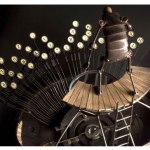
Metal is one of the most satisfying mediums I have ever worked with and I hope to get a chance to do more in the future. But even if I never do, I will always love metal art. The strength and flexibility of the material means an artist is really only constrained by the bounds of their imaginations (okay, and sometimes their tools). I really enjoyed these metal men and the world I imagine them inhabiting, especially the “search engine” and the “observatory.”
You can find more of Greg Brotherton’s artwork (including many different angles of the pieces I chose for my post), as well as pictures from his studio here.
I always like to hear about people from the Midwest finding success, and it looks like Greg is one of those people. Here’s his bio:
“Born in Ames, Iowa, in 1968, Greg experienced a somewhat nomadic childhood, spending the majority of his youth in Utah and Colorado. His interest in the mechanical surfaced at age five, when he began disassembling anything with screws in it. By the age of twelve he had taught himself to mine his backyard with homemade explosives (no injuries!). Then, after being successfully ejected from a series of public and private learning institutions, Greg, equivalency test in hand, entered the Colorado Academy of Art, beginning his undergraduate studies at sixteen.
In 1987, after receiving a degree in graphic design, Greg set off for California. Over the next two decades, he forged a successful career as an award-winning commercial artist, while honing his skills as a sculptor.
With a consuming drive to build things that often escalate in complexity as they take shape, Greg’s work is compulsive. Working with hammer-formed steel and re-purposed objects, his themes tend to be mythological in nature, revealed through a dystopian view of pop culture.
Greg’s work has received international recognition, has been exhibited throughout the United States and is collected worldwide. In 2007, he was invited to serve as the featured artist at the Technology, Entertainment and Design (TED)Conference in Monterey, California, joining the ranks of some of the most prestigious artists, luminaries, and scientists of our time. He currently resides in Los Angeles, California, where he continues to sculpt and experiment.”
Gingersnap Creations: Valerie Brincheck


Gingersnap Creations: July Muse Showcase: Valerie Brincheck.
Mood Swings: Bob Dylan’s New Art Exhibit “Swings” Towards Steampunk

As if “Bobby D” couldn’t get any awesomer, it turns out he has a new exhibit opening today at London’s Halcyon Gallery. The photos of his studio made me absolutely drool over his shelves of scrap metal bounty. His show centers on gates made of scrap gears, and he had this to say about his inspiration:
“Gates appeal to me because of the negative space they allow. They can be closed but at the time they allow the seasons and breezes to enter and flow. They can shut you out or shut you in. In some ways, there is no difference.”

Bob Dylan in his studio (source: Gizmodo)
I noticed a comment on the Gizmodo article lamenting the application of the label Steampunk to his work because Dylan uses steel instead of cast iron. Does that mean that clothes containing lycra can’t be Steampunk? Or that “real” Steampunk makeup would include zinc oxide powder even though its poisonous? Steampunk is an aesthetic that often (though obviously not always) includes the appearance and outlines of clockwork, not unlike Dylan’s exhibition Mood Swings.

Bob Dylan in his studio (source: Gizmodo)
Source: http://gizmodo.com/hey-did-you-know-bob-dylan-is-a-steampunk-metalworker-1462363371
I Can’t Describe How Excited I Am For Lantern City- Steampunk Inspired TV Series


I was puttering on Pinterest and I found some art by Justin Yun (pictured above). I was curious to find out more and it turns out it was a piece of concept art for a new TV series, Lantern City.
The project was announced in 2012 and is set to premier in 2014. One of the creators, Bruce Boxleitner,has made a short film describing the concept. The most exciting thing about the series to me is the call to Steampunk artists, designers, artisans and enthusiasts to send in submissions and contribute directly to the show.

As a prelude to the television series, the creators have released an illustrated novel called Rise. Check out this video from Chicago’s C2E2 for a concept film about Lantern City followed by the announcement of Rise.
The only downside I can find is that when they described the overall concept, basically an alternate universe where Steampunk is the way of life, was the basis of my own novel-in-progress, Soaring Heights.
Here’s a description of the plot/history from the Lantern City website:
History of Lantern City
“Lantern City is the southern-most city in Hetra, a world parallel to Earth, and is bordered on the south by the Silver Sea and has the largest river in Hetra, the Faudnice River, running through its heart. The city was always known for its commerce, agriculture, innovation, and trade; because of its isolated geography it never developed a real military power. Lantern City was difficult to travel to by land and it had the ability to control who came in and out of its ports.
Eventually, a band of warlords from the outlands of Hetra conquered the surrounding areas leaving Lantern City as their final target. The onslaught of refugees from the other cities gave the citizens of Lantern City ample warning to protect themselves, However almost no one in Lantern City had minds for military strategy or any real combat experience. This was the perfect opportunity for soldier and entrepreneur Isaac Foster Grey to rise to power and “save” the city from the invaders. To secure the city after the battles for Lantern City’s existence, Grey had a wall built around the city and enacted isolationist policies.
Over one hundred years later, the citizens of Lantern City know little about the rest of Hetra.
Since so few citizens know anything about the history of Lantern City or anything about Hetra, a myth has replaced the actual history. Many of the working class citizens and the members of the Underground believe that a peasant named Nolvan inspired thousands to travel as far south as they could and establish a new and free place called Lantern City. It wasn’t until the Grey Empire tricked the populous and took over that the citizens weren’t free.
Many of the working class are waiting for the next Nolvan to arrive and save them from their fates.”
The cast also looks fantastic. I recognized Raphael Sbarge and Tony Amendola from Once Upon a Time, but of course John Rhys-Davies’ face was immediately familiar as well as Mira Furlan from Babylon 5.

Mira Furlan

Raphael Sbarge

John Rhys Davies

Tony Amendola
PBS’ Off Book Takes a Closer Look @ Steampunk

 You have to sign in via Facebook or Google to see this amazing video series by PBS, but then you have access to all 45 windows into the media and how it influences our culture. I also really enjoyed their piece on how fandom and fan fiction are a dialog with society.


 For Whom the Gear Turns