The Spitalfields Nippers

A link to a Daily Mail Online article about a set of photographs that were taken in the decades surrounding 1900 showing the heartbreaking state of the children of the poor inhabitants of Spitalfields in East London. The photographer was Horace Warner, a Quaker working in the East End to fight poverty and hunger. Some of his photographs were used to highlight the plight of the poor; most were stored away until now.
 Adelaide Springett was so ashamed of her tattered boots, she took them off for this 1901 photograph. Source: Daily Mail website (link above).
Those of us enamored by the Victorian Period or its revival movement, Steampunk, often forget that it was not all tea parties and polished brass doorknobs. Not everyone had a country manor or took the “Grand Tour” through Europe to finish one’s education. The orphanages and workhouses were full, and not with the happy…
View original post 47 more words


Abraham Lincoln: Vampire Hunter (2012) May be Full of the Fangs, But it Sure Doesn’t “Suck”

 Maybe witches aren’t your thing, so you won’t be seeing Hansel and Gretel as part of your Steampunk Halloween. But everyone likes vampires, right? In 2010, author Seth Grahame-Smith penned an alternate history featuring America’s favorite president and pitted him against the forces of darkness running rampant in the South. It was made into an insanely good action movie in 2012 and it is another awesome choice for any steam-inspired monster movie marathon.
 Abe’s (Benjamin Walker) sojourn into the vampiric underworld starts when he is a child, though he doesn’t know it. His mother falls victim to a mysterious disease as a result of his father standing up to the unfair treatment of free black people under his boss, Jack Barts (Marton Csokas). Even as a child he knows that Barts is somehow behind his mother’s death, and once he is grown he tries to take his revenge. To his shock, his bullets have no affect on Barts and Abe has to be rescued by a stranger whom he just met in the bar. The man calls himself Henry (Dominic Cooper) and tells Lincoln about how vampires escaped persecution in Europe to the American South, where they are deeply involved in the slave trade as their source of food.
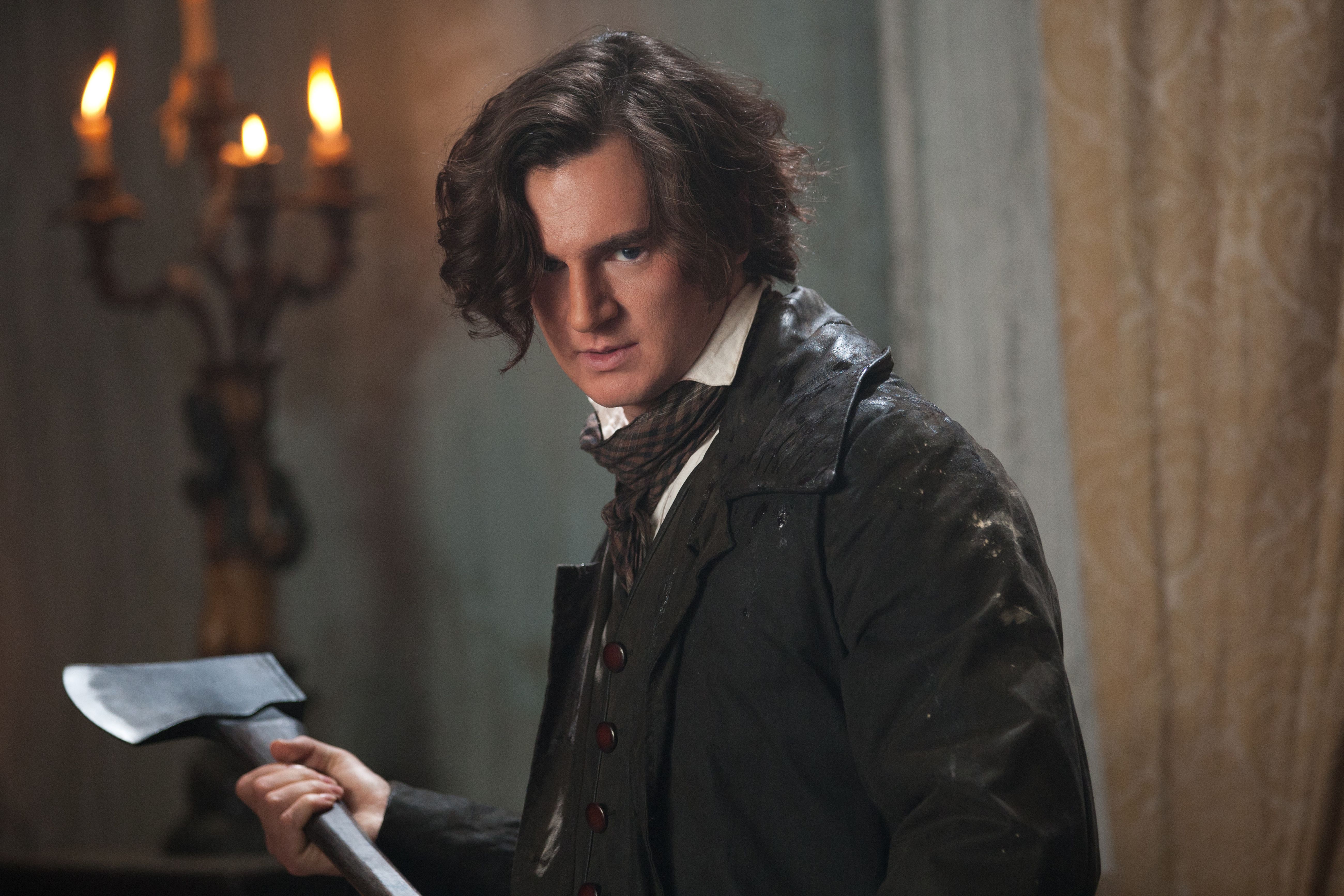 Abe is only interested in his own vendetta, but agrees to be a vampire hunter under Henry’s guidance in order to gain the skills he needs to finally take down Barts. After hunting a series of vampires one by one, Lincoln decides he can make a much bigger difference in the world as a politician than by wielding his special silver-bladed axe, and his life takes the shape of the history we know for a while, including his marriage to Mary Todd (Mary Elizabeth Winstead), presidential election and the outbreak of the Civil War. But when the Southern politicians ally themselves with the vampires, the unkillable soldiers start to tip the scales towards a Southern victory, and Abe must confront them and the mastermind of their ascent to power (Rufus Sewell).
Whether or not you know anything about the real Abraham Lincoln, this is a really fun and entertaining film. The effects are very special, the lighting and camera work are Gothic and moody and the action scenes are dynamic and sometimes even breath-taking. This was a much better film than I expected just based on the premise, and as it turns out the author did a great job of integrating vampire lore into the politics of the mid-19th century and documented historical events. Plus, it is a great action film. There is a fight scene that takes place during a stampede of horses, and a struggle on a speeding train that will keep you on the edge of your seat. It does not have the same ratio of dark comedy to action as Van Helsing or Brothers Grimm, but there are still some good lines and ironic twists that will make you smile. I haven’t read the book, but I really enjoyed this movie and I will definitely be re-watching it to bring some “spook” to my “steam” again this year.
Tips for Makers: You Can Fake it When you Make it Part 3, “Plastic is Your Pal”

Plastic is an incredibly versatile material and it is everywhere. With a little ingenuity and elbow grease you can make it into just about anything.
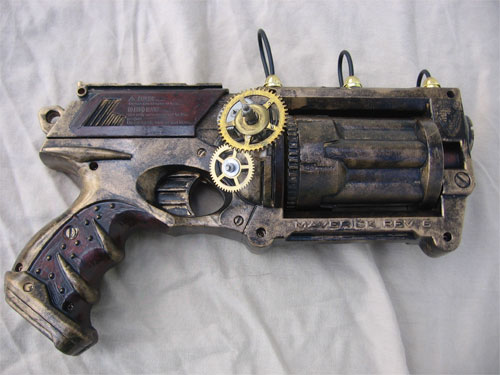 First off, there are toys. At any Steampunk cosplay event you can be sure you will see souped up Nerf guns and squirt guns that look like they walked right out of an H. G. Wells story. But keep in mind that if you want to paint a plastic gun that spray paint will chip over time. If you scour your plastic surface ahead of time with steel wool, sand paper or even a kitchen scouring pad you will create pores for the paint to adhere to and it will last much longer. Kinex is a line of plastic engineering toys so it is a great way to get lightweight and cheap plastic gears that you can paint to look like metal.
At the Form and Function session at The Asylum one of my favorite items was a remote-control Dalek toy that a maker Steampunked by adding metallic paint and little makeshift boiler on the back.

Major Quicksilver Power Glove
Plastic pipes like the ones you can find at the hardware store are also really useful. Just like plastic guns, they need to be roughed up before you paint them, but they are relatively easy to drill into with a small electric drill so they are easy to embellish. Major Quicksilver had an amazing “power glove” that he built by attaching a leather work glove to the interior so the fingers were flexible even though the gauntlet was rigid. It was enhanced by flexible plastic tubing and a leather strap that attaches to the upper arm.
You can also get the look of rivets without having to use real metal. If you search for “half pearls” on eBay you can find these great little half-spheres that look just like metal rivets, sometimes without having to paint them. The Major warns that you can find one with adhesive on the backs, but they are much more expensive than getting the kind you glue on yourself. And if you are attaching them to EVA foam hot glue will hold them on really well. An audience member also mentioned that dried peas or lentils can also do for rivets in a pinch, as long as you don’t mind a little irregularity in the shape.

Quicksilver flexible hand
Another great use for plastic is if you have to make something hinged. Sure, you can use real metal hinges that require screws but if you want a quick and easy hinge you can just cut plastic packaging like the top from a butter tub or the like into strips. Attach one end of each strip to the pieces you want to hinge and you will have a flexible and lightweight connection. The amazing giant hand at right had metal hinges on one side and plastic on the other. He was able to manipulate the fingers by pulling strings attached to a leather glove on the other side. In case you are thinking of doing something similar, he let us know that the thumb was the most difficult part to get to move, so he used his pinky finger instead, ergo the three-fingered hand.
The good Major also told the crowd all about a wonderful malleable plastic called polymorph. It comes in the form of little beads and you can melt them in boiling water on your stove. After they become gel-like and come together in a glob you have about 5 minutes to mold it into any shape you want. And if you don’t like the result you can just put it back into the hot water and start again. Of course, you have to be careful about burning yourself when you take the polymorph out, so if you use something like welders gloves it will protect your hands. It usually comes as a transparent plastic, but you can add dyes or paint it later. Once it is solid it is a great material to drill into or file.
If you want an antiqued look to your paint jobs you can use a dry brushing technique. This is done as the second layer to add a bit of a weathered look to your surfaces. For instance, if you are trying to get the look of copper armor that has begun to oxidize, you should start with a solid layer of copper paint before you add the touch of turquoise to make it look tarnished. To dry-brush, add a glob of paint to your brush (this is a good use for old brushes) and remove most of the paint on a newspaper, magazine, etc. Even if you remove most of the paint there will still be just a bit left on the bristles, and you can apply this to your finished project.
Do you have any suggestions for working with plastic? Please comment below!
For more tips about creatively cutting corners, you can check out parts 1 and 2 of this series.
Lindsey Stirling Rocks it Steampunk Style in her New Video

Lindsey Stirling is my favorite artist to listen to while I am working on my Steampunk-inspired novel, and she just came out with a new (and totally amaze-balls) “Steam Western” video a few days ago. Sit back and enjoy!
Tips for Makers: You Can Fake it When you Make it Part 2, “Foam is Your Friend”


Quicksilver’s table-o-goodies
During the “Creating with Quicksilver” session, the Major couldn’t say enough good things about a material called Ethylene Vinyl Acetate (EVA) foam. My only experience with it has been with bedrolls and yoga mats, but he demonstrated several ways to use it when you are constructing costumes.
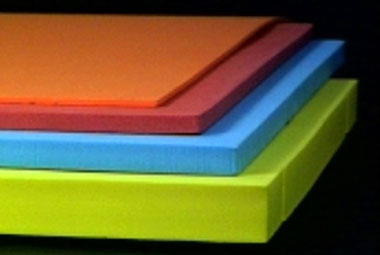 EVA foam comes and many different colors and thicknesses. There are floor mats that are popular for kids to play on and these often have texture on one side which can add interest. Unlike many plastics, this foam also readily takes to hot glue without extra treatment. It is easy to draw on it with permanent markers, and can be cut with scissors or for more accuracy, a craft knife. It will dull your blade pretty quickly, though, so if you plan to make repeated cuts it is a good idea to invest in a craft knife that allows you the change out the blade easily.
If you do end up with rough edges you have a couple options. You can use something like a Dremel or other electric tool to grind them down, but it will be very messy when the foam starts flying. Major Quicksilver advises running the blunt side of a scissors across any rough parts to smooth it down without the mess.
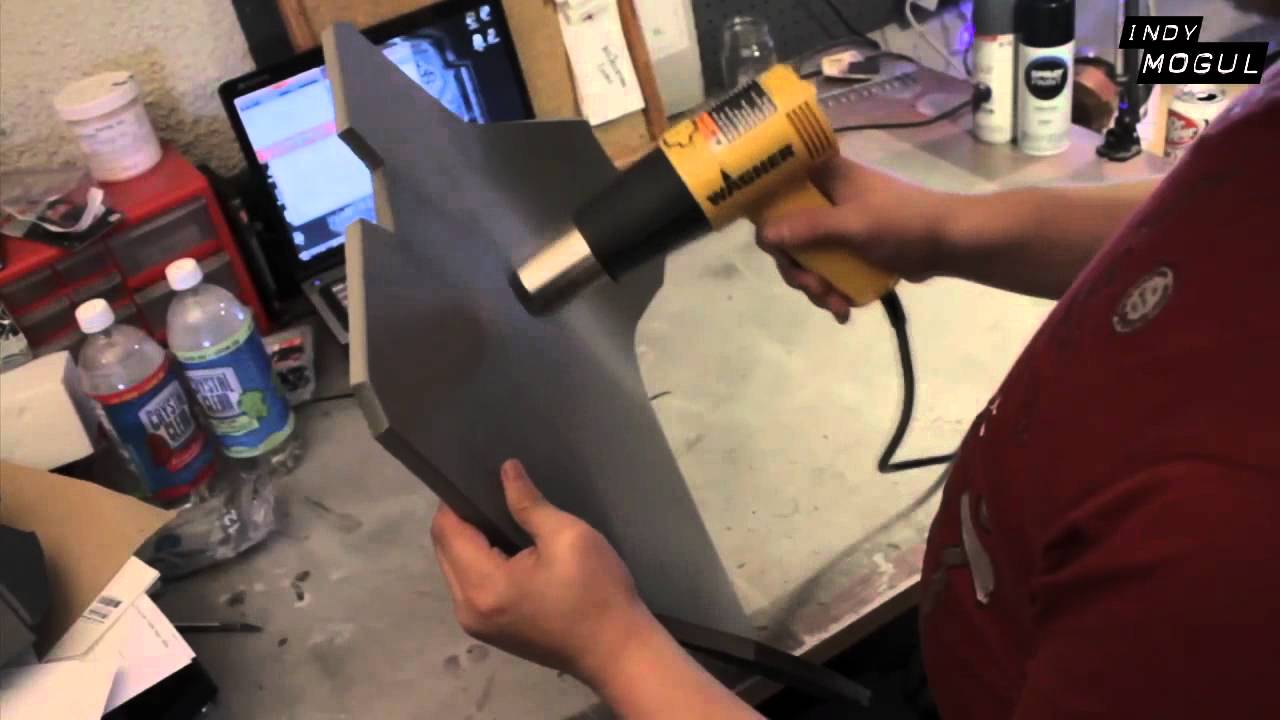 EVA is especially good for things like armor that need to look heavy and sturdy but you don’t want to weigh you down. There are tons of patterns out there on the web for different kinds of armor, and the foam is great for layering so you can add bulk to your character easily. It is also easy to mold when heated with a heat gun, or even a hairdryer and holds it shape like a dream.
There are some foams, like polystyrene, which are even lighter and readily available, but be advised that there is often a chemical reaction with certain paints that can actually melt the foam. It would be a shame to build a whole suit of armor just to have it disintegrate while you are adding the finishing touches! EVA, on the other hand, is great for painting, especially with spray paint. But beware that the more a part of your project has to bend the more likely it is that your paint job could crack and flake.
Here are a few Steampunk examples I found on the web to inspire your own creations.


Tips for Makers: You Can Fake it When You Make it Part 1, “Gathering Resources”
I hope you have been enjoying my Tips for Makers series based on the sessions at the Weekend at the Asylum festival so far. “Taming Metal” parts 1, 2, 3 and 4, were for the people who want to use real metal in their props, costumes and gadgets, but that’s not for everyone. Sometimes you want things to look a certain way but you don’t have the time, materials or skills to make it happen. And there is no shame in cutting corners or substituting one thing for another. I know some people are all about the “authenticity” but Steampunk should be a bit of silly fun and lack of know-how shouldn’t keep you from trying your hand at making something cool.
I went to a session hosted by “Major Quicksilver” during my great weekend in Lincoln and he had tons of advice about materials and how to get them at an affordable rate. The most important thing he told the audience was if you see something, buy it right then and there. Don’t wait for a project to start gathering materials, because chances are when you go back to get something it will be gone, or it will have gone up in price. I have been moving around a lot in the last few years so I have been holding off from gathering too much myself, and I can’t wait until I get settled enough to amass the craft room of my dreams.

“Sky “Shadowbox by ForWhomTheGearTurns
But even with my space restriction I can’t help myself from going into overstock and scrap store I come to, and I usually leave with at least one treasure. It may take years before I use it, but whenever I start a new project I take infinite pleasure in going through my materials and rediscovering things that will enhance my work. For instance, I started collecting pieces of chandeliers because they were crystaline and shiny. Then I discovered if you turn them upside down they make wicked mini hot air balloons. Some of the scrapbook paper in this piece were from the first pad I ever bought years ago.
There are lots of random things around your house that can be put to new uses. Pill bottles, for instance, can hold tiny things like beads or screws, and the covers can be used as knobs or dials on a jet pack or ray gun. I made a pair of aviator goggles for my toy poodle and I used the caps from pill bottles as the makeshift lenses. He was never going to let me put goggles on him for real, so it didn’t matter if they were functioning. Unfortunately he and the goggles are back stateside or I’d post a photo, so you’ll just have to take my word for it that they are adorable.
Want to add a little brass? The wire used for hanging framed art comes in a brassy color and you can get it for pretty cheap. There are also a lot of old cameras and other gizmos at your local thrift store just waiting for you to take them apart and find all the goodies inside. Drawer pulls which can do double duty as various cosmetic adornments and come in lots of shapes, sizes and finishes and there are often bucketloads of these are scrap yards.
So get on out there and start gathering your resources, you never know when a project will come up!
Here are a few places where I get my arts and crafts supplies. (Sorry UKers, I mostly make and therefore shop in the US).
Ax-Man (4 locations in MN)- hands down the best place to get random mechanical parts that actually function, or just look cool. Glass bottles and beakers, circuit boards, switches, leather scraps, magnets, you name it, they have it and it is SUPER cheap.
ArtScraps (St. Paul, MN)- When I got married I made my own wedding invites by getting cheap art prints and cutting them down to size. They have stamps, fasteners and bulk randomness, plus classes and birthday parties for kids.
The Scrap Box (Ann Arbor Michigan)- This is where I got all those pretty chandelier dangles that I use in my shadowboxes. There is a back room where they charge you by weight so you just go in, load up a grocery bag and it may cost you $5 for a full one.
Scrap Creative Re-Use Center (San Franciso, CA)- This is advertised as a great place for teachers to come and get supplies for their classes. In addition to overstock and bulk goodies, there are magnets, wooden blocks and whiteboards.
Urban Ore– This is a pretty hardcore scrapyard with lots of doors, furniture, marble tiles and other home
Do you have and advice about where to find cool and useful stuff? Please comment below!
Spiritualism: a Haunting Pastime
Whenever I explain Steampunk to the uninitiated I always find that I have to say, “oh yeah, and also…” at least 4 times to try to encompass everything the genre/aesthetic can cover. I can always get them on board when I go from Jules Verne to punking technology, but then I have to back up and include all of the supernatural creatures that also make regular appearances in Steampunk literature and I often get raised eyebrows in response. But if you know the time period, ghosts, ghouls and other things that go bump in the night fit in directly with the trends of the era.
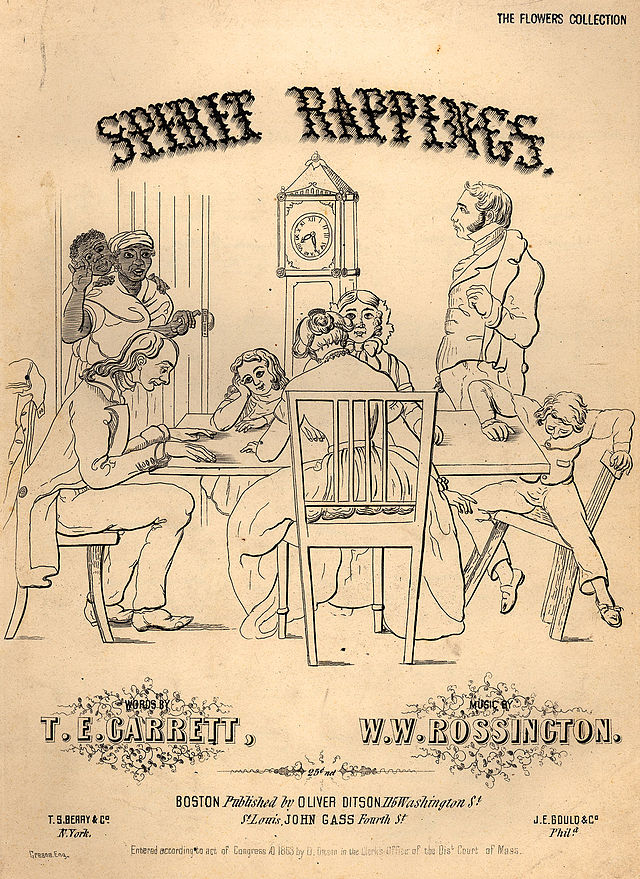 Ghost stories appear in the folklore of countries all over the world, but ghosts as we think of them today in America and the UK where the majority of Steampunk stories occur have their roots in Spiritualism. Some people treated Spiritualism like a religion, and others viewed it more as a science but either way it is based on the belief that spirits are hanging around waiting to have conversations with the living, and they do so by knocking on tables, moving around objects, and occasionally even taking mediums clothes off. They speak through people who claim a supernatural ability or through the use of hypnotized volunteers (and very rarely say “wooooOOOOoooo”). I learned most of what I know about the Spiritualist movement from a wonderful and funny book by my favorite non-fiction writer and former Wired magazine columnist, Mary Roach. She has written several books worth reading, but for the skinny on communicating (or pretending to communicate) with the dead, you must read Spook: Science Tackles the Afterlife.
Many notable historical Brits like Sir Arthur Conan Doyle and Queen Vicky herself were taken in by the “evidence” of spirits among us. But, most folks point to a happening in New York in 1848 where two sisters supposedly contacted a ghost as the beginning. Four years later, mediums started popping up in England and conducting seances. By the late Victorian period many people claimed to have communicated with the dead, and women dominated the medium business. In a time when class division and a clearly patriarchal society predominated, Spiritualism was movement that crossed these boundaries and brought people from all walks of life into its fold. There were even pamphlets, newspapers and public spectacles for the spiritually-inclined during the 1860s.
One popular thing to do during private parlor sessions was to contact famous people, and Charles Dickens (who died in 1870) was one of the most popular spirits to contact. In addition to speaking through the mouths of mediums, ghosts would sometimes also use a typewriter or the like to pen a message from the beyond. Dickens died before he finished his last novel, and in 1873 an American author claimed to have been contacted by his spirit who dictated the ending of the novel. I wonder if this is the origin of the term “ghost writer?”
Ever heard of ectoplasm? Think of the goo left behind by Slimer from the Ghostbusters. Some folks believed that ghosts could leave a trail of the stuff, or that mediums would extrude it as evidence of spirit possession. Ewwwwww.
For more fun facts about this “spirited” movement, check out the articles on Victoria Web.


 For Whom the Gear Turns