Steampunk Short: The Mysterious Geographic Explorations of Jasper Morello
This hauntingly beautiful sojourn to an island in the sky is not for the fainthearted. It tells the tale of Jasper Morello, who embarks on an airship expedition and finds himself an unwilling cog in a mad scientist’s plot. It was directed by Anthony Lucas.
Steamboy (2004) is an Epic Steampunk Adventure out of Japan


When I first ran across a description for a manga Steampunk movie I admit that I was skeptical. But, I am so glad that I got it through Netflix and gave it a shot because it was incredible!
 The director, Katsuhiro Otomo, is best known for his cyberpunk directorial debut Akira in 1988. I have a great respect for graphic artists and animators, and the creators of this film lend all of the attention to detail and breath-taking beauty to the Victorian era as you could hope for. The settings are primarily the Crystal Palace of the Great Exhibition in London and inside an enormous “steam castle” and they have been rendered with incredible detail.
Otomo takes a few liberties with those pesky historical facts, but you can’t go letting the facts get in the way of a good story 🙂 For instance, Steamboy takes place in 1866, but the Great Exhibition took place in 1851. Likewise you get to see the Tower Bridge totally destroyed, but it was not built until 1894. I recommend you just chalk it up to being an alternative Victorian era and enjoy the ride.
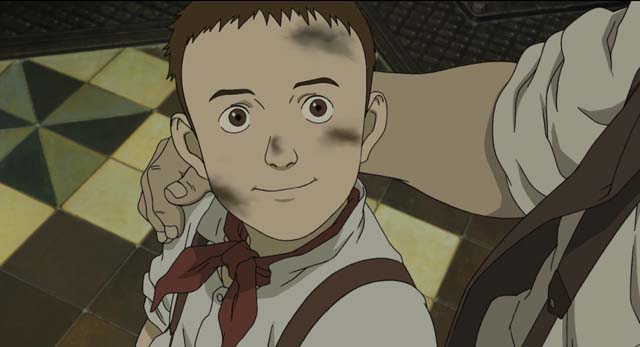 The story centers around a young boy named Ray Steam. He comes from family of talented inventors and has inherited their knack for tinkering. His father, Edward Steam and Grandfather, Lloyd Steam, have been gone for some time working on their inventions, but Ray’s world is turned upside down when his Grandfather sends him a mysterious package with instructions to protect the contents at all costs. Soon after it arrives, representatives of O’Hara Foundation (the wealthy and powerful company that sponsors his family’s work) appear and try to steal it from him. Grandpa Steam gets to Ray in time to tell him of his father’s death and to help him escape the clutches of the O’Hara cronies.

Monowheel from Steamboy
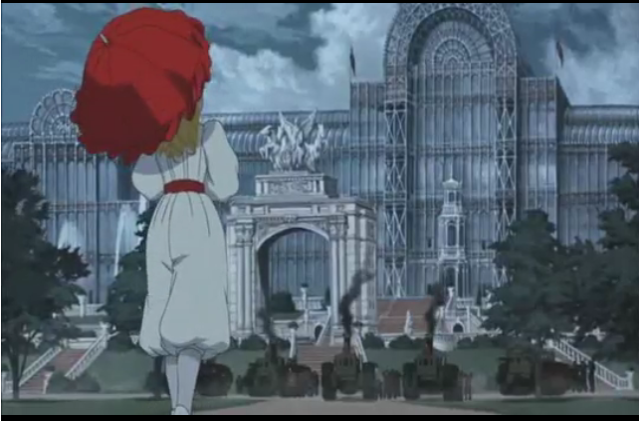 The letter from Grandpa Steam tells Ray to get the steam ball to another inventor, Robert Stephenson. By happy coincidence, Stephenson was on his way to see Ray’s grandfather so he was on the train Ray uses to escape the agents of the O’Hara Foundation. Or, at least that is what they think. But, as the train pulls into the station in London a zeppelin descends and the henchmen use a huge metal arm to capture Ray and take the steam ball to their headquarters at the Crystal Palace. When Ray arrives he finds out that his grandfather lied and his father is still alive and the steam ball is an integral part of a colossal steam-powered castle that is hidden within the walls of the Palace itself.
For a while, Ray works side by side with his father and meets Scarlett, the incredibly spoiled granddaughter of the O’Hara Foundation’s found. Unbeknownst to Ray, his grandfather is being held prisoner inside the steam castle, but he manages to escape. Ray finds him attempting to sabotage the steam castle because he knows its true and nefarious purpose. Ray has to decide where his loyalties lie and whether he is will to be just another cog in his father’s machine.


In case you couldn’t tell, I loved this movie. And don’t give me any of that “I don’t DO anime” or “cartoons are for kids,” because this film can totally stand up against any Hollywood blockbuster simply because it is animated. Illustrators and animators have the freedom to make anything they can imagine actually appear, and the massive scale of this movie would hardly be possible any other way. And never fear, just because it is a Japanese movie doesn’t mean you are doomed to subtitles. Just make sure to change the language setting on the DVD and you can watch the whole thing dubbed in English.
Steampunk Book Review: Morlock Night
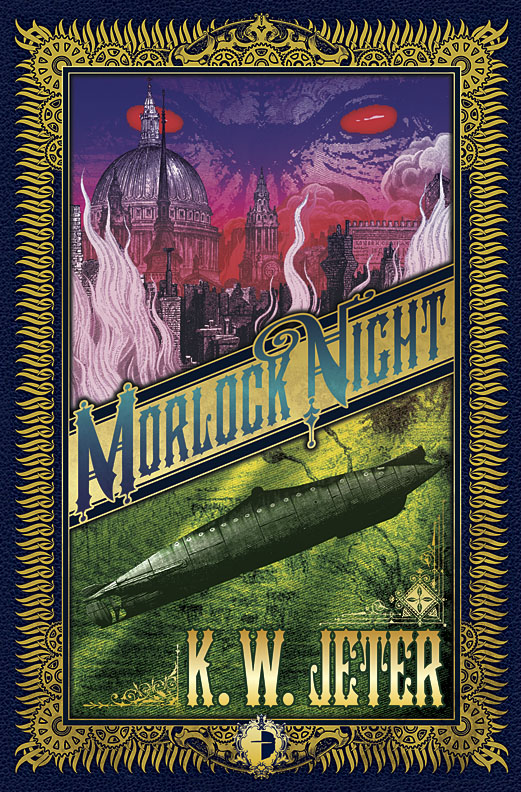
Morlock Night cover art
In case you weren’t already aware, K. W. Jeter was the first person to put the word Steampunk into print. You can find out more about that story here.
Morlock Night was released in 1979 and asks the question “What happened after the events of The Time Machine?” H. G. Wells’ classic tale is told through the vehicle of a dinner party being held by a man known only as “the time traveler.” Jeter’s story picks up right as the party has broken up for the night and the guests are wending their dreary ways home through the London fog.
One of the guests, a Mr. Edwin Hocker, shares his walk and his skepticism with another guest, the mysterious Dr. Ambrose. Hocker is appalled by the turn their conversation takes and finally extricates himself from Ambrose’s company only to be thrown into a nightmare version of his beloved London far in the future. In this world he is confronted by a scenario where the Morlocks, our subterranean future selves, have taken control of the time machine and have invaded the year 1892.
Thankfully this future can still be prevented, and with the guidance of Ambrose, who by the way is the wizard Merlin, Hocker and his compatriot from the future, Tafe, are sent on a series of quests. First, the reincarnation of King Arthur needs to be found and freed from Merlin’s nemesis, Merdenne. But the aging king is in failing health, a condition that can only be stopped by the magical sword Excalibur, the power of which has been diminished through the machinations of Merdenne and his use of the Time Machine.
But even more dire than the ensuing Morlock invasion is the rift in time itself, which is slowly undoing the universe. If Hocker cannot succeed all is lost for not just the human race, but the entirety of existence.
I always enjoy a story with imagination, and Morlock Night certainly fits the bill. Jeter constructs a story that includes Arthurian folklore, Atlantian technology and the time travel paradox that is seen through the eyes of a Victorian gentleman. There was a lot of flag waving for England, but many of Hocker’s biases about class and gender are confronted and changed, which adds the weight of social commentary to a fun story. The combination of disparate elements such as the Morlocks and a submarine stolen from the former residents of Atlantis reminds me of epic tales like Verne’s Mysterious Island, so as long as you go in expecting to suspend your disbelief Morlock Night has a lot to offer.
But, a bit of criticism about the ending. I had already guessed the twist so I was gearing up for an epic climax and was disappointed. The final good vs. evil happens in only a few pages. It felt like Jeter was under deadline or something and just had to wrap it up quick. I am reading his other two steampunk books, Infernal Devices and Fiendish Schemes, and I hope they get to come fully to fruition.
For a complete list of K.W. Jeter’s works, click here.
Neo-Victoriana at Hom Furniture

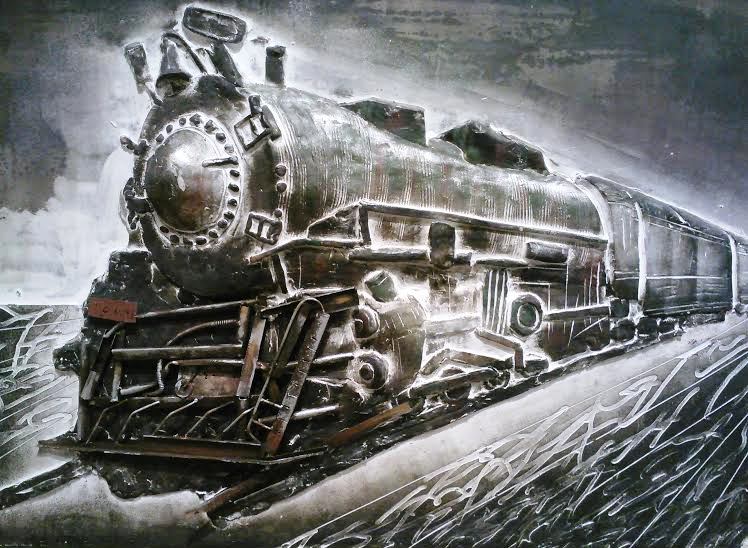
 My parents just bought a townhouse so my mom wanted some help shopping and I was happy to oblige. We went to Hom Furniture and I found a surprising amount of decor that could be considered Neo-Victorian or Steampunk. I took some pictures on my phone of my favorite items. This particular Hom store also had a pseudo-balcony that was lined with cupboards that looked like library shelves so it helped at to the Steampunk feeling due to all the books in the interior design.
This table below and the side table set above really caught my eye.

But most of what I found was wall art like the pieces below.





Victorian Fairy Spotters


Victorian Fairy Spotters by James M. Bordeau
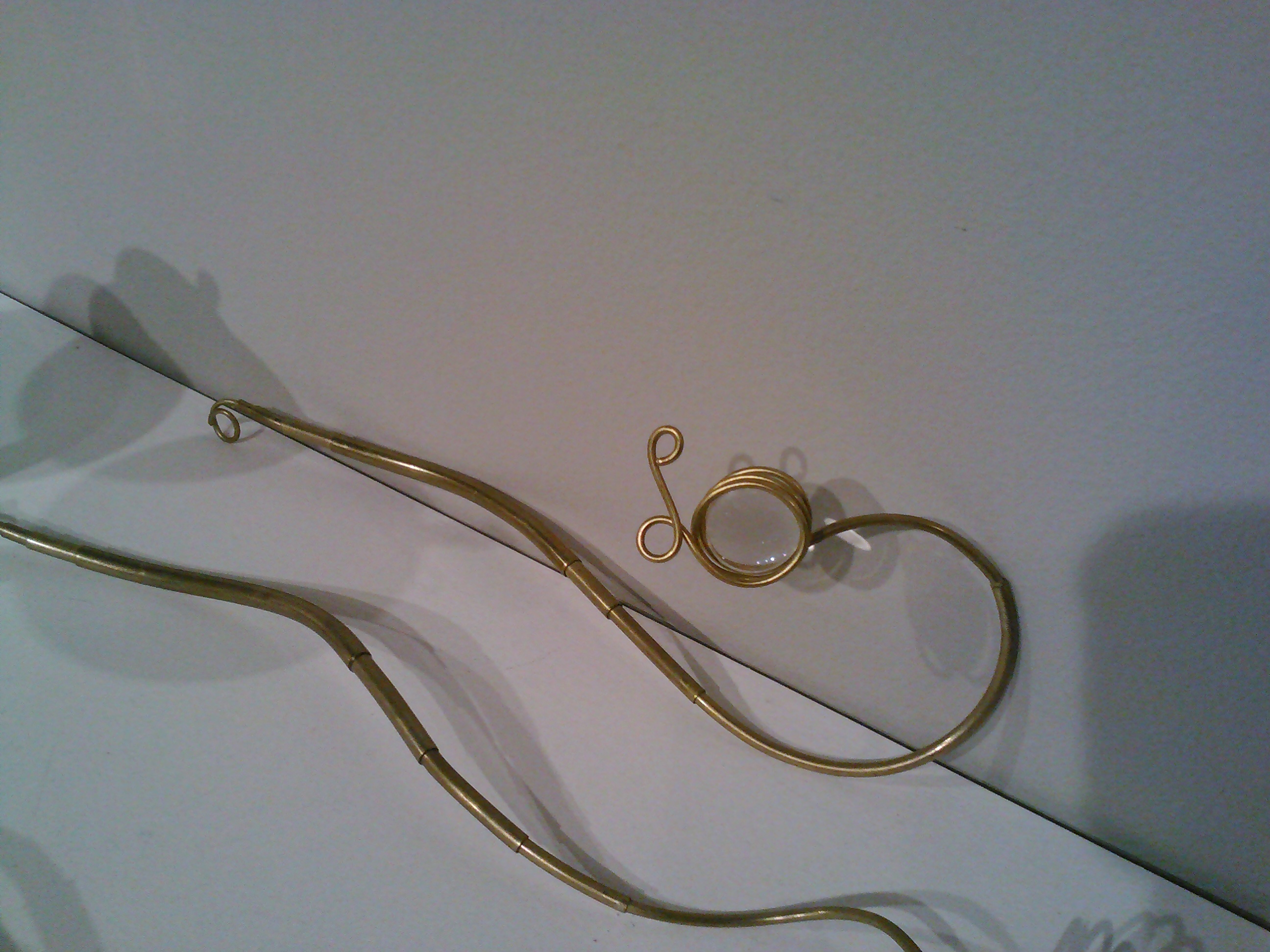
by James M. Bordeau
I was strolling around downtown Ann Arbor, MI yesterday and I ran across a series of whimsical and beautiful pieces by James (Jim) M. Bordeau in the WSG gallery on Main Street. He has created several brass and glass contraptions which he calls “Victorian Fairy Spotters,” as well as one “Steampunk Wand” (the curly one in the corner). I love the notion of a special tool just for finding fairies, and it made me think of one of my all time favorite books, Lady Cottington’s Pressed Fairy Book. I would have loved to handle them but it was an art gallery, not a store, so I resisted the urge to touch. The lighting made it difficult to take photos of the ones lying flat without casting shadows so I could only get a detail of the one above. The spotters were between approximately 8-14 inches in length. I haven’t been able to find much more information about the artist, but there is a very limited profile here.
Mad scientists, airships and class: the politics of Steampunk by Rjurik Davidson
Rjurik Davidson is an author who tackled this topic in 2012 an Australian magazine called Overland. I ended up reading this one because it was listed on Cate Russel-Cole‘s Steampunk Inspiration and How-To for Writers as “a controversial article by people who just don’t get the concept of fantasy” and I absolutely agree with that as an assessment of the literary critics quoted by Davidson, but not of Davidson himself. (Though I don’t agree with Davidson that Steampunk has reached its zenith and is in decline.)
I’ve included the first few paragraphs and a link to the main article below. I’d love to hear what people think of the article, so please come and report back by commenting on this post.
“The subgenre of Steampunk – that subgenre of speculative fiction set in a fantastical Victorian era filled with airships, mad scientists and mechanical replicas of people or animals – may well have reached its zenith. With the new Sherlock Holmes movies, The Golden Compass or Scorsese’s Hugo, it seems possible that the initial burst of zest and inspiration will now settle into a more subtle ticking over of novels and films as the subgenre colonises the cultural spaces still open to it (Heart of Darkness steampunk? Opium-war Steampunk?).
For some time a debate has been raging about the politics of the subgenre.
For some, Steampunk is a reactionary nostalgia for past that never happened. In a review last year, author and critic Adam Roberts claimed that Steampunk is a perfect example of Jameson’s claim that the culture of postmodernism means a loss of any sense of historicity. For Roberts, Steampunk is ‘a studied dismantling of the consecutiveness of history in the service of a particular set of styles and fashions.’ He continues:
the appeal of the genre is in the way it finesses the past into the present. This is an aesthetic strategy it shares with Heroic Fantasy (or much of it) as a mode: a disinclination to encounter the past as past. Most twenty-first century representations of a notional “past” are based on the idea that people in the nineteenth century (or, in post-Tolkienian Fantasy, the middle ages) were basically people exactly like us, and therefore people with whom it requires no effort from the reader to identify.
According to Roberts, Steampunk jettisons a sense of the logic of history. Fundamentally, the subgenre is an irrationalism.
Others have mounted similar arguments. A couple of years ago, science fiction author Charles Stross claimed on his blog that most steampunk refused to face up to the Nineteenth Century as it really was. In that world, Stross claimed:
Life was mostly unpleasant, brutish, and short; the legal status of women in the UK or US was lower than it is in Iran today: politics was by any modern standard horribly corrupt and dominated by authoritarian psychopaths and inbred hereditary aristocrats: it was a priest-ridden era that had barely climbed out of the age of witch-burning, and bigotry and discrimination were ever popular sports: for most of the population starvation was an ever-present threat. I could continue at length. It’s the world that bequeathed us the adjective “Dickensian”, that gave us a fully worked example of the evils of a libertarian minarchist state, and that provoked Marx to write his great consolatory fantasy epic, The Communist Manifesto. It’s the world that gave birth to the horrors of the Modern, and to the mass movements that built pyramids of skulls to mark the triumph of the will. It was a vile, oppressive, poverty-stricken and debased world and we should shed no tears for its passing (or the passing of that which came next).”
Read the whole article here.
Beyond Bustles: Daisy Viktoria Designs

Daisy Viktoria thought she was going to be a scientist, but her passion for fashion pulled her away from chemical engineering and into the world of fantasy. Her whimsical designs flirt with fairy tales, Victorian England and the wild west, and she was kind enough to send me photos from her most recent Steampunk-inspired shoot. (Click on the thumbnails for larger images)


I love the gold and black motif in this set of designs, especially the black on black striped shorts. But if bustles and corsets are a little too steamy for your everyday wear, Daisy has many subtly Steampunk designs as well. If Santa leaves some money in my stocking I am definitely going to ‘stock up’ on some of her ready to wear items. (Click on the thumbnails for larger images). You can check out more of her designs and her online store here.


PBS’ The Paradise is Chock-full of Victorian Fashion to Inspire Your Steampunk Designs

(Image from http://www.janeaustenfilmclub.blogspot.com)
One place you can always count on for period pieces and beautifully constructed costumes is the Masterpiece Theater on PBS, and The Paradise is no exception. Set in an 1870s shopping Mecca, this series is a veritable parade of inspiration for Steampunk fashion. The hats alone already have my mind whirring! And as the visionary store owner, John Moray says “how can such beautiful women ever have enough beautiful things?”
Before the Victorian era, all clothing was sewed by hand. The industrialization of the garment industry led to a growing collection of “ready-made” dresses, but the upper class ladies were slow to move away from their couture gowns. This is one of the hurtles that the staff of The Paradise must overcome, and fast-thinking shopgirl Denise is able to make the “hard sell” from the very beginning.
“This isn’t a shop. This is a kind of heaven!” cries one of their customers. Keep in mind there was no such thing as Harrod’s or Macy’s in the form we know it today until the 1890s, so the convention of a store that caters specifically to women and their buying power was all but untapped of at this time.
You can see full episodes on PBS’s website by clicking here and scrolling to the bottom of the page for Episode 1.


 For Whom the Gear Turns