Mechanical Menagerie: The Creepers and Crawlers

There are lots of artists doing interesting and often Steampunkish things with insectoid forms, or even the insects themselves. Check out my gallery of just a smattering of these amazing works of art.


Like what you see? Check out some of my other “Mechanical Menagerie” posts about undersea creatures, birds and our four-legged friends.
Hyde Park

 There are eight Royal Parks in London, and this one dates back to the 1500s. Over time, different monarchs, architects, and gardeners have changed the landscape from a prime place to hunt deer to a sprawling grassy knoll perfect for picnics. It’s an appropriate site for “steam tourism” because the Great Exhibition was held on its grounds in 1851. There is nothing left of the Crystal Palace today, but this green respite is still a very nice place to visit.
 If you are there on a Sunday and you stop by Speaker’s Corner on the north-east side of the park, you may still see people exercising their right to free speech on the same spot that has seen countless protests and demonstrations, including several advocating for the Women’s Suffrage Movement in the early 1900s. The Kensington Gardens used to be part of Hyde Park, but today they are considered separate entities due to a road that was built in the 1820s.
Music to Steampunk By: The Mechanisms


The Aurora, by Ivy Alexandria
“Ostensibly folk, but folk run over with a steam-powered bus driven by Homer” –The Ocelot
“The Mechanisms were created by Dr Carmilla to form her backing band in late 2010. When the doctor decided to concentrate on her solo work, they threw her out of an airlock and struck out on their own. They work mainly from their homeport of Oxford, but since 2012 they’ve also presented several well-received shows at the Edinburgh Fringe Festival.
With anything up to nine members playing more instruments than you can count, they re-work traditional songs and weave them into dark stories from possible futures. So far they have told of Snow White’s bloody rebellion against the villainous Old King Cole (“Once Upon a Time (in Space)”, 2012), of the fate of Ulysses, who built a Vault which contains a secret every Olympian in the City is afraid of (“Ulysses Dies at Dawn”, 2013), and of the struggles of the Pendragon Gang to impose order on Fort Galfridian (“High Noon Over Camelot”, 2014).”
For more info visit their website and for music, check out their bandcamp site.
The History of Facial Hair
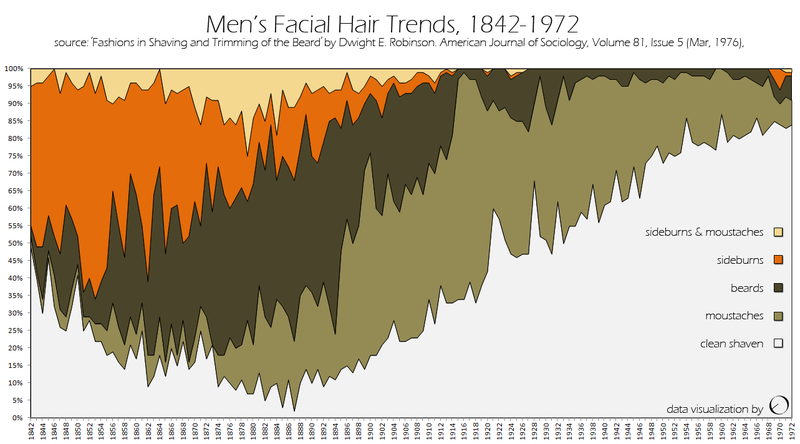
I found this nifty chart as part of an interesting piece on Vox. For more info read the whole article, which also includes a graph of women’s skirt widths.
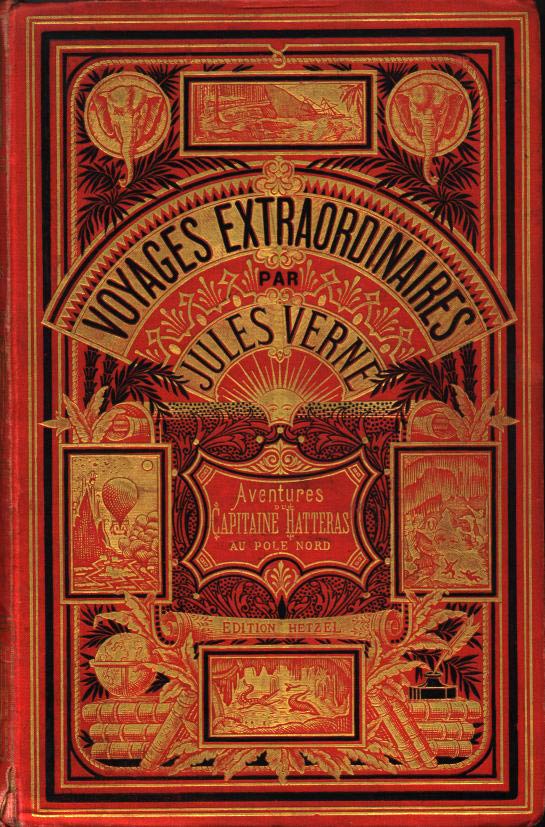
Steampunk Sourcebook: Jules Verne

 Fun Facts and Context

- Jules Gabriel Verne was born on Feb. 8, 1828 and died from complications of diabetes on Mar. 24 1905.
- He was on track to become a lawyer when he started writing articles and fiction for magazines, as well as penning plays.
- In the English speaking world he was regarded as a children’s writer during his lifetime, probably because of the popularity of his genre fiction, which was often abridged when translated. Nowadays of course he is considered one of the “fathers of science fiction,” along with H. G. Wells. As far as I could find, the two of them never met in person, which isn’t too surprising consider their age gap (Verne was 38 years old when Wells was born).
- Verne’s imagination was captured by travel and the trope of the “castaway” early in his life. As a child, he had a teacher whose husband had been lost at sea and believed he would some day be found living life like Robinson Crusoe (published 1719). He often stranded his characters on islands during their adventures, such as in In Search of Castaways (1867-1868), The Mysterious Island (1874), and Two Years’ Vacation (1888).
- Verne made lots of famous friends during his lifetime. His close relationship to Alexandre Dumas Jr. and Sr. helped him as a playwright early in his career. He was also a buddy of the noted French explorer and geographer Jacques Arago whose accounts of his travels around the globe helped to lead Verne to his path as a travel writer.
- He fell in love with Honorine de Viane Morel, the sister-in-law of a good friend, in 1856. In order to provide enough financial security to marry her, he went into finance. But there was no way Verne was going to totally abandon his first love, his literary career. He woke early in the morning to write before heading to the office.
- Two years later, at the age of 30, Verne got his first chance to leave France. That year he traveled to the British Isles, and upon returning to Paris he wrote a semi-biographical novel called Backwards to Britain, but it was not published until 1989. In 1861 he visited Sweden, Norway and Denmark and missed the birth of his son, Michel the same year. After he found literary success, he purchased a succession of larger and larger vessels which he used to travel all around Europe.
- Unfortunately traveling became difficult for Verne after an incident in 1886. His nephew, Gaston, suffered from paranoia and shot his uncle in the leg (or foot, depending on the account) and Verne never fully recovered. Luckily for his fans, this did not stop him from continuing to write sometimes two novels a year.
- According to one article I found, there is a lot of evidence the Verne plagiarized large portions his most well-known work, Journey to the Center of the Earth. He was sued by Leon Delmas in 1863, and the court case was not resolved until 1874.
- With the help of Verne’s son, some of his books were published posthumously.
- Several of Verne’s manuscripts and plays were found in a safe 1989, so have only recently seen the light of day. Among these was a novel called Paris in the Twentieth Century, which was initially rejected by Verne’s publisher, Pierre-Jules Hetzel, because of its pessimistic view of the future. The story is set in a dystopian 1960 (97 years after it was written), and predicted the invention of many things that ended up being absolutely correct such as gas-powered cars, fax machines, elevators and sky scrapers.
Verne’s most note-worthy works
I’ve been writing about Verne off and on since I started this website, so I won’t reproduce all of my reviews and info again verbatim.. Here are links to those articles:
20,000 Leagues Under the Sea and Steampunk Sourcebook: Captain Nemo
Around the World in 80 Days book review, Steampunk Sourcebook and review of the Steampunk reinterpretation The Other Log of Phileas Fogg.
Journey to the Center of the Earth book and 2008 movie
The Mysterious Island movies in 2005, 2012 and Journey 2: The Mysterious Island 2012, which actually served as a sequel to the Journey to the Center of the Earth film. I have not yet read the book myself, but plan to some time in the future and will add a link then 🙂
Are you a fan of Jules Verne? What’s your favorite book?
Steampunk Book Review: Journey to the Center of the Earth (1864)

It’s time to return again to our regularly scheduled Jules Verne programming. It doesn’t look like I will make my original writing goal for this weekend, but I will hopefully get to 10,000 words by the end of the month, so I will keep posting things after my tribute to Verne is over.
 Voyage au centre de la Terre is the third Verne novel I have read, and so far it is my favorite. There are multiple translations and the names of the main characters are different depending on which one you read. I read the version where the narrator is called “Harry Lawson” rather than Axel Lidenbrock. According to Project Gutenberg, this 1871 translation is the one that is most widely circulated, but it is also not as true to the original text as the 1877 version. Apparently what I read was somewhat abridged, but was still about 470 pages.
So here’s a very brief synopsis: Harry starts his story by setting the scene of his life with his eccentric uncle, whom is most often referred to as “the professor.” But the story really gets going when the professor discovers a coded message scrawled in an antique text he has just purchased. The former owner was a 16th century alchemist named Saknussem who left behind directions to the finding the exact center of the Earth.

by Édouard Riou
The enthusiastic professor drags the reluctant Harry along for the ride to Iceland, where Saknussem’s tunnel is located. With the help of a taciturn Icelandic hunter, they embark on an incredible journey of discovery into the depths beneath our feet. Along the way they encounter living fossils from bygone ages, a huge subterranean sea and a multitude of other wonders.
There were two main reasons that I liked this book more than 20,000 Leagues Under the Sea and Around the World in 80 Days. First, the first-person narration by Harry was often very humorous, especially when it came to his own misgivings and cowardice. Second, this story was not bogged down by minutiae. There were only a few Latin names dropped in here and there, and because Verne was pulling this place out of his imagination rather than reporting on a real locations, it freed him to be able to drive the action any way he pleased. It would be nice to read a version that has gone through a modern editing process to get rid of the redundancies that so often occur in these old serials. For instance, the phrase “my uncle, the professor” occurs several times, and the Icelander is referred to as “Hans, our guide” almost without fail, as if there would be some other Hans wandering around hundreds of miles below the Earth’s crust. I am sure it helped readers of the original serial over the course of the year it took to read the whole thing, but it does get to be a bit repetitive when reading it as a novel.
The science in this book doesn’t stand the test of time quite as well as others from this period, but for when it was written it was right in the middle of the scholarly debate concerning the origins of life on Earth. In the 1860s, academics had only recently abandoned the straight Biblical interpretation of our origins in light of the discovery of fossil hominids in unexpected strata. There were also distinct schools of thought concerning the nature of the planet itself, the inner workings of which were not fully explained until the theory of plate tectonics was put forth almost a century later.
Perhaps this is the reason, not to mention the enormous sets that would be required, that Journey to the Center of the Earth has only rarely been adapted to film and television compared to Verne’s other works. The first film was made in 1959, but it wasn’t remade in English again until the 2008 re-interpretation which put a contemporary uncle (Brendan Fraser) and nephew (Josh Hutcherson) on the path described in Verne’s novel rather than following the narrative as it occurred in 1864.
Enjoy reading this review? Check out some of my others!
The Time Machine
The First Men in the Moon
Soulless
The Strange Affair of Spring-Heeled Jack
The Iron Jackal
The Monster Hunter
Three New Pages of Steampunky Goodness
Hello friends
Over the last two weeks I have added three new pages to this site to help give easier access to related articles that have been published several days or weeks apart. Many of you probably saw these articles when they were first posted, but as the number of Gear Heads (as I refer to my followers) increases, some folks may not have gotten in on all the fun. Here are links and descriptions of each new page.
Steampunk Sourcebooks– So far I have published 11 of these long articles about a single subject such as Sherlock Holmes, H. G. Wells and Jack the Ripper, with fun facts and information about what has come before and ideas for further punking.
Tips for Makers– Articles about working with metal, plastic, foam and paper.
How to Punk Your Steam– I am publishing one article per month over the next year about different ways to mess with the Victorian era. There is advice for how to do things yourself, as well as links to the work of others to serve as examples. So far there are only two, but the page also lists the upcoming titles for the rest of 2015.
Also, if you weren’t along for the whole ride during my escapades in London, you can get the whole feed by visiting the Steam Tour: An American Steampunk in London page.
Jules Verne’s Mysterious Island (2012) Adds Time Travel to the Classic Tale
 In this made-for-TV flick part of the mystery of the island comes from relocating it from off the coast of New Zealand to the Bermuda Triangle. According to the movie, ships regularly disappear from this spot because of a rift in time that sucks in travelers. This allows the story to include not only 17th century pirates and refugees from the American Civil War, but also some ladies from the present. I really enjoyed this twist because it was a chance to call attention to how much has changed in the last century and a half. There are culture clashes even between fellow Americans because of advances in technology and social norms.
Ever since the 1961 version, the trend with movie adaptations of The Mysterious Island seems to be to add some kind of creepy critter to up the ante when it comes to danger and action to what is really a pretty subtle story about a group of castaways. In both the 1961 the 2005 version, all of the animals on the island grew to huge proportions. In this one, in addition to a giant octopus blocking their escape by sea, the island is overrun by apelike creatures who (spoiler alert) turn out to be Nemo’s disenfranchised crew.
The writing had a few holes and the acting was pretty hit or miss, but it was a fun movie all the same. I, of course, like “bad” movies so I will probably put with more than your average movie viewer. You can watch it on Netflix or through youtube below.
This mockbuster was made to piggyback on the major motion picture release the same year of Journey 2: The Mysterious Island, which was a sequel to the big budget Brendan Fraser movie, Journey to the Center of the Earth that came out in 2008. I’ll bring you reviews of those as well, so stay tuned during March for even more Verne and adaptations!


 For Whom the Gear Turns