Steampunk TV: NBC’s Dracula

I have heard some hemming and hawing about the costumes in NBC’s Dracula because they aren’t “period” enough. Personally, I think that is part of what makes it steampunk rather than a period drama and therefore way more interesting. I watched a special about the making of the Tudors and I think the costumers on Dracula are taking the same approach: It’s not about historical accuracy, it is about making the audience look at clothes and get an impression about the person wearing them. For instance, records about the real Anne Boleyn show that she was on the forefront of fashion in her day, but how do you capture that for an audience that doesn’t know the difference between silk and satin?
So the costume designers made a compromise between authenticity and modern designs to appeal to the audience and give the impression of her changing status as her look evolved. The same goes for music in movies like Moulin Rouge and The Great Gatsby, these aren’t the original songs or even the original genre of music, but the point is to capture the excitement of the time and place and draw the audience into the world of the film.
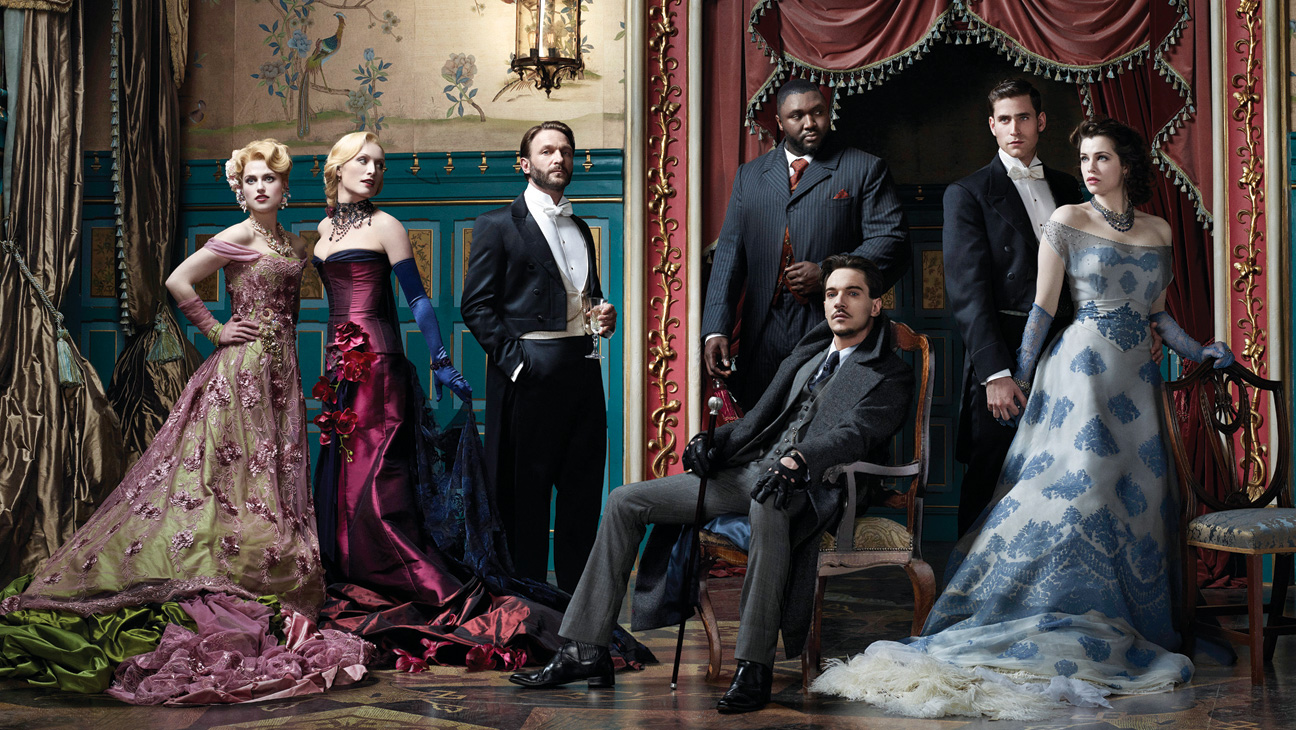
Dracula Cast
And the same goes for NBC’s Dracula. The men’s clothing is absolutely gorgeous and connotes the huge wealth that Dracula and the Order Draco control. Except for during the occasional ball, Mina’s clothes are much plainer than Lucy’s, which brings their different social statuses into focus. Here are some costumes and sets for you to drool over.
-
- Renfield and Harker look great in velvet collars
-

- NBC Dracula
-

- Renfield rocking a suit with a single button closure
-

- Dracula in pin stripes
-

- Lovely ladies of Dracula
-

- NBC Dracula
-

- Harker looks amazing in his blue corduroy suit
-

- Interior of Dracula’s house
-

- Interior of Dracula’s house
Prada’s Steampunk Fashion for Men

Prada added some Edwardian style to their Fall/Winter 2012 line for men. I think menswear has a lot of potential for subtle Steampunk because suits are always in style, its just the cut and patterns that change. I also noted several very high-necked shirts and collars. Gary Oldman and Willem Dafoe headline this shoot along with Garrett Hedlund and Jamie Bell. Check out the gallery of photos from JDFalksen.com.


Dystopian Metal: The Art of Greg Brotherton
-

- Watchtower
-

- 3 Wheeled Horn
-

- Into the Void
-

- Mercury 5000- It reminds me of Abraham Sapiens from Hellboy
-

- Migraine Machine
-
- Oracle
-

- Search Engine
-
- Sounding the Furnace
-

- The Lift
Metal is one of the most satisfying mediums I have ever worked with and I hope to get a chance to do more in the future. But even if I never do, I will always love metal art. The strength and flexibility of the material means an artist is really only constrained by the bounds of their imaginations (okay, and sometimes their tools). I really enjoyed these metal men and the world I imagine them inhabiting, especially the “search engine” and the “observatory.”
You can find more of Greg Brotherton’s artwork (including many different angles of the pieces I chose for my post), as well as pictures from his studio here.
I always like to hear about people from the Midwest finding success, and it looks like Greg is one of those people. Here’s his bio:
“Born in Ames, Iowa, in 1968, Greg experienced a somewhat nomadic childhood, spending the majority of his youth in Utah and Colorado. His interest in the mechanical surfaced at age five, when he began disassembling anything with screws in it. By the age of twelve he had taught himself to mine his backyard with homemade explosives (no injuries!). Then, after being successfully ejected from a series of public and private learning institutions, Greg, equivalency test in hand, entered the Colorado Academy of Art, beginning his undergraduate studies at sixteen.
In 1987, after receiving a degree in graphic design, Greg set off for California. Over the next two decades, he forged a successful career as an award-winning commercial artist, while honing his skills as a sculptor.
With a consuming drive to build things that often escalate in complexity as they take shape, Greg’s work is compulsive. Working with hammer-formed steel and re-purposed objects, his themes tend to be mythological in nature, revealed through a dystopian view of pop culture.
Greg’s work has received international recognition, has been exhibited throughout the United States and is collected worldwide. In 2007, he was invited to serve as the featured artist at the Technology, Entertainment and Design (TED)Conference in Monterey, California, joining the ranks of some of the most prestigious artists, luminaries, and scientists of our time. He currently resides in Los Angeles, California, where he continues to sculpt and experiment.”
Building an Anatomy of Steampunk (Book)

Anatomy of Steampunk cover
“Steampunk style has become synonymous with many things as it has become more pervasive in popular culture, for good and ill: 19th-century, retrofuturism, neo-Victorian, colonialism, stuff white people like. What the steampunk community needs is a game-changer: more examples of what steampunks are really doing, and why does this subculture fit their wheelhouses. When you’re an outsider looking in, however, how can you avoid being blindsided by what has become the “tropes of the genre” (gears, goggles, pith helmets, and all)?”
Follow the link for the full article.
Æther Feature — Building an Anatomy of Steampunk—An Insider’s View.
Steampunk Sourcebook- The Golden Compass


For die hard fans, His Dark Materials (known as the Golden Compass trilogy in the US), wouldn’t technically fit into the definition of Steampunk.
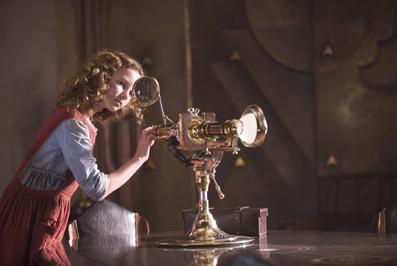
The series is set in the present/near future so steam power is a thing of the past and the story has nothing to do with Victorian England or an alternate history, but the parallel universe Lyra Belacqua inhabits has some decidedly Steampunk elements to it. The images in this post are all from the 2007 film release of The Golden Compass.

First, England gets “punked.” Lyra lives at Jordan College within Oxford University, which doesn’t exist in our universe. She later travels to an alternative London with dirigibles floating over head and horseless hansom cabs, apparently their answer to the automobile.
The spaces that she inhabits in while in the power of the evil Mrs. Coulter remind me a lot of the work of Alfonse Mucha (1860-1939).
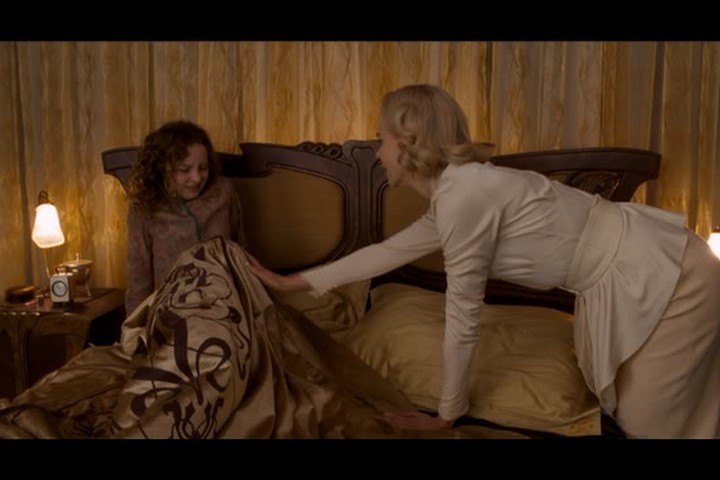
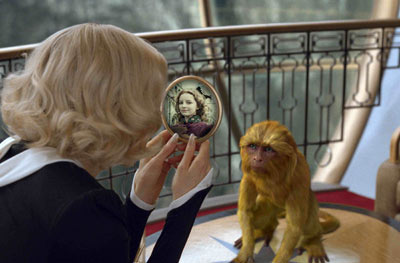
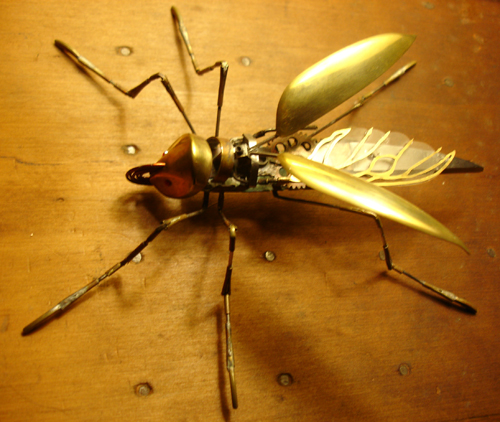
There are also so some fun alternative technologies, for instance, a projector (which they call a spirit projector) that uses glassy orbs to create 3D, moving images of of the mysterious Dust (which is basically powdered sentience). The bad guys also employ “spy flies” which are clockwork insects “with a bad spirit pinned to it” and sent to locate Lyra and her band.
Fun Facts and Context
- The Golden Compass was originally released under the name Northern Lights.
- The trilogy explores contemporary concepts in science such as quantum entanglement (lodestone resonator), dark matter (dust is invisible without the amber spyglass even though in the Golden Compass film they depict it clearly as visible by the naked eye) and human evolution (how did we become “more” than animals? Where did sentience come from?)
- The Golden Compass film stops short of the plot of the first book. The real ending of the Golden Compass is darker and sadder, but I think they stopped where they did in hopes of continuing the trilogy and that needed a more hopeful note.
- Unfortunately, the films of The Subtle Knife and The Amber Spyglass were never made. Many people, including actors in the film, blamed the Catholic church for killing the series. I admit that I watched the movie before I read the books and I couldn’t understand why they didn’t continue and why the church would protest so much. Then I read the books and I totally get it. (Spoiler alert) Even if the story wasn’t overtly about killing god (or at least the one posing as god), there are multiple scenes of a violence against children, like in Citegazze (a city in another alternative universe), that would have been hard to stomach on the silver screen.
Albert Robida

 Albert Robida (1848-1926) was a french illustrator and science fiction writer. You can find a good article about his life here. Below is a small sampling of this prolific artist’s work.

“Going to the Opera in the Year 2000”
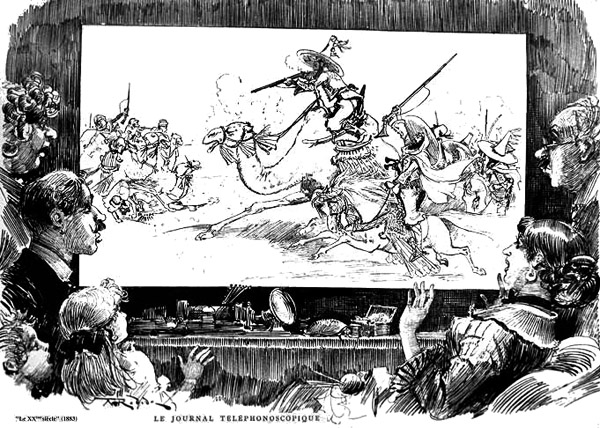
1880 illustration of something eerily like a flat-screen television


 For Whom the Gear Turns