Steampunk Book Review: The Monster Hunter (2014)
 Kit Cox, also known in Steampunk circles as Major Jack Union, has a new book out on October 23. I was lucky enough to get an advance copy, and it is the perfect way to kick off my Halloween Extravaganza. Where his first book, How to Bag a Jabberwock: A Practical Guide to Monster Hunting, is more of a a how-to for aspiring protectors of the Crown, The Monster Hunter is a novel about a young boy coming of age amidst the threat of these monsters.
Benjamin Jackson Gaul is half-British and half-Indian, but doesn’t fit in to either place. His only real friend growing up is his mother, whom he loses at the tender age of 12 to a terrifying encounter with a mysterious creature despite her obvious, though unexpected, fighting skills. He passes a year in silence, wracked with guilt and questions that his storybooks cannot answer. He knows if he will ever get to the bottom of his mother’s death he will need to learn more than he can in Ceylon, and when offered a chance to move to England he jumps on it. After almost a year on the sailing ship the Hallowe’en, he arrives in 1885 at the Garden Orphanage in Kent, where a strange illness is affecting the children. With the help of a Gypsy girl and armed with books and good intentions he tries to solve the mystery, and finds out more about his mother’s fate along the way. The most important book he possesses is the journal of Major Jack Union, the older brother of his caretaker Nanny Belle, which paves Ben’s way to becoming the next monster hunter.

Jack Union, Photo: Martin Soulstealer.
For an adult, this book won’t take up much more than one long afternoon, but it will be a fun afternoon! At 200 pages and written in simple language, it is best described as a young adult book. This is in no way meant to be a slight, I love YA fiction, and I am happy to find more of it to add to my Steampunk Book list. The opening chapter is extremely well done and the image of monster attack is very strong in my mind and helps compel the reader onward to find answers with the protagonist. I loved accompanying Ben on his journey across the sea and into the wide world that words and books can open a mind to. I just checked Major Jack Union’s facebook page and he recently announced the completion of his second manuscript in the Adventures of Benjamin Gaul series, so you can also be sure there is more to come. I always love a good series 🙂
The Monster Hunter will be released on Amazon on October 23, but you can already order your copy if you want to get it before Halloween.
Happy Hunting!
Have you ever read anything in the Union-verse created by Kit Cox? I’d love to hear what you think!
Steampunk Book Review: The Difference Engine

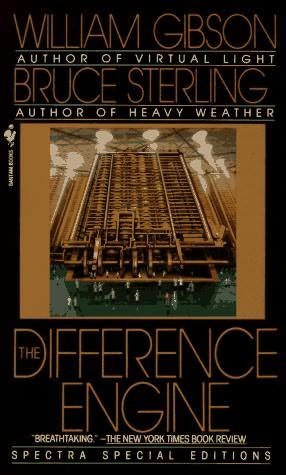 A big part of my Steam Tour is finding out about the historical events and people who influenced the time period reflected in Steampunk books. I love the idea of alternate histories, and many times that is at the core of Steampunk novels, such as The Difference Engine by sci-fi greats William Gibson and Bruce Sterling.
If you are like me and you don’t have a good handle on the real history, I would recommend a quick glance at the wikipedia article about this book before you begin it. There is a great summary there of where and how the alternate history of the novel diverge from real events. I didn’t do this before I started reading and I spent a lot of the book wondering about fact and fiction.

Trial portion of the Difference Engine No. 1, completed 1832
In short, it tells the tale of the trajectory of the world if the computer age came in the 1800’s. The political structures all over the world are deeply effected by Charles Babbage’s completion of his mechanical computers (called Analytical Engines) in 1824, and there are numerous references to a fragmented United States (including a communist Manhattan) as well as historical figures such as Lord Byron, Ada Byron (the “queen of engines”), and Laurence Oliphant in different roles. The English politicial system has been completely dismantled and a meritocracy put up in place of hereditary lordships. The story is mostly told through the eyes of Edward Mallory, a “savant” who discovers the first huge dinosaur bones, giving him the nickname “Leviathan Mallory.”
There were a lot of things I really liked about this book. The descriptive language was excellent and Ned is a great character on whose coattails to ride through the adventure. I loved the shift in politics in response to technology and the parallels between then and now when it comes to the power of information. The authors clearly put a lot of thought into both logically and imaginatively extending the repercussions of the rise of computer technology long before we experienced it in our timeline.
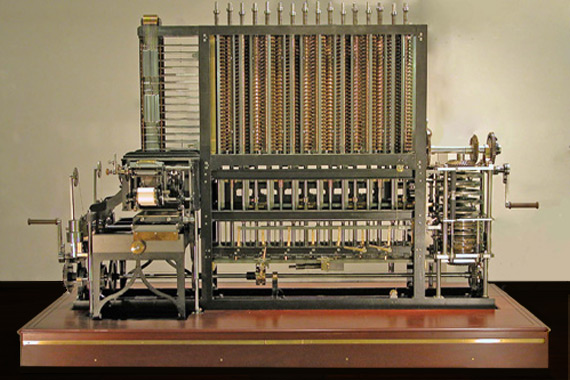
Babbage later designed a simpler difference engine that was not built until the 20th century, on display at the Computer History Museum
On the whole, the story felt a bit fragmented because there are three distinct characters that get followed and the treatment is uneven. The first person you explore this world with is Sybil, and her story comes to an abrupt halt right as it gets really interesting. Then Mallory comes onto the scene and his story is great, but I couldn’t help but wonder where Sybil had gone to. Mallory’s tale comes to a head and he gets what he wants, but he is not actually the agent of change so even though there is a stand-off and big ‘splosions (whoo-hoo!) it felt sort of anticlimactic. Lastly, we trail Mallory’s one-time ally Laurence Oliphant for a little while on his political espionage. Each section was full of wonderful prose, but as a full story it ended up feeling kind of jerky and a bit too long.
That being said, I think it is definitely worth a read for the wonderful writing and imagination of the authors.
Have you read this book? What did you think?
Steampunk Book Review: Around the World in 80 Days
I have been “poorly” as they say here in Britain, meaning that I have been under the weather for a few days, so I didn’t make it into the city yesterday as I had planned. But, with all the trains, planes and automobiles lately I have gotten plenty of reading done in anticipation of my upcoming articles for the ezine, so here is a book review to tide you over until I can start posting about London in earnest.
 I chose to do an in-depth article on Around the World in 80 Days mostly as an excuse to watch the 1956 movie again that I remembered from my childhood, but of course I needed to start with the text itself. I won’t go into a lengthy synopsis here because I will be doing that for my upcoming Sourcebook, so I’ll skip straight to the review.
I really expected to adore this book and it had all the makings of greatness, but all and all I’d say this one isn’t a must-read for a Steampunk or a Jules Verne fan. The voice of the narration is inconsistent and swings between third-person omniscient and totally opaque, especially when it comes to Detective Fix who is pursuing Fogg through his journey on suspicion of bank robbery. I also felt like the action, the real meat of the adventure, was often treated as a footnote with very little description whereas the reader must sit through several pages of Mormon history and detailed itineraries of exactly where their train is stopping. For instance, Passepartout is taken hostage by the Sioux during the trek across America, but all we know if the daring rescue is that Aouda and Fix paced a lot while waiting.
There are definitely gaps that would be fun for an author to try to fill, and indeed Philip Jose Farmer attempted to do just that in his novel The Other Log of Phileas Fogg, which is the next book I will review.
Steampunk Book Review: The Strange Case of Dr. Jekyll and Mr. Hyde
 I have seen several adaptations of R. L. Stevenson’s novella, including an amazing British series called Jekyll that follows one of the not-so-good doctor’s progeny in modern times. One of the amazing parts of the story of this book is how it immediately caught the imaginations of the public and was adapted for the stage within a year of its publication. But I realize recently that I had never actually read the slender tome myself.
Unfortunately, the big reveal that Henry Jekyll (properly pronounced JEE-kill, I recently learned) and Edward Hyde are one and the same is the one part of the tale that is always consistent across all adaptations, so it is impossible for the story to titillate and surprise in the same way it would have been for readers in the 1880s. The idea of a split-personality has long been linked to this piece of literature, and the names of the title characters are part of our vernacular.
BUT, this doesn’t mean the book isn’t worth reading. I really enjoyed Stevenson’s prose, and it is always interesting to return to the source. I surprised to find that in the original that nature of Jekyll’s original “sins” that lead him to want to extricate his two halves from each other are never mentioned, and the details of Hyde’s antics are equally left to the imagination. In order to stretch the story into a full-fledged play or movie the adapters have had to fill in some of these details, which can really alter the tone and nature of Hyde. For instance, in The League of Extraordinary Gentlemen, Hyde reveals to Mina that Jekyll occasionally had ‘impure thoughts’ about boys, and his overwrought Christian guilt made him consider himself a great and terrible sinner when really he was a pretty boring and upright citizen.
In the foreword to the collected works of Stevenson in which I read the mere 60-page novella, Claire Harman recounts a story of Stevenson seeing a theatrical adaptation in 1887. He is all but horrified to see Hyde depicted as “an unbridled womanizer” because, as Stevenson wrote to John Paul Bocock, “The hypocrite [Jekyll] let out the beast in Hyde… who is the essence of cruelty & malice… these are the diabolical in man– not his poor wish to love a woman.”
I found the ambiguity in the story itself very intriguing, and it seems ripe for someone to explore not only the exploits of Hyde during his short life, but Jekyll’s past and his other experiments that are only hinted at in the original. I was also surprised to see that the Hyde of the original story is nothing like the huge monster versions in Van Helsing and League of Extraordinary Gentlemen, but a tiny, young and underdeveloped man who does not have amazing strength, but unbridled passions.
Hustlers, Harlots and Heroes is a Must-Have Resource for any Steampunk Author

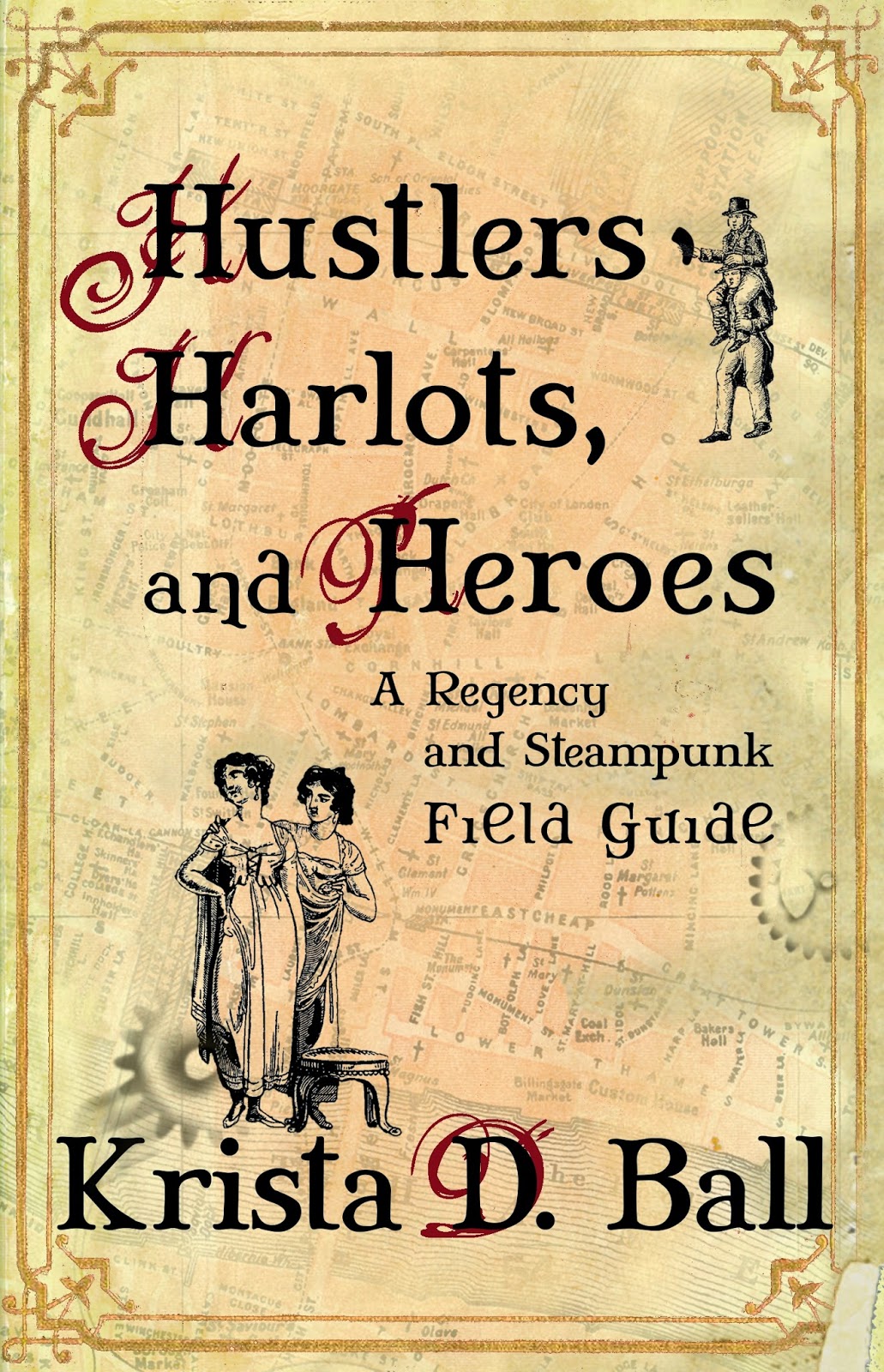 As part of my preparation for Steam Tour I picked up a great little reference volume by historian/geek Krista A. Ball. Hustlers, Harlots and Heroes: A Steampunk and Regency Fieldguide tells the story of the untold, the people who populate your Steampunk imaginings but are rarely the focal point. She brings you the inside scoop on the maids, footmen and even your friendly neighborhood knocker-upper (think alarm clock with a stick) to offer readers and writers a window into how the 99% really lived during the Regency and Victorian eras.
Ball’s first reference book, What Kings Ate and Wizards Drank, also sounds like a lot of fun, but so far I have only read Hustlers. Both books include recipes that you will want to make at home (and some like tooth paste made from cuttlefish that you’d never EVER want to try) in addition to some great background information and delicious tidbits to add depth and interest to your own Steampunk projects.
Let me know if you have any ideas for other reference books I should read before Steam Tour starts in August! I finally got a reliable internet connect here in Greece so I hope to go back to posting more often and letting you know all the amazing Steampunkery that is to come.
Steampunk Book Review: The Iron Jackal
The Iron Jackal Cover
When I started writing For Whom The Gear Turns I thought maybe, just maybe, someday a literary agent would contact me and offer me a free book to read and review. You can imagine my surprise when after only blogging for 6 months it happened! I worried a little that this would color my view of The Iron Jackal (Book 3 of The Tales of the Ketty Jay), especially after the giddy rush I got from opening the package when it arrived. But in the end, it gave me a giddy rush all on its own.
Chris Wooding has been writing the Tales of the Ketty Jay for several years, he is all the way through Book 5 in the UK. But, it was his US agent who contacted me, and told me that they were going to start with Book 3 for the American release on June 1. I was a bit skeptical about starting in the middle of a series, but it meant being dropped into a fully formed and complex world that was a joy to explore and made me even more interested to go back and read the earlier books. There are airship pirates, complicated relationships, daemon-imbued walkie talkies and multi-faceted cultural and political systems that overlap and contradict in a very realistic way. What’s NOT to like?
This tale focuses on the captain of Ketty Jay, Frey, but the story is told through the eyes of the entire crew as they take turns enriching the story with their insights and foibles. It all starts when this rag-tag band is enlisted by Frey’s “its complicated,” Trinica the pirate queen, to steal an artifact of unknown origin and purpose off of a moving train. It reminded me a little of one of my all-time favorite episodes of Firefly, only I really doubt that Frey would ever return the goods like Malcolm Reynolds no matter what they are. In this case, the artifact turns out to be a weapon that seems both ancient and futuristic at the same time, but when Frey lets his ego get the best of him and lifts it from its case the real adventure begins. The weapon pricks his palm and leaves behind the most dreaded of pirate iconography, “the black spot.”
As scary as the Kraken is, I think the daemon that pursues the bearer of the spot in Wooding’s world is even more terrifying. The Iron Jackal is a sinister amalgamation of flesh, machine and the bearer’s darkest secrets and most painful regrets. Frey is haunted by the voice of a man he left to die and the eyes of the woman he abandoned to pursue his life of piracy. But even with his dark past, his loyal crew will stop at nothing to help their captain return the artifact to its resting place to save his life and the family they have built aboard the Ketty Jay. If only they knew where that resting place was…
I would absolutely recommend this book to anyone who is looking for a fun read, but doesn’t mind some moral ambiguity. Frey is by no means a “good guy” by nature, but his Archer-like humor and quest for redemption in Trinica’s eyes make him a very compelling hero. The rest of the crew also gets to be fully-formed people with loves, losses and secrets all their own, so in the end it is really an ensemble piece rather than a story just about Frey. There are some nuances of the political issues that I am sure that I have missed because of not reading the earlier books, but it still definitely holds together as a stand-alone novel and a great place to start exploring Wooding’s work.


 For Whom the Gear Turns