Steampunk Book Review: The Difference Engine

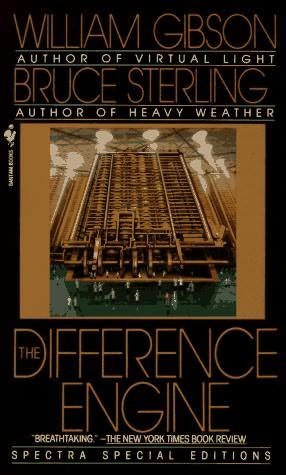 A big part of my Steam Tour is finding out about the historical events and people who influenced the time period reflected in Steampunk books. I love the idea of alternate histories, and many times that is at the core of Steampunk novels, such as The Difference Engine by sci-fi greats William Gibson and Bruce Sterling.
If you are like me and you don’t have a good handle on the real history, I would recommend a quick glance at the wikipedia article about this book before you begin it. There is a great summary there of where and how the alternate history of the novel diverge from real events. I didn’t do this before I started reading and I spent a lot of the book wondering about fact and fiction.

Trial portion of the Difference Engine No. 1, completed 1832
In short, it tells the tale of the trajectory of the world if the computer age came in the 1800’s. The political structures all over the world are deeply effected by Charles Babbage’s completion of his mechanical computers (called Analytical Engines) in 1824, and there are numerous references to a fragmented United States (including a communist Manhattan) as well as historical figures such as Lord Byron, Ada Byron (the “queen of engines”), and Laurence Oliphant in different roles. The English politicial system has been completely dismantled and a meritocracy put up in place of hereditary lordships. The story is mostly told through the eyes of Edward Mallory, a “savant” who discovers the first huge dinosaur bones, giving him the nickname “Leviathan Mallory.”
There were a lot of things I really liked about this book. The descriptive language was excellent and Ned is a great character on whose coattails to ride through the adventure. I loved the shift in politics in response to technology and the parallels between then and now when it comes to the power of information. The authors clearly put a lot of thought into both logically and imaginatively extending the repercussions of the rise of computer technology long before we experienced it in our timeline.
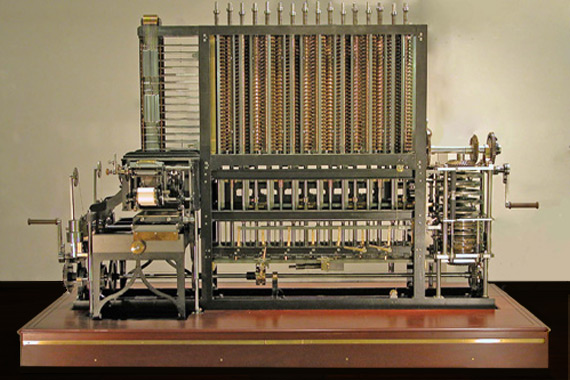
Babbage later designed a simpler difference engine that was not built until the 20th century, on display at the Computer History Museum
On the whole, the story felt a bit fragmented because there are three distinct characters that get followed and the treatment is uneven. The first person you explore this world with is Sybil, and her story comes to an abrupt halt right as it gets really interesting. Then Mallory comes onto the scene and his story is great, but I couldn’t help but wonder where Sybil had gone to. Mallory’s tale comes to a head and he gets what he wants, but he is not actually the agent of change so even though there is a stand-off and big ‘splosions (whoo-hoo!) it felt sort of anticlimactic. Lastly, we trail Mallory’s one-time ally Laurence Oliphant for a little while on his political espionage. Each section was full of wonderful prose, but as a full story it ended up feeling kind of jerky and a bit too long.
That being said, I think it is definitely worth a read for the wonderful writing and imagination of the authors.
Have you read this book? What did you think?
The Burlington Arcade

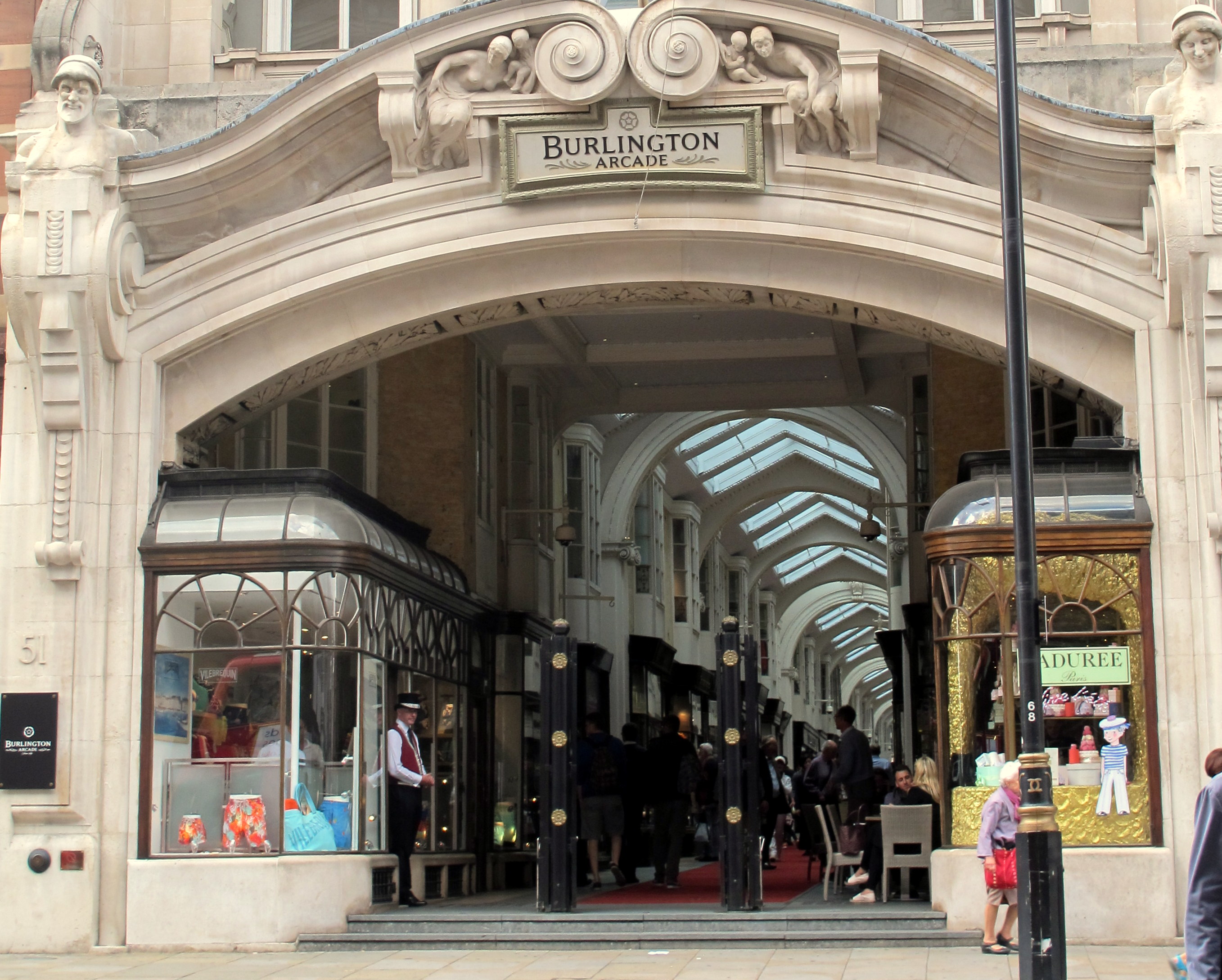 While I was in the Piccadilly area for the market I also did some serious window shopping. There are so many lovely stores and window displays in this posh neighborhood! I didn’t really have anything in mind, but as soon as I spied the Burlington Arcade I had to take a stroll down this lovely little pedestrian thoroughfare. I am not sure if it was all the shiny watches glinting at me from across the street, or the top-hatted man in the portico, but I had a feeling I would find something relevant there for my Steampunk wanderings.
I was surprised when I entered to find a high ceiling complete with beautiful skylights hidden behind the curving façade. The natural light was great for looking at the new and vintage jewelry and watches, but terrible for taking pictures due to the glare on the almost unbroken string of glass display cases that line the lane, which means I don’t have much to illustrate this post. So here is a little history instead. (Adapted from http://www.burlington-arcade.co.uk/the-arcade)
Lord George Cavendish was a prominent politician during the late 1700s and early 1800s, and he had a garbage problem. Ruffians were always throwing trash like oyster shells and other refuse over the wall to the grounds of Burlington House where he lived, so he decided to finance the building of a shopping arcade to fill the alleyway. Officially, his reasoning was to offer “gratification to the public” as well as “work to industrious females” but really he was just tired of all the rubbish. When it opened in 1820 only 4 of the 47 leaseholders were women, but the prevailing convention at the time was to address even male shopkeepers as “madame”, so I guess he sort of kept his word.
 There are several shops of note that still have their polished doors open to the public even now. For instance, Hancocks is a fabulous jewelry store, and back in 1856 was commissioned to design the Victoria Cross, the highest award given in the commonwealth military.
If you are in the Piccadilly area, I would definitely suggest a stroll down this historical pedestrian street.
Don’t Miss Longitude Punk’d at the Royal Observatory
 The Royal Observatory is probably best known for being the home of the Prime Meridian, but I went there to check out an amazing Steampunk exhibit dedicated to “the longitude question.” Thousands of seamen lost their lives because they couldn’t be sure where they were when they were in the open ocean, so the British Parliament implemented a competition in 1714 and offered a reward of 20,000 pounds to anyone who could figure out how to calculate longitude when out to sea. Little did the Longitude Board know that it would be 50 years before anyone could find the answer.
The exhibit, Longitude Punk’d, is set up as a series of submissions to this contest and is intermixed with the Observatory’s collection of real and sometimes bizarre submissions. There are many buildings in the Greenwich Observatory complex, and this exhibition takes advantage of the historic Flamsteed House that sits on the grounds. There is normally already a gallery dedicated to longitude in the house, but for now the Steampunks have taken over that gallery as well as several other rooms as well as the courtyard to show their amazing contraptions and costumes.

The Commodor employed kiwi birds to keep him informed about his position.
Throughout the house you can read “The Rime of the Ancient Commodore,” which is a whimsical epic poem about one of the artists’ alter ego and his unique quest for the answer to the longitude question. His theory? Animals know exactly where they are, so if you can learn to talk to animals, all you have to do is ask for directions 🙂 Make sure to take the time to watch the series of short films embedded between display cases to meet the artists and find out the ideas behind their amazing creations.
The exhibit costs 8.50, but you also get admission to the Cutty Sark and the complementary and more serious examination of longitude at the Maritime Museum called Ships, Clocks and Stars any time within a month of your first visit. It will run between now and January 2015, so don’t miss your chance to get punk’d!


But even if you aren’t in town in time for the exhibit, there is a ton to see at the observatory for fans of the Victorian era, and I am going to post soon about their permanent galleries as well so stay tuned.
More Clockwork Treasures from the Royal Observatory

One of the biggest leaps forward in human history was when we started to use the movements of the stars, sun and moon to tell time. And as far as we know, we are the only animals that do. You may find yourself noticing a slight bend in space and time as you approach the Observatory, or perhaps it was just the long trek up the steep hill that made the minutes seem like hours!
Eventually, humans invented machines to keep track of the units in which we divided the world and some would argue that these machines now rule our lives. But no matter how you feel about clocks and schedules, you can’t deny the ingenuity and skill that has gone into inventing, improving and crafting timepieces. And if you are a steampunk fan, you probably can’t get enough of the shiny gears and complex mechanisms that had their heyday in the 18th and 19th centuries.
The Royal Observatory (also called the Greenwich Observatory) is the home of the Prime Meridian line, and the site for calculating Greenwich Mean Time since the 19th Century. This means that even more than anywhere else it has been imperative that they keep accurate time, and they celebrate this history in their exhibits. After I was done at the Longitude Punk’d galleries, I took a stroll through the rest of the Observatory and I found amazing machines for seeing the stars and terrific time-keepers. I had accidentally used up a lot of my battery during the first half of the day at Longitude Punk’d and the Cutty Sark, but even with a full battery I don’t know if I would have been able to fit all of the beautiful pocket watches, nautical devices and astrolabes onto my memory card anyway!
Here’s a sampling of what there is to see in the history galleries.


In addition to the Observatory, you can also visit the Astronomy Center for free. There are lots of exhibits there for amateur astronomers, as well as London’s only planetarium.
Have you ever visited the Royal Observatory or Astronomy Center? Did you have a favorite part?
Fortnum and Mason

One of the defining parts of the Industrial Revolution was the rise of ready-made fashions and pre-packaged foodstuffs, and on the forefront of the trend was the posh department store, Fortnum and Mason. When the first steam-powered factories were just starting the churn out their wares F&M was already in business, and it continues to be a mainstay of the stores on Piccadilly today.
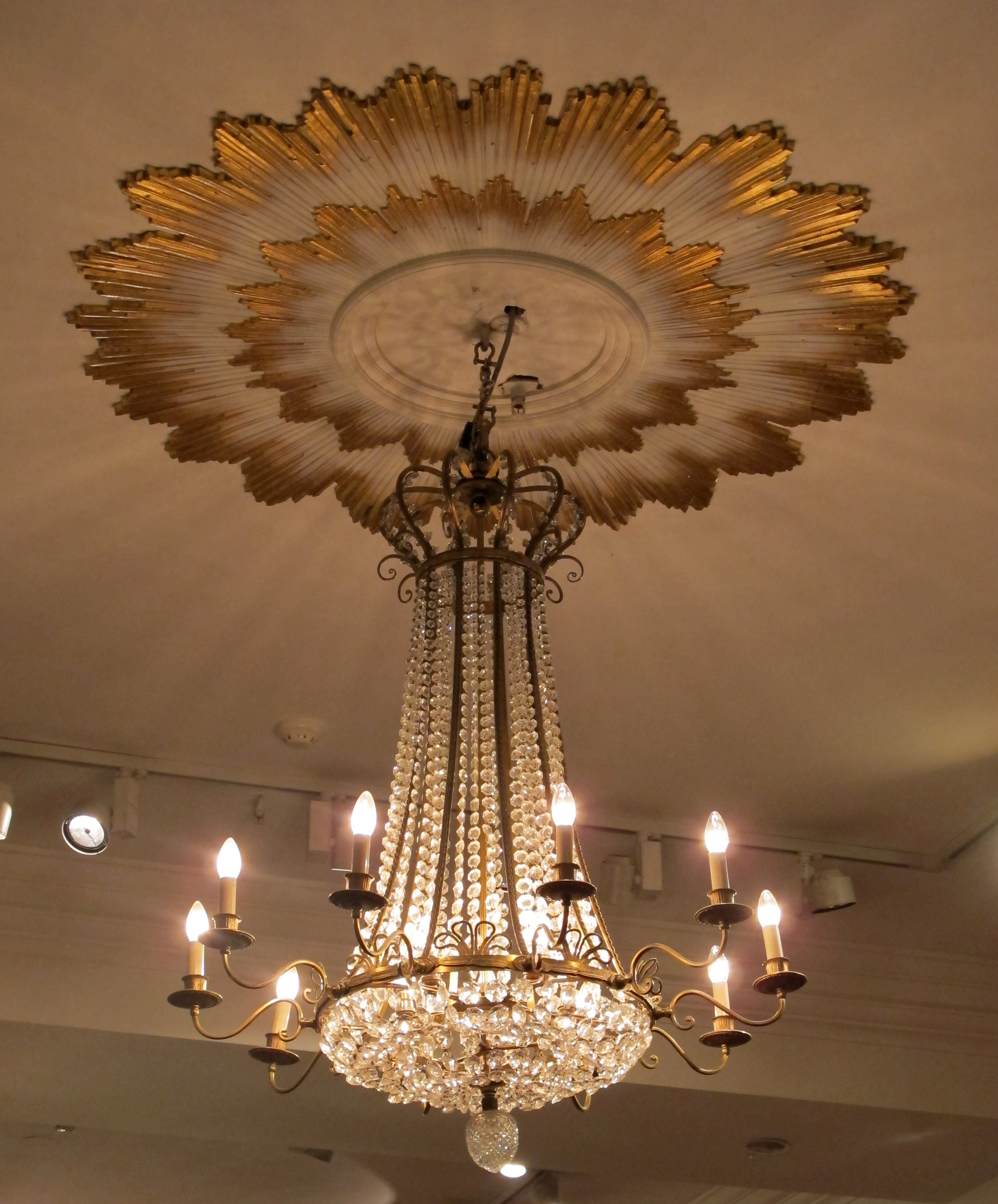
Beautiful crystal chandeliers provide light all over the store
They made a splash at the Great Exhibition in 1851 where they won first prize for their imported delectable desserts and dried fruits. In addition, when Henry Heinz (best known nowadays for ketchup) wanted to market his canned baked beans in the UK, he took his wares there. Within a few years, baked beans had become an important part of the British diet.
In literature, F&M are best known for their picnic hampers and several Victorian authors including Charles Dickens and Wilkie Collins made mention of their characters enjoying a luxurious feast. I am also reading The Difference Engine right now, and the day after snapping shots of the whimsical window displays below I read a passage where the protagonist passed by this prestigious store on his way to buy a wedding gift for his sister. Today, you can still visit and stroll through the heaps of lovely packages tied with bright ribbons and peruse the fanciful fudge of the dessert counter.
As with many luxury goods stores, the prices are steeper for things such as tea and cookies than at a normal grocer, but the ambience alone is worth a stop in at the store, or at least a meander by the window displays!


Mechanical Marvels at the National Museum of Scotland
The Mister and I stumbled upon this amazing museum totally by mistake. We had just escaped the crowd on the Royal Mile after picking up our tickets for Fringe and were looking for a quieter place to look at the map. We soon found ourselves on the stone steps outside the National Museum of Scotland with a few hours to kill before our first show. A few hours wasn’t nearly enough!
The first visit was spent mostly in the ancient history section, but we went back a second day to check out the rest of the historical and industrial arts exhibits. If you are a fan of steam engines, elaborate clockwork, intricate model ships and all manner of shiny things, don’t miss this stop if you find yourself in Edinburgh. The museum recently underwent a massive renovation, but the largest gallery dates to the Victorian era and calls to mind the pictures I have seen of the Crystal Palace.
I hope you enjoy the gallery of photos below. (Click on any picture to see a them in a different view).


Have you ever visited this museum? Did you have a favorite part?
Leave a comment below!


 For Whom the Gear Turns