Steampunk Sourcebook: The Illusionist
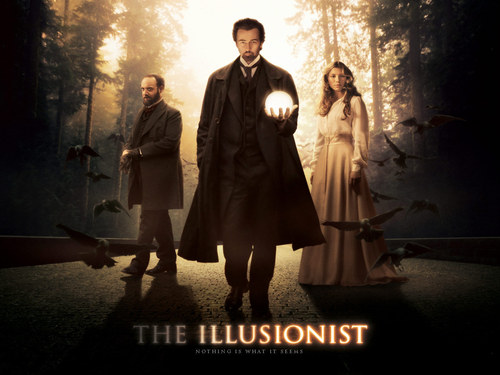
The Illusionist poster
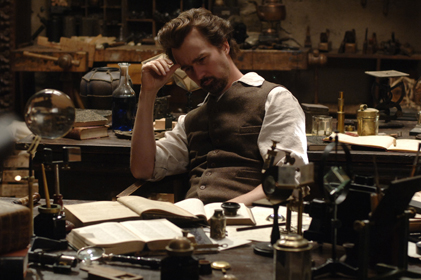
Eisenheim in his workshop
Illusions are all about making an audience believe the impossible. Magicians can accomplish this through sleight of hand, misdirection and clever technology. Innovative and deceptive designs makes the turn of the century magician a great trope of steampunkery. At left, Eisenheim (Edward Norton) is seen pondering in his workshop where this son of a cabinet-maker aspires to and achieves greatness.
Most of this romantic drama centers on the relationship of Eisenheim and his childhood love, Sophie, who is being made to marry the crown prince of Austria. The special effects are beautiful and based on magic tricks that were really performed during the 20th century.
Fun Facts and Context:
۞ The film was based on a story that appeared in a volume of short stories called The Barnum Museum (1990). This was in reference to Barnum’s American Museum, an American attraction of oddities popular in the 1840s-1860s.
۞ The tale is called Eisienheim the Illusionist by Steven Millhauser. You can read the full text here.
۞ The romantic intrigue with Jessica Biel‘s character that drives the film is completely absent from the original story. The police become interested in Eisenheim because of the disappearance of a rival magician.
۞ The film is told from the perspective of Walter Uhl (played by Paul Giamatti), a police inspector.
۞ Giamatti spends most of the film flashing back over his investigation for the benefit of Prince Leopold of Austria (played by Rufus Sewel). Leopold was not a real person, but is based on Rudolf, the crown prince of Austria who died at the age of 30 in 1889. Rudolf had a mistress who died under shadowy circumstances like the Sewel character.
۞ The filmmakers wanted to capture to beauty and awe of watching a master illusionist, so many of most impressive tricks are done with computer graphics to achieve what the Eisenheim of the original story had been able to do. But, you can see a video of a real mechanical orange tree illusion here.
۞ Edward Norton did perform many of his own sleight of hand tricks, but his hands were sometimes portrayed by his double, James Freedman.

Sophie (Biel) and Leopold (Sewel) watching Eisenheim
I’ve created a gallery below featuring images both from the turn of the century and contemporary portrayals of Steampunk magicians and illusions.
Of course, I can’t talk about The Illusionist without giving a shout out to The Prestige. I will do another sourcebook entry for The Prestige in particular, but I wanted to know from you, my readers, which movie you prefer. Weigh in below by commenting on this post and make sure to say why you picked the film you did.
Gingersnap Creations: Valerie Brincheck


Gingersnap Creations: July Muse Showcase: Valerie Brincheck.
PBS’ The Paradise is Chock-full of Victorian Fashion to Inspire Your Steampunk Designs

(Image from http://www.janeaustenfilmclub.blogspot.com)
One place you can always count on for period pieces and beautifully constructed costumes is the Masterpiece Theater on PBS, and The Paradise is no exception. Set in an 1870s shopping Mecca, this series is a veritable parade of inspiration for Steampunk fashion. The hats alone already have my mind whirring! And as the visionary store owner, John Moray says “how can such beautiful women ever have enough beautiful things?”
Before the Victorian era, all clothing was sewed by hand. The industrialization of the garment industry led to a growing collection of “ready-made” dresses, but the upper class ladies were slow to move away from their couture gowns. This is one of the hurtles that the staff of The Paradise must overcome, and fast-thinking shopgirl Denise is able to make the “hard sell” from the very beginning.
“This isn’t a shop. This is a kind of heaven!” cries one of their customers. Keep in mind there was no such thing as Harrod’s or Macy’s in the form we know it today until the 1890s, so the convention of a store that caters specifically to women and their buying power was all but untapped of at this time.
You can see full episodes on PBS’s website by clicking here and scrolling to the bottom of the page for Episode 1.
Building an Anatomy of Steampunk (Book)

Anatomy of Steampunk cover
“Steampunk style has become synonymous with many things as it has become more pervasive in popular culture, for good and ill: 19th-century, retrofuturism, neo-Victorian, colonialism, stuff white people like. What the steampunk community needs is a game-changer: more examples of what steampunks are really doing, and why does this subculture fit their wheelhouses. When you’re an outsider looking in, however, how can you avoid being blindsided by what has become the “tropes of the genre” (gears, goggles, pith helmets, and all)?”
Follow the link for the full article.
Æther Feature — Building an Anatomy of Steampunk—An Insider’s View.
Mood Swings: Bob Dylan’s New Art Exhibit “Swings” Towards Steampunk

As if “Bobby D” couldn’t get any awesomer, it turns out he has a new exhibit opening today at London’s Halcyon Gallery. The photos of his studio made me absolutely drool over his shelves of scrap metal bounty. His show centers on gates made of scrap gears, and he had this to say about his inspiration:
“Gates appeal to me because of the negative space they allow. They can be closed but at the time they allow the seasons and breezes to enter and flow. They can shut you out or shut you in. In some ways, there is no difference.”

Bob Dylan in his studio (source: Gizmodo)
I noticed a comment on the Gizmodo article lamenting the application of the label Steampunk to his work because Dylan uses steel instead of cast iron. Does that mean that clothes containing lycra can’t be Steampunk? Or that “real” Steampunk makeup would include zinc oxide powder even though its poisonous? Steampunk is an aesthetic that often (though obviously not always) includes the appearance and outlines of clockwork, not unlike Dylan’s exhibition Mood Swings.

Bob Dylan in his studio (source: Gizmodo)
Source: http://gizmodo.com/hey-did-you-know-bob-dylan-is-a-steampunk-metalworker-1462363371
America’s Next Top Model 2012 Steampunk Shoot (Clockwork Couture)

-

- ANTM contestant Kiara Steampunk photo shoot
-

- ANTM contestant Yvonne Steampunk photoshoot
-

- ANTM contestant Natasia Steampunk photoshoot
-

- ANTM winner Laura Steampunk photoshoot
-

- ANTM contestant Jessie Steampunk photoshoot
-

- ANTM contestant Brittany Steampunk photoshoot
-

- ANTM contestant Victoria
America’s Next Top Model has been around for a long time, and they do their best to push the boundaries of fashion and aesthetics for their photoshoots. It should come as no surprise then that Steampunk would eventually make an appearance. In the gallery above I picked my favorite images of ANTM contestants bedecked in Clockwork Couture, who have also featured celebrities like Mythbuster’s Grant Imahara in their photos.
I Can’t Describe How Excited I Am For Lantern City- Steampunk Inspired TV Series


I was puttering on Pinterest and I found some art by Justin Yun (pictured above). I was curious to find out more and it turns out it was a piece of concept art for a new TV series, Lantern City.
The project was announced in 2012 and is set to premier in 2014. One of the creators, Bruce Boxleitner,has made a short film describing the concept. The most exciting thing about the series to me is the call to Steampunk artists, designers, artisans and enthusiasts to send in submissions and contribute directly to the show.

As a prelude to the television series, the creators have released an illustrated novel called Rise. Check out this video from Chicago’s C2E2 for a concept film about Lantern City followed by the announcement of Rise.
The only downside I can find is that when they described the overall concept, basically an alternate universe where Steampunk is the way of life, was the basis of my own novel-in-progress, Soaring Heights.
Here’s a description of the plot/history from the Lantern City website:
History of Lantern City
“Lantern City is the southern-most city in Hetra, a world parallel to Earth, and is bordered on the south by the Silver Sea and has the largest river in Hetra, the Faudnice River, running through its heart. The city was always known for its commerce, agriculture, innovation, and trade; because of its isolated geography it never developed a real military power. Lantern City was difficult to travel to by land and it had the ability to control who came in and out of its ports.
Eventually, a band of warlords from the outlands of Hetra conquered the surrounding areas leaving Lantern City as their final target. The onslaught of refugees from the other cities gave the citizens of Lantern City ample warning to protect themselves, However almost no one in Lantern City had minds for military strategy or any real combat experience. This was the perfect opportunity for soldier and entrepreneur Isaac Foster Grey to rise to power and “save” the city from the invaders. To secure the city after the battles for Lantern City’s existence, Grey had a wall built around the city and enacted isolationist policies.
Over one hundred years later, the citizens of Lantern City know little about the rest of Hetra.
Since so few citizens know anything about the history of Lantern City or anything about Hetra, a myth has replaced the actual history. Many of the working class citizens and the members of the Underground believe that a peasant named Nolvan inspired thousands to travel as far south as they could and establish a new and free place called Lantern City. It wasn’t until the Grey Empire tricked the populous and took over that the citizens weren’t free.
Many of the working class are waiting for the next Nolvan to arrive and save them from their fates.”
The cast also looks fantastic. I recognized Raphael Sbarge and Tony Amendola from Once Upon a Time, but of course John Rhys-Davies’ face was immediately familiar as well as Mira Furlan from Babylon 5.

Mira Furlan

Raphael Sbarge

John Rhys Davies

Tony Amendola


 For Whom the Gear Turns