Steampunk Sourcebook: Captain Nemo

The enigmatic Captain Nemo made his first appearance in Jules Verne’s science fiction classic, 20,000 Leagues Under the Sea (1870), which takes place in the late 1860s. Little is revealed about the mysterious figure besides his hunger for scientific knowledge and his rejection of imperialism and by extension, most of the world above the ocean. He and his dedicated crew exist “below the law” by rarely stepping foot on dry land and aiding those oppressed by imperialism. In the second novel featuring Nemo, The Mysterious Island (1874), he tells a group of castaways that he is the son of a raja named Prince Dakkar and that he lost his family in the First Indian War for Independence against the British (1857). After the death of his loved ones he goes into hiding and embarks on secret scientific research, culminating in an electric submarine called the Nautilus.
Fun Facts and Context:
۞ Nemo means “Nobody” in Latin
۞”20,000 Leagues under the sea” is often interpreted as the vertical distance down into the depth of the ocean, but it is a slight mistranslation of the french title “Vingt mille lieues sous les mers” where mers (meanings seas, plural) was translated as “sea.” It is meant to indicate the horizontal distance traveled under the water, not the depth of the water. 20,000 leagues is 6 times bigger than the diameter of the planet (each league is 4 kilometers).
۞ In the original manuscript, Nemo was a Polish noble whose family was killed in the January Uprising (1863-1865) by Russian oppressors. Fearing a blow to sales (as well as insulting France’s ally), Verne’s editor asked him to change the character and keep the details shadowy.
۞ Though he is an Indian prince in the final iteration of the novel, Nemo spent most of his formative years in Europe so he speaks with a British accent (he admits to speaking French, Latin and Gerrman as well).
۞ And though he hates the imperialist nature of European nations, the Nautilus is full of treasures from around Europe including an organ which Nemo plays masterfully. There is also a substantial library on board to feed his scientific pursuits.
۞ Nemo has a brief appearance in one more of Verne’s works, a play called Journey Through the Impossible. The play was not published until 1981 after a handwritten copy was discovered in 1978. The first English translation was completed in 2003.
۞ There was a real submarine called the Nautilus, which was designed by an American inventor living in France named Richard Fulton. It was developed in the late 1700s and was powered by a hand crank.
Captain Nemo has appeared in various adaptations of Verne’s novels, but few of these belong in the Steampunk canon. For instance, the 1954 film adaptation is heavily influenced by the style and politics of the era, and some important details are changed (for instance, the Nautilus runs on nuclear power rather than electricity). You can find a full list of Captain Nemo’s appearances here, but for the sake of this post I am focusing on the versions of Nemo that fit firmly into Steampunk.
For instance, Alan Moore’s graphic novels (and the film adaptation) featuring The League of Extraordinary Gentlemen. In this series, Nemo is much more callous, even bloodthirsty, than the original character. Verne’s Nemo saved whales, Moore’s Nemo mows down people with machine guns (Volume 1).
Captain Nemo also appears in The Other Log of Phileas Fogg, a 1973 novel by Philip Jose Farmer. If you haven’t guessed it, this is a crossover novel that takes place in the world of Around the World in 80 Days but incorporates (or rather co-opts) characters from other novels like Sir Arthur Conan Doyle’s Sherlock Holmes series. In Farmer’s account, Captain Nemo is better known in some circles at Professor Moriarty.
Kevin J. Anderson rewrites Captain Nemo’s history (and brings a childhood spent with Jules Verne into the mix) in his novel, Captain Nemo: The Fantastic History of a Dark Genius (2002).
Check out my gallery below for various versions of this Victorian antihero and other steamy sea captains.


Steampunk Sourcebook- The Golden Compass


For die hard fans, His Dark Materials (known as the Golden Compass trilogy in the US), wouldn’t technically fit into the definition of Steampunk.
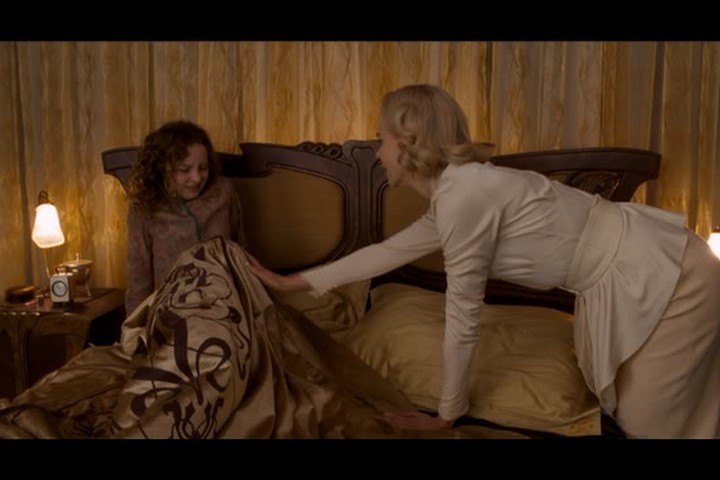
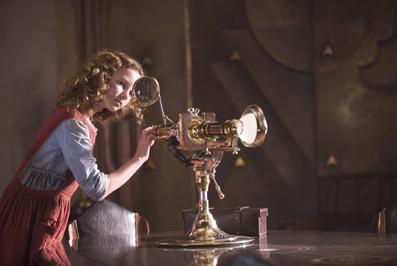
The series is set in the present/near future so steam power is a thing of the past and the story has nothing to do with Victorian England or an alternate history, but the parallel universe Lyra Belacqua inhabits has some decidedly Steampunk elements to it. The images in this post are all from the 2007 film release of The Golden Compass.

First, England gets “punked.” Lyra lives at Jordan College within Oxford University, which doesn’t exist in our universe. She later travels to an alternative London with dirigibles floating over head and horseless hansom cabs, apparently their answer to the automobile.
The spaces that she inhabits in while in the power of the evil Mrs. Coulter remind me a lot of the work of Alfonse Mucha (1860-1939).
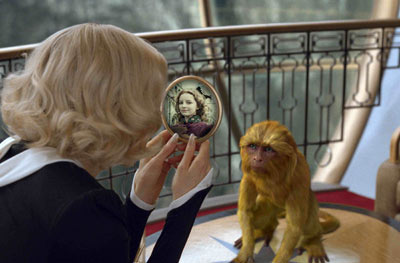
There are also so some fun alternative technologies, for instance, a projector (which they call a spirit projector) that uses glassy orbs to create 3D, moving images of of the mysterious Dust (which is basically powdered sentience). The bad guys also employ “spy flies” which are clockwork insects “with a bad spirit pinned to it” and sent to locate Lyra and her band.

Fun Facts and Context
- The Golden Compass was originally released under the name Northern Lights.
- The trilogy explores contemporary concepts in science such as quantum entanglement (lodestone resonator), dark matter (dust is invisible without the amber spyglass even though in the Golden Compass film they depict it clearly as visible by the naked eye) and human evolution (how did we become “more” than animals? Where did sentience come from?)
- The Golden Compass film stops short of the plot of the first book. The real ending of the Golden Compass is darker and sadder, but I think they stopped where they did in hopes of continuing the trilogy and that needed a more hopeful note.
- Unfortunately, the films of The Subtle Knife and The Amber Spyglass were never made. Many people, including actors in the film, blamed the Catholic church for killing the series. I admit that I watched the movie before I read the books and I couldn’t understand why they didn’t continue and why the church would protest so much. Then I read the books and I totally get it. (Spoiler alert) Even if the story wasn’t overtly about killing god (or at least the one posing as god), there are multiple scenes of a violence against children, like in Citegazze (a city in another alternative universe), that would have been hard to stomach on the silver screen.


 For Whom the Gear Turns