Review: Action to the Word’s Dracula at Ed Fringe 2014
When I got my tickets for this Steampunk rendition of Bram Stoker’s novel I had no idea it was a world premiere. The packed house was rowdy even for a 9:20pm start time, aided no doubt by the chaos in the Pleasance courtyard below. The set is composed mostly of low scaffolding that is used athletically by the extremely physical Dracula and co. I love a show where the actors are also the musicians, and this ensemble included not only the essential elements of a rock band, but also a violin, bass, flute and cello that were expertly played and nearly flying across the stage in this extremely energetic performance. The costumes were fantastic, especially those of Mina and Lucy and I coveted every corset.
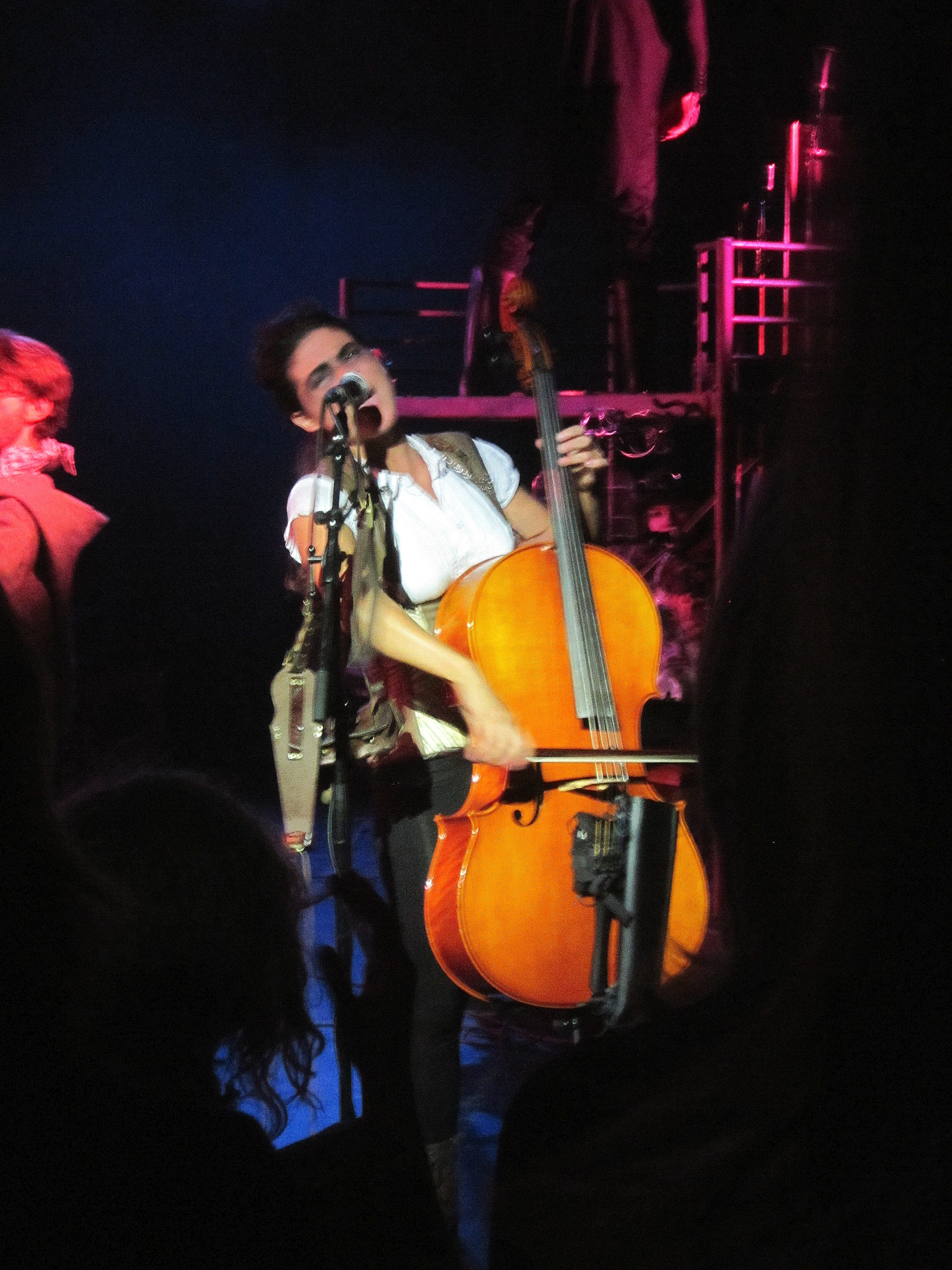
Dr. Joanna Seward rocking the strings.
The director, Alexandra Spencer-Jones, made some interesting choices with gender, most obviously making Doctor Seward female. One of Dracula’s ‘wives’ was male, which also added an interesting twist to the story that everyone thinks they know. This was definitely an adaptation of the famous movie, using many of the details that were added to the film that never appeared in the book. But, they made some other additions like great stage combat and a more empowered Mina for their own flavor and I really enjoyed the whole performance, which included original songs as well as covers of some unexpected ones.
The only downside was the audience itself. One girl in my row got nauseous from the special effects blood (of which there is a lot, so be prepared if you are squeamish), but the worst were the idiots who laughed over and over at inappropriate moments. For some reason just the name Van Helsing elicited giggles. These were also the same people who gave a standing ovation at the end though, which makes me think they were probably friends and family of the actors and were reacting more to seeing their loved ones acting strangely than to the acting itself, which was great. Renfield’s crazy and Lucy’s delirium were fantastic, and the manic Dracula was alternatingly sensual and spasmatic (in the best possible way).
The company, Action to the Word, has been touring all over the world with its version of A Clockwork Orange, and this is their newest addition to theater scene.
Get your Ed Fringe tickets here: tickets.edfringe.com/whats-on/dracula
There is more than one Dracula at Fringe this year, so make sure you get tickets for the right one!
Review: Victorian Vices at Ed Fringe 2014

The Durham-based company, Another Soup, has two back-to-back shows this year at the Space on Niddry St. Both are promenade musicals, meaning that the actors move in and out of the audience to give them an immersive experience. I have never seen a show like these before and I thought the approach was interesting, though better suited to Sweeny Todd and the String of Pearls than to a Picture of Dorian Gray. In Sweeny Todd, the ‘ladies of the night’ and other patrons of Mrs. Lovett’s shop wend their way through the audience going through purses and trading hats with members of the crowd, which was engaging and silly fun during a tale of gruesome murders. But the side characters in Dorian Gray were aristocrats (though similarly gin-soaked by the end) which didn’t lend itself to the same treatment, and the larger crowd made it difficult for a short person stuck in the middle of the pack (ie, me) to see most of the action.
The lighting situation was also more favorable to Sweeny Todd, and faces were never lost behind the shadows of the audience, where Dorian Gray could have benefited from even one light in Dorian’s chambers when tall patrons between the single bank of lights and the small but lovely set sometimes totally obliterated the well-executed efforts of the cast. The audience is expected to stand and move about during the shows, as well as occasionally dancing with the actors, something I wish I had known before spending the whole day at the National Museum of Scotland and then seeing the shows one after the other. By the time I got home my feet were killing me! So be prepared if you are planning to see them both. (People with health issues are welcome to sit during the performances but they will definitely miss some of the action.)
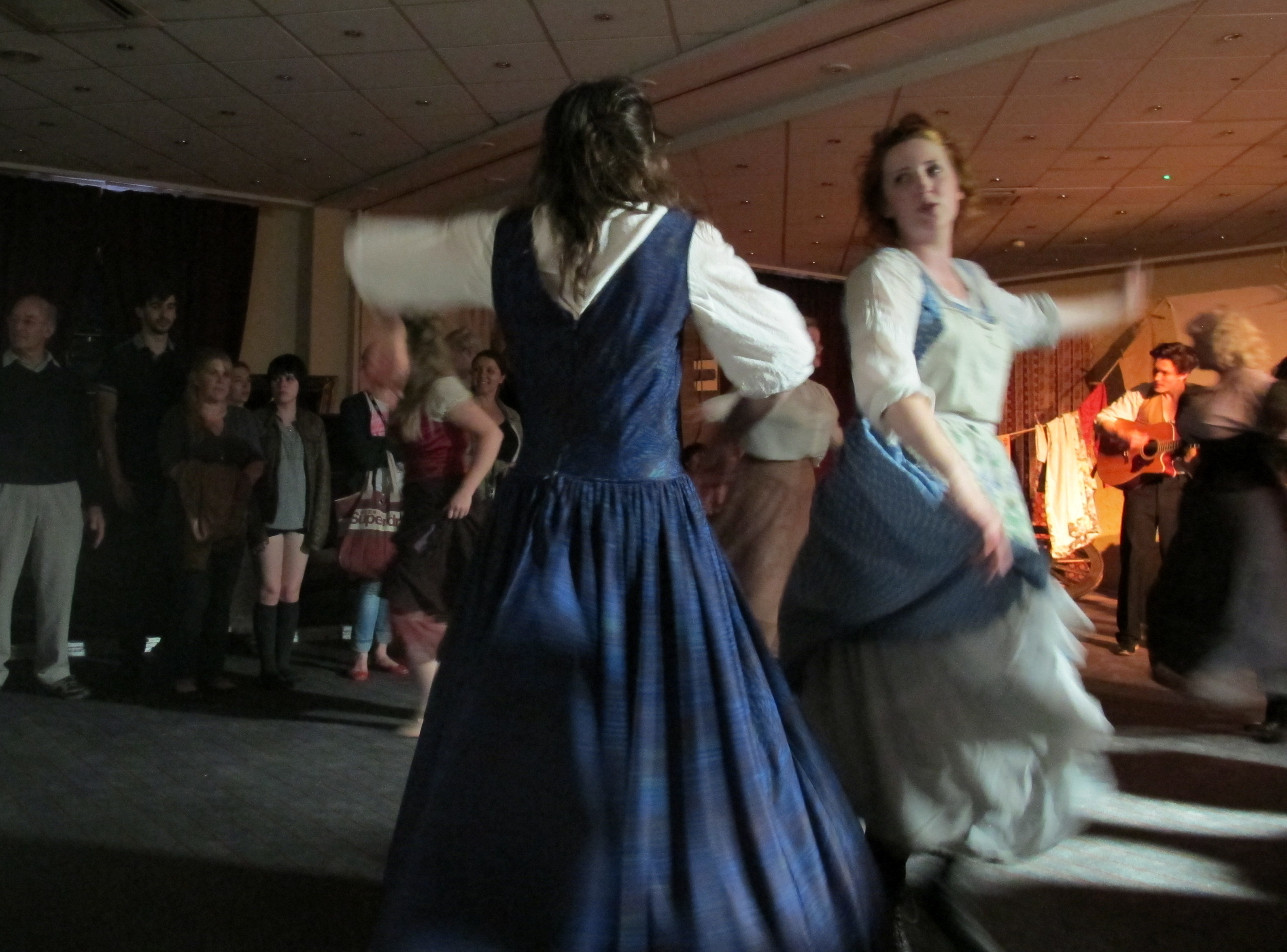
Captured surreptitiously but posted with permission during Sweeny Todd
So let’s take them one at a time.
Sweeny Todd and the String of Pearls is adapted from a serialized tale called The String of Pearls: A Romance, which took place in 1785 and was first published as a serial in 1846-47. The story has been adapted for stage and screen many times over, but in case you aren’t familiar with it, here’s the short version. Sweeny Todd is a barber on Fleet Street in London. He kills his victims (sometimes through breaking their necks and sometimes giving them too close a shave with his straight-edge razor) and then disposes of the bodies by giving them to his neighbor, Mrs. Lovett, to bake into meat pies at a time when meat is very scarce in the darker corners of the city. In Another Soup’s version, the story takes place in the 1850s during the Great Stink and the Cholera epidemic of 1858 but the main plot is still the same. Depending on the adaptation, Todd and Lovett are business partners, friends or lovers, and in this version they are most decidedly the latter, sometimes carrying on their affair while the main action of the show takes place elsewhere. It is Todd’s affection for Mrs. Lovett, who commits the first two murders, that leads him to help her with the cover up and makes him her “supplier” for her meat pies. Business is booming so Lovett needs an assistant, which eventually leads to their discovery and downfall.

Captured surreptitiously but posted with permission during Sweeny Todd
The music was played by a live band including an accordian that sometimes was in the thick of it with the actors. The enthusiasm of the cast was infectious and the singing was well blended and balanced. I enjoyed having the sound come from all around me when the actors were sprinkled throughout the crowd. Todd and Lovett were very well cast and did a splendid job, as did the playful smaller parts. Unfortunately, if you are right next to the band you lose a lot of the lyrics, which were in general much stronger writing than the dialog. The music is clearly the focus of the show, but when the actors don’t have mics it can be hard to follow.
For the best experience, I would suggest that you stand near the corner of the room where the two sets come together so you can get the most out the singing but still hear the music clearly. Be prepared to move during the show and come back together in a different configuration. I loved this aspect because it allowed people who had not had as good of a vantage point in the beginning to see more of the show later. So even if you start out at the back, be patient and you will get a chance to see, plus more of a chance to interact with the side characters. The crowd for this show was smaller than for Dorian Gray, and I think the group of 30 or so in the audience is the right size for the venue.
 After about a 30 minute break where we rested our feet by sitting on the stone steps outside, we went back in for round 2. The Picture of Dorian Gray was the first show I found on the Ed Fringe docket to write about for Victorian and Steampunk inspiration and I was the most excited to see it. Sweeny Todd I had seen as a musical before, but never Dorian Gray and I was intrigued. The story centers on Dorian, a lovely youth seduced by the delectable debaucheries of the Victorian age, his mentor, Lord Henry Wotton, and the painter of his portrait, Basil Hallward. Upon seeing his portrait, he wishes that he could always stay as young and beautiful as it is, and in wishing makes a pact with the devil. Dorian falls in love with an actress, but later rejects her when she wants to quit the stage, which leads to her suicide. When he later looks at the portrait, it has changed and started to become ugly to reflect the decay of his soul while he remains the same.
The three main male roles were perfectly cast, though I think the strain of so many performances was starting show in their voices (and who can blame them!). The music and especially the female chorus voices were lovely (and the “sisters” steal the show), though they sometimes overpowered the male soloists who were singing very low in their ranges, which makes it harder to project in a room without very good acoustics. They were all very true to their roles and stayed in character, even when I saw one audience member start to giggle in Henry’s face during a dramatic moment in the closing number. So, well done to the cast for making the most of a less than ideal situation.
The crowd was larger, and I think on the whole taller, which meant I could not see nearly as well as during the first show. At least half of the action takes place right in front of the band, and so directly in front of a bank of stage lights which also made it harder to see. I would love to see this show again staged as a traditional musical where I could get all the action from start to finish. (I think the best place to stand for this one is near the free-standing gas lights on the near wall as you enter the space.) Because I knew the basic story already (though I haven’t read the original yet) I wasn’t surprised by the turns of events, but I didn’t feel that the dialogue did enough to move Dorian from one stage of his thinking to another. I would have liked to see him first fall in love with his painting and then become jealous rather than his first reaction to be disdainful. I also liked that the homosexual undertones were brought to the forefront, but I found the scene where Dorian and Basil kiss to feel strange and I expected to see Basil more swept up and given hope rather than saddened. But on the whole the acting was very good even if the actors made different choices than I would have.
If you only choose one Victorian Vices show to see, I would say go with Sweeny Todd for the dynamic staging and charismatic Todd and Lovett. Dorian Gray was very well done, it just didn’t work as well in the space. If you have comfy shoes, they are great to see back-to-back for a great night of entertainment. The soundtracks for both shows will be available soon, and I highly recommend them!
Both shows are running from now until the 23rd, so don’t miss your chance to taste a little vice.
Get tickets here: tickets.edfringe.com
Learn more about Another Soup at their website: www.anothersoup.co.uk
The Concept Art for Adventures of Victoria Clarke Will Definitely Get Your Gears Going

My blogger buddy Bia Helvetti just pointed out this amazing movie-in-the-making and I couldn’t wait to share. According to the website for Adventures of Victoria Clarke:
“Stylistically, “Victoria Clarke” borrows heavily from the world of Steampunk, and its sub-culture sometimes referred to as Dieselpunk. Unlike traditional steampunk, which is Victorian-based, we are rooted in the pre-WWII world of Hollywood, and so borrow technology from World War I and Art Deco design influences. However, because Victoria’s family is solidly rooted in Victorian London, fanciful technologies, the designs of Edison and Tesla, and the writings of HG Wells and Jules Verne heavily influence both the design aesthetic and story elements.
The story is based in history, yet features fantastical machines, characters and events that only exist in the alternative reality of our created world. The tone is fun, retro and sexy, and punctuated with periods of intense comic book style action.”


The film was partially funded through a crowdsource website called Indiegogo, but they were short of their goal so proceeding has been slow. The website was last updated in June though and reports progress on the screenplay as well as the amazing images above. The plan is to make not only the movie, but a graphic novel series as well. I really hope to see more progress on this enterprise, it looks amazing and the character of Victoria sounds really interesting. Here is another blurb from the site about how she is more than just a pretty face:


Steampunk Book Review: The Strange Case of Dr. Jekyll and Mr. Hyde
 I have seen several adaptations of R. L. Stevenson’s novella, including an amazing British series called Jekyll that follows one of the not-so-good doctor’s progeny in modern times. One of the amazing parts of the story of this book is how it immediately caught the imaginations of the public and was adapted for the stage within a year of its publication. But I realize recently that I had never actually read the slender tome myself.
Unfortunately, the big reveal that Henry Jekyll (properly pronounced JEE-kill, I recently learned) and Edward Hyde are one and the same is the one part of the tale that is always consistent across all adaptations, so it is impossible for the story to titillate and surprise in the same way it would have been for readers in the 1880s. The idea of a split-personality has long been linked to this piece of literature, and the names of the title characters are part of our vernacular.
BUT, this doesn’t mean the book isn’t worth reading. I really enjoyed Stevenson’s prose, and it is always interesting to return to the source. I surprised to find that in the original that nature of Jekyll’s original “sins” that lead him to want to extricate his two halves from each other are never mentioned, and the details of Hyde’s antics are equally left to the imagination. In order to stretch the story into a full-fledged play or movie the adapters have had to fill in some of these details, which can really alter the tone and nature of Hyde. For instance, in The League of Extraordinary Gentlemen, Hyde reveals to Mina that Jekyll occasionally had ‘impure thoughts’ about boys, and his overwrought Christian guilt made him consider himself a great and terrible sinner when really he was a pretty boring and upright citizen.
In the foreword to the collected works of Stevenson in which I read the mere 60-page novella, Claire Harman recounts a story of Stevenson seeing a theatrical adaptation in 1887. He is all but horrified to see Hyde depicted as “an unbridled womanizer” because, as Stevenson wrote to John Paul Bocock, “The hypocrite [Jekyll] let out the beast in Hyde… who is the essence of cruelty & malice… these are the diabolical in man– not his poor wish to love a woman.”
I found the ambiguity in the story itself very intriguing, and it seems ripe for someone to explore not only the exploits of Hyde during his short life, but Jekyll’s past and his other experiments that are only hinted at in the original. I was also surprised to see that the Hyde of the original story is nothing like the huge monster versions in Van Helsing and League of Extraordinary Gentlemen, but a tiny, young and underdeveloped man who does not have amazing strength, but unbridled passions.
Steampunk Book Review: First Men in the Moon
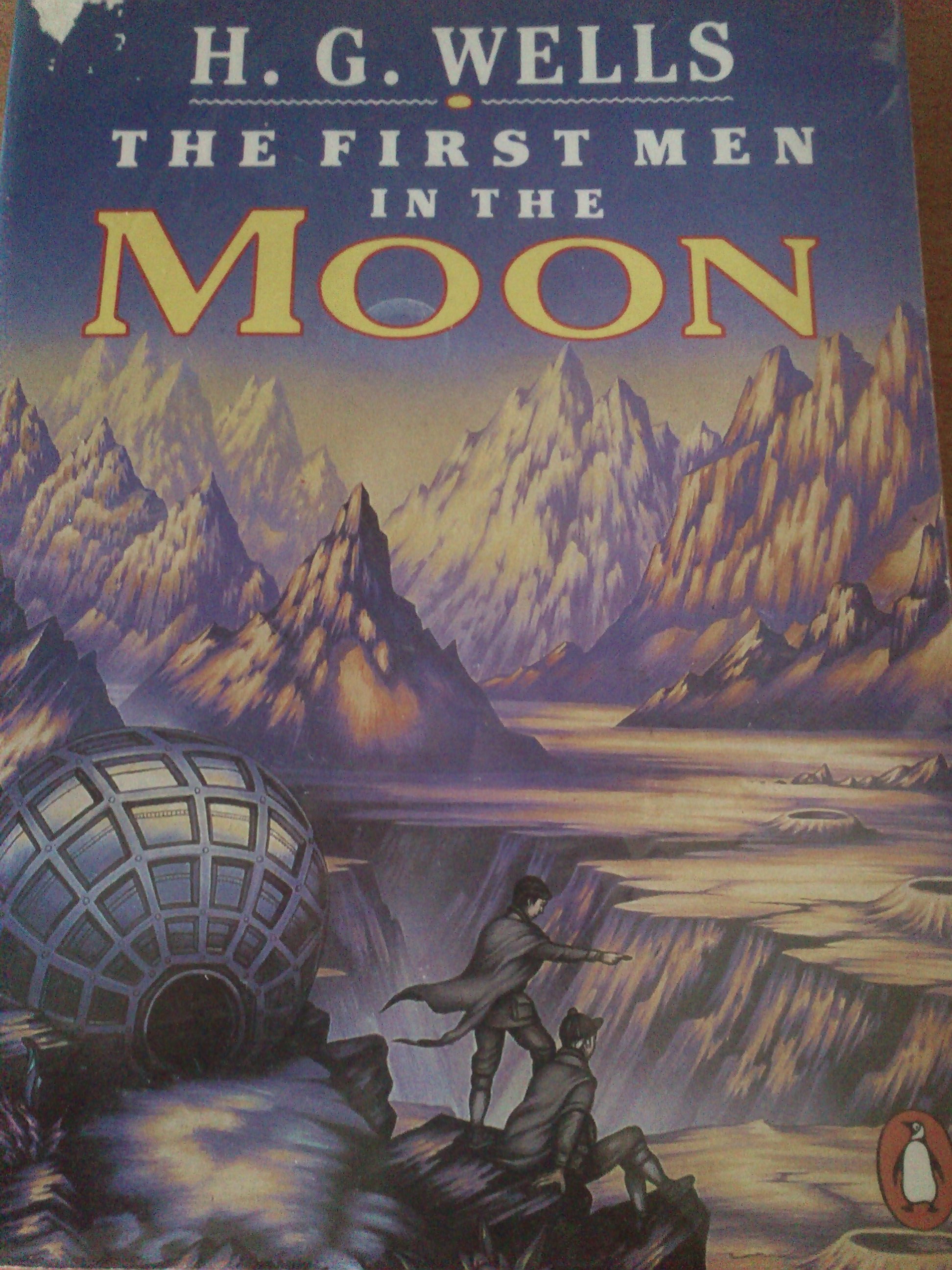 I have yet to meet an H. G. Wells book that I didn’t like, and First Men in the Moon is no exception. His scientific romances are always full of interesting concepts and he was all for turning Victorian ideals on their heads even during his own time.
When I was making my list of books to read I repeatedly called this one First Men on the Moon by mistake, but truly it is a tale of going deep inside the Moon to visit a strange, insect-like race that inhabits its Swiss cheese like interior. During Wells time, astronomers already knew that the Moon was made up of material similar to that of the Earth, but they also knew it was only about 1/3 the density. Their highly logical, though we know now totally wrong, conclusion was that the moon must be filled with tunnels that ran deep into the sphere. (In case you are interested, we know now that the Moon was basically made from an impact way back in Earth’s infancy, long before water had condensed on the surface. A large portion of the crust of the Earth was thrown into space and reconglomerated into a new sphere, leaving our iron core behind. The core of the Earth accounts for the difference in density.)
People first reach the moon thanks to an ingenious new metal called Cavorite, which is so named for the Doctor Cavor who creates it. His concept is that there are materials that are “opaque” to difference electromagnetic forces like light, and gravity is another such force. By combining different metals and chemicals, he is able to create a metal sphere that carries himself and the narrator off on their adventure to a Moon far different from what the Apollo astronauts found. Wells explanations of the natural history of the moon and its various species is especially enchanting if you have any biology in your background because the system of their society holds together with a totally inhuman but wonderful logic all its own.
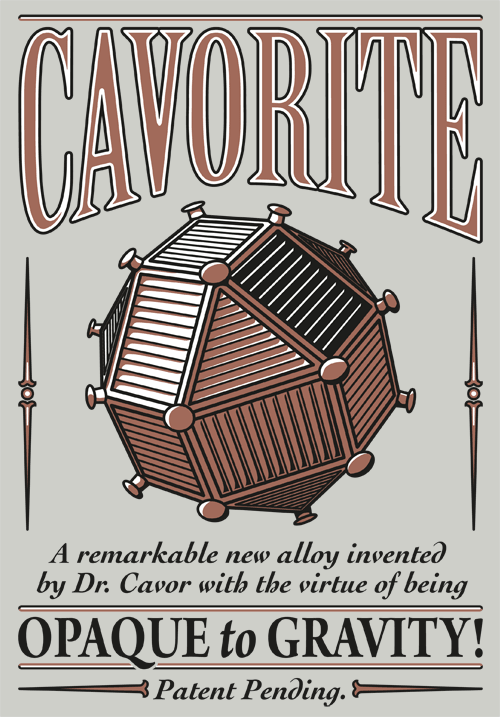 I would definitely recommend this book, it was a fast and interesting read. I thought his portrayal of the detached and socially inept scientist Cavor was especially interesting, as well as seeing how the narrator and Cavor both interpret the same events differently.
By the way, did you know that many of Wells books are no longer under copyright, so you can get them for free? I read my copy on a Free Books app for my Surface, but you can also find them many places online.
Want to read more of my book reviews? Check out these: The Strange Affair of Spring-Heeled Jack, The Iron Jackal, The Clockwork Angel, The Time Machine and The Island of Doctor Moreau.
Steampunk Book Review: War of the Worlds

To help me get ready for the H.G. Wells Sourcebook I am going to write for Steam Tour: An American Steampunk in London, I decided to read several of his scientific romances. I read the Time Machine and The Island of Doctor Moreau several months ago, but it is always interesting to read an author’s whole canon in quick succession. My goal is to read War of the Worlds, First Men in the Moon, Tales of Space and Time and The Door in the Wall at minimum before the ezine comes out, but if you think I am missing something even better than what is on that list let me know!
My experience with War of the Worlds was a bit backwards, because I read League of Extraordinary Gentlemen Vol. 2, and the events of that book are closely related to Wells classic tale, and very faithfully adapted it turns out.
Like many of Wells books, this story started as a serial in magazines rather than as a novel from the beginning. The serial ran during 1897 and it was later compiled into a book in 1898. It is divided into two parts, The Coming of the Martians and Earth Under the Martians. The name of the Surrey-based narrator is never revealed, and he tells the harrowing adventure through his eyes as well as through his brother’s account of what happens to London itself when Martians descend and start an invasion.
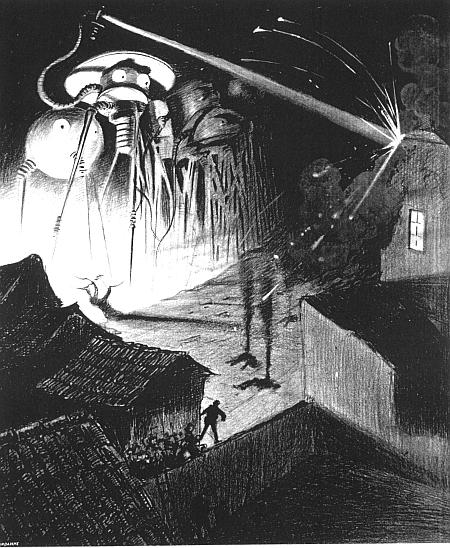 One thing that I love about Wells stories is how much of the scientific knowledge of the times he includes in his tales. For instance, the arrival of the Martians is preceded by strange explosions visible on the surface of the red planet, and it takes the Martian pods several weeks to arrive to the outskirts of London. It then takes over a day for the metal to cool down enough for the pods to open. In the meantime, people have started to gather and even sell refreshments around the first pit where they crash-landed. I love that detail, and I absolutely believe it would happen that way. Soon, the festival atmosphere turns to terror when the Martians assemble their deadly heat ray, our narrator only escaping because he had been sent on an errand and was not in the pit with the scientists who first try to make contact. Through a series of near-misses and some quick thinking, the narrator survives the first wave of attacks by the be-tentacled Martians and their huge fighting machines, and tells the story of (in his view) the apex of society falling to pieces in the face of a cold and calculating enemy. He is surprisingly pragmatic about the whole affair, often likening the human race to insects or rodents who are disturbed by the machinations of people. This is not true of most of the people he meets on his way though, and there are several different kinds of madness worked into the narrative.
This is a tale of invasion, but also of devotion between a husband and wife, which took me by surprise. I have only just started to look at Wells personal life, but he carried on a number of affairs during his second marriage after divorcing his first wife, so the commitment shown by the narrator seems inconsistent with what I know of the author.
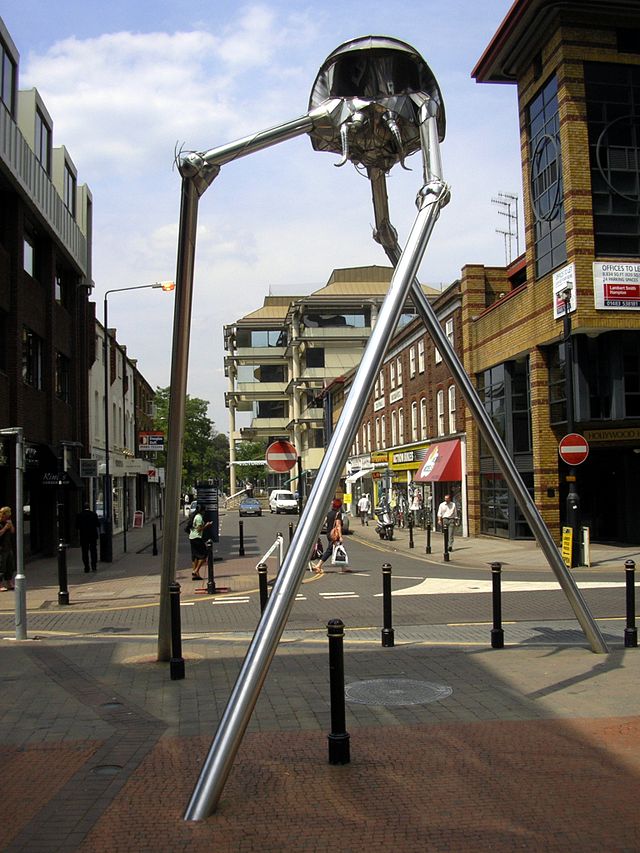 The first time I ever heard of War of the Worlds it was the story of its broadcast on Halloween 1938. The accounts vary, but in the days following several newspapers reported a wave of fearful folks who believed a real invasion was taking place. They opted to present 40 minutes of the hour-long tale as a series of simulated news bulletins, and this coupled with a lack of commercial breaks added to the realism. There was a disclaimer at the beginning of the show, but anyone who tuned in late could have gotten the impression that they were hearing something that was going on in real time. Most likely, the newspaper accounts of a panicked populace were blown out of proportion because of the competition between traditional print media and the new radio technology. (What?! The news was sensationalized? Never!)
I can definitely see why this book has been adapted and re-adapted several times and in different media. The aliens and their technology remains alien and stands the test of time better than say, First Men in the Moon. It is definitely worth a read, not just because it is a classic but because it is a genuinely interesting social commentary that transcends the time in which it was written.
Have you read it or seen a movie version? What did you think?
Gearing up for Steam Tour: Dorian Gray Double Feature

There are two shows at Edinburgh Fringe Fest that reinterpret Oscar Wilde’s The Picture of Dorian Gray (1891) and I hope to see them both. In case you don’t know, Dorian (who makes an appearance in the League of Extraordinary Gentlemen) is an immortal. There is a painting of him that ages and becomes gradually more and more hideous to reflect the degradation of his soul, and if he ever looks at it the spell is broken and he will die.
Here are the descriptions of the two shows:
Victorian Vices- The Picture of Dorian Gray
London, 1859. The wealthy young man, Dorian Gray, arrives in the piteous promenades of Piccadilly and begins to model for artist Basil Hallward. He meets the incorrigible Lord Henry Wotton and makes a life changing decision, which amazes and appals friends and foes alike. He indulges in the variously sordid Victorian vices of the times, tainting his acquaintances and using his wondrous looks to turn all those he comes into contact with away from the light. Original, immersive promenade musical.
| Category | Theatre |
|---|---|
| Genres | Site-specific, Musical theatre |
| Group | Another Soup |
| Venue | theSpace on Niddry St |
| Times | 20:00 |
| Suitability | 16+ |
| Duration | 1 hour 40 minutes |

A collaboratively devised creative adaptation of Oscar Wilde’s The Picture of Dorian Gray in a high impact Berkovian style, putting a new spin on the classic tale of the pursuit of hedonism and the destruction of the human soul. Performed by six promising young actors from Dorset.
| Category | Theatre |
|---|---|
| Genres | Physical theatre, Devised |
| Group | The Egg Theatre Company |
| Venue | Greenside @ Nicolson Square |
| Date | 14-16 August |
| Time | 10:20 |
| Duration | 40 minutes |
| Suitability | 16+ |
When I get closer to Steam Tour I will post a schedule of when I intend to see which shows. Maybe I will see you there!
Hustlers, Harlots and Heroes is a Must-Have Resource for any Steampunk Author

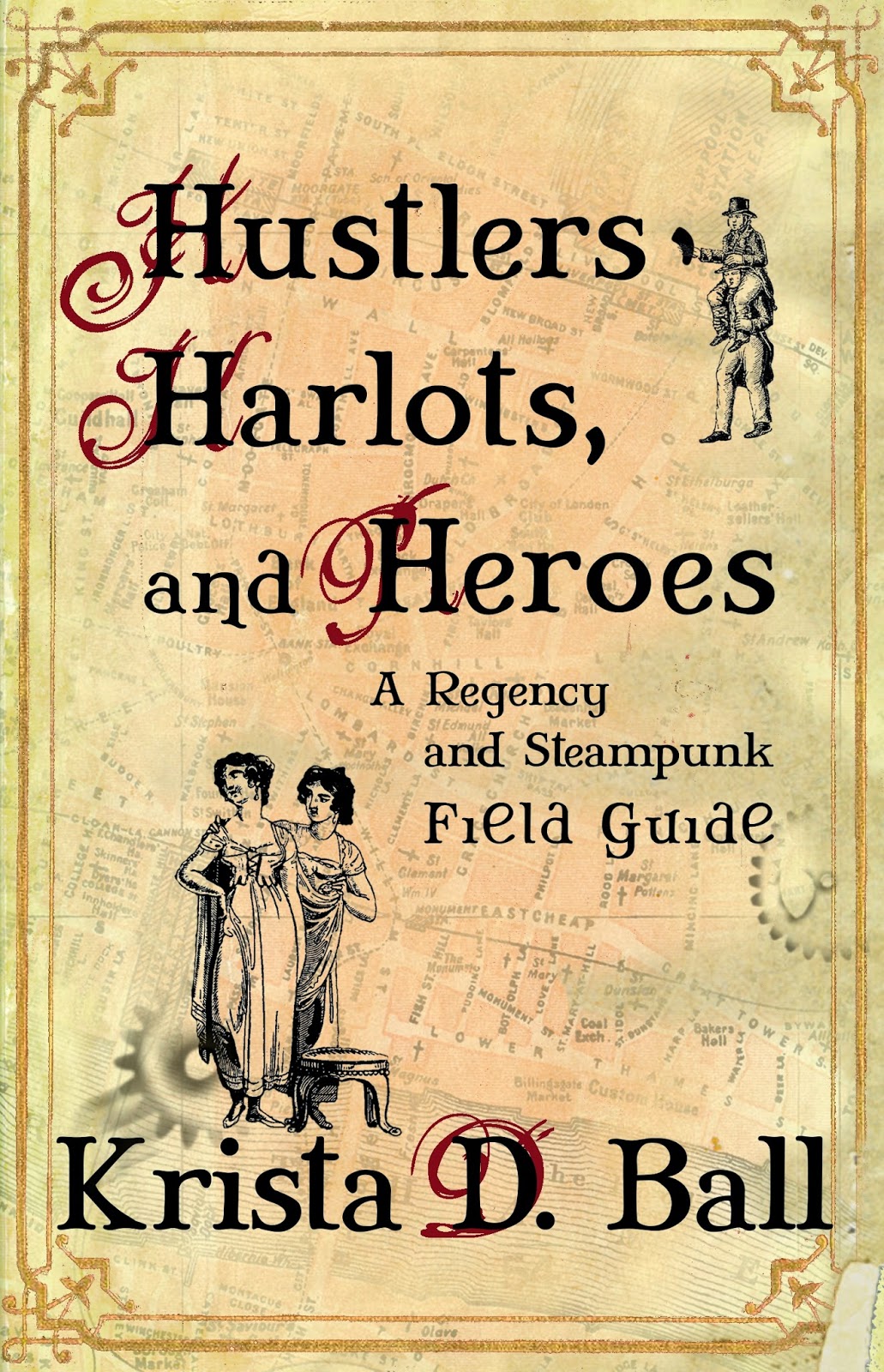 As part of my preparation for Steam Tour I picked up a great little reference volume by historian/geek Krista A. Ball. Hustlers, Harlots and Heroes: A Steampunk and Regency Fieldguide tells the story of the untold, the people who populate your Steampunk imaginings but are rarely the focal point. She brings you the inside scoop on the maids, footmen and even your friendly neighborhood knocker-upper (think alarm clock with a stick) to offer readers and writers a window into how the 99% really lived during the Regency and Victorian eras.
Ball’s first reference book, What Kings Ate and Wizards Drank, also sounds like a lot of fun, but so far I have only read Hustlers. Both books include recipes that you will want to make at home (and some like tooth paste made from cuttlefish that you’d never EVER want to try) in addition to some great background information and delicious tidbits to add depth and interest to your own Steampunk projects.
Let me know if you have any ideas for other reference books I should read before Steam Tour starts in August! I finally got a reliable internet connect here in Greece so I hope to go back to posting more often and letting you know all the amazing Steampunkery that is to come.


 For Whom the Gear Turns