Mysterious Island (2005) Both Adds and Subtracts from Verne’s Story

 I caught this quirky two-parter for the first time close to when it first aired in 2005. I wasn’t familiar with the Mysterious Island book, but the premise sounded fun and I was familiar with several of the actors. During my research I found several people who say their favorite rendition is from 1961, but I haven’t had a chance to see that one yet. So during March I will bring you reviews of adaptations in 2005 and 2012.
Quick book synopsis: During the American Civil War, five people escape a POW camp in Virginia by stealing a reconnaissance balloon. They end up crash landing on a tiny island off the coast of New Zealand. Their chances of survival seem bleak, especially with bloodthirsty pirates afoot, but thanks to a mysterious benefactor they create a cozy home for themselves. It turns out that their “host” is none other than Captain Nemo, who has retired the Nautilus and now lives with a single servant on the island. (Note- the chronology of 20,000 Leagues Under the Sea as it relates to this book is problematic. The American Civil War ended in 1865, but 20,000 Leagues takes place in 1866, which means the war would have been over before the events of The Mysterious Island.)
 Now onto the movie. It originally aired on the Hallmark Channel in two, 90-minute parts. This makes it a big commitment for a single evening. In this version, the lead role of the engineer and Union soldier is played by Kyle MacLachlan (Sex in the City, Agents of S.H.I.E.L.D.), and in place of two of the soldier-types they substitute a comely widow (Gabrielle Anwar) and her teenage daughter. They also decided that building up the mystery surrounding Nemo (Patrick Stewart) wasn’t worth their time, so giant CG animals are added to the mix. The pirates, lead by Vinnie Jones (Snatch, Lock, Stock and Two Smoking Barrels) also get a more central role in the plot.

The Nautilus (which is waaaaaaaaay too small)
Though this is technically not a mockbuster because it did not accompany any big-budget release with a similar name, I would file this under that heading in terms of quality. The graphics were probably pretty good 10 years ago when it came out, but look pretty choppy and fake by today’s standards. I actually dug the addition of the monsterous creatures because it added action to what would be a pretty boring film, but my inner geek has to complain for just a second. I am perfectly fine with suspending my disbelief enough to buy into the explanation that the animals got really big because there was radioactive material on the island, I can live with that. But the uber ant was like 20 times bigger than the XL rat. Proportions people! Ok, I am done now.
So, yeah, if you like giant insects and a plot dripping with pirate-itude, then by all means, check this one out (both parts are embedded below). If you are trying to get your hands on a faithful portrayal of Verne’s vision, maybe try to find the 1961 version instead.
Steampunk Book Review: 20,000 Leagues Under the Sea
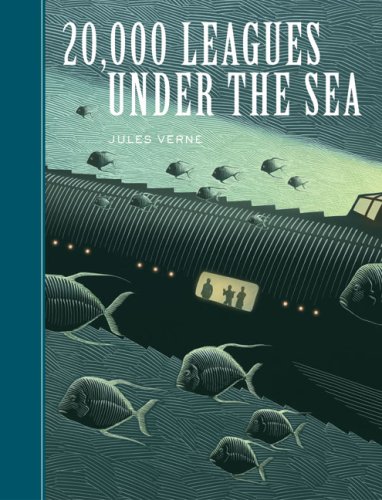 Even if people aren’t a fan of science fiction, chances are they have heard of this book or seen the 1954 Disney movie version. If you read my review of Around the World in 80 Days, you know I am only lukewarm on Jules Verne’s writing style, but I’ve read a few different Steampunk books that use Captain Nemo as a character, so I wanted to go back to the original source to learn a bit more.
It all begins with the mysterious disappearances of various vessels in 1866. Many believe a giant sea creature is behind the attacks, and the narrator, a French marine biologist named Pierre Aronnax, is enlisted to aid in the search while visiting New York. He departs from the United States along with his faithful manservant, Conseil, and together they join a team of explorers including a Canadian harpooner named Ned Land. Shortly after setting out, the intrepid team encounters the creature, only to find it is in fact an incredibly advance submarine captained by one of the most famous figures in all of Steampunk literature, Captain Nemo. The rest of the story details the journey of Aronnax, Conseil and Land as they criss-cross the globe as Nemo’s prisoners.
20,000 Leagues Under the Sea was incredibly well-researched. I used to work at an aquarium, so I probably was able to get a bit more out of it than the average reader, because the narrator, Aronnax, goes into exhaustive detail about the different marine animals he encounters while traveling the seven seas with Nemo. I would like to read it again some day, but this time I would make sure to find an illustrated version. When the story was originally published as a serial in Magasin d’Éducation et de Récréation from 1869-1870 it did not include any illustrations, but since it was compiled as a novel a few years later there have been several illustrated and even a graphic novel version of the tale.
But, this meticulous detail can also be a drag. The Mister and I read this one out loud as we often do with the books I review, and even though I have my science background and he is a Roman historian, we both stumbled over the multitude of Latin names. Though of course it makes sense to use the proper scientific names of species, both for clarity and because the narrator is a marine biologist, it can make the actual reading a bit tedious. We were about halfway through when my brain was just begging for a giant squid to attack. This bit of action comes very late in the book, and gets a lot more attention in movie adaptations than Verne gave it in the text.

The Nautilus as it appeared in the Disney film
Unlike Around the World in 80 Days, where the indefatigable Passepartout can offer a respite from the monotony of travel, there is no comedic relief in 20,000 Leagues. Nemo is an interesting and enigmatic character to be sure, but I think overall it makes for pretty dry reading. The science in this book is sound, so it holds up to time better than Journey to the Center of the Earth, but for me it wasn’t really entertaining enough for the slog through over 300 pages.
March is Jules Verne Month

Portrait of Jules Verne circa 1878
Jules Verne died in March of 1905, so to commemorate his many contributions to the science fiction canon that have inspired myriad interpretations within Steampunk, I am devoting all of March to Verne-themed books, movies, artwork and characters.
Here are few things to look forward to this month:
Steampunk Sourcebooks for Around the World in 80 Days and Jules Verne himself
Reviews of two adaptations of The Mysterious Island
Unveiling a brand new 3D paper illustration by yours truly
Book reviews of two classic Verne tales
and more!
But there is still space in my editorial calendar for a few more things, so feel free to make suggestions! Have you ever dressed as a character from a Verne novel and you’ve got a photo you want to see on my blog? Do you know some fun facts you think others would enjoy? Let me know : )
The Brothers Grimm Fairy Tale Guide (and Drinking Game)

 One of my most popular posts is my review of The Brothers Grimm movie with Matt Damon and Heath Ledger. The original book of stories, Children’s and Household Tales, was published in 1812, and its English translation was read in nurseries during the Victorian period. This is one of my favorite movies of all time, so I have watched it many times with many different people. Across these viewings, a drinking game has emerged according to the references to the Grimm’s fairy tale collection. There a few instances of fairy tale-like phrases and characters that I haven’t been able to find a basis for in the Grimm’s book, so below is a guide both for people who want to play the game or who just want to know what the movie is referencing.
The rules of the game are pretty simple. Every time there is a Grimm’s fairy tale reference, you have to take a swallow of you adult beverage of choice. These references fall into a couple categories:
1. Fairy tale numbers: The numbers 3 (as in 3 wishes), 7 (dwarves) and 12 (dancing princesses) often occur in fairy tales. This film uses 3 and 12 more than once, so each time one of these numbers is mentioned, take a swig.
2. Phrases: Things like “Once upon a time” and “happily ever after” have become synonymous with fairy tales. Other recognizable tropes are “the fairest of them all,” “true love’s kiss,” and “Mirror, Mirror on the wall.” So any time you hear these types of phrases that ring a bell from a childhood tale, swallow away.
3. Direct references: There are tons of verbal and visual references to classic fairy tales throughout the film as well. The writers combine several tales into single characters, so there may be several times to drink stacked on top of each other. These are the ones that I have been able to confirm using a translation of the original text.
- Jack and the Beanstalk- Magic beans are mentioned at least 5 times
- Briar Rose (aka Sleeping Beauty)- one of the first gadgets they use is said to be from Briar Rose’s castle, and later several girls are put into a magically induced sleep after their fingers are pricked.)
- Little Red Riding Hood (cape, “what big eyes you have”, big bad wolf)
- Godfather Death
- Rumpelstilkskin (Jacob mentions an imp whose name they had to guess)
- The Frog Prince (“kiss a frog” mentioned, and kissing a toad in the woods)
- Hansel and Gretel (Hans and Greta)
- Rapunzel (tower with no entrance, long hair used to escape the tower)
- The Juniper Tree (trees that move. You could play that any time you see a tree move you take a drink, or only the first time when Greta is taken)
- Snow White (old crone with an apple, magic mirror)
- Cinderella (Cavaldi calls the brothers this while making them scrub floors, later glass slippers appear on the feet of a kidnapped girl)
- The Goose Girl- the peasants of Marbaden can occasionally be seen herding geese in the film.

Red herrings: There are other fairy tale references that you will recognize, but they were NOT in the original Grimm’s collection. It is up to you if you want to play the game with or without these.
- Bridge Troll (3 Billy Goats Gruff)- This is a Norse tale, first recorded in 1841.
- Horse infected by spiders- There is a terrifying scene where an enchanted horse swallows a little girl with the aid of the spiders who infected it earlier. Though compelling and in the spirit of the dark tales, I couldn’t find any basis for this in Grimm’s collection.
- The Gingerbread Man- in the film, one of the girls is encased in mud and takes the form of a gingerbread man. This story was not published until 1875, so post-dates the Grimm’s collection.
- The Princess and the Pea- In the film, the evil queen is sleeping on a thick stack of mattresses. But, this is a Danish story recorded for the first time by Hans Christian Andersen in 1835.
- “Huff and puff”- Though there are two “big bad wolves” in the Grimm collection, they don’t blow anything down.
- Ravens as minions- There is a tale in the Grimm collection of seven brothers who are turned into ravens, but in the film the evil queen employs them as spies and to carry someone up to the tower window. Ravens were the minions of Odin in Norse mythology, but are not used this way in the German collection of stories.
Did I miss something? Leave a comment below!
You Can Be Extraordinary Everyday in the World of Penny Blake
 In my experience, Steampunk literature, movies and games fall along a series of spectra. Some stories tend more towards science fiction, with an emphasis on the technology of the time, while others focus on the world of the supernatural with its ghosts, vampires and other things that go bump in the night. Then there is the range of serious, like Whitechapel Gods, to the silly and fun, like Rae Smith and Penny Blake’s new release, The Everyday Extraordinaries: Extraordinary Adventures for Ladies and Gentlemen.
This live action role play (LARP) project has deep roots. Penny has been writing about the whimsical, alternative reality of “New World” for a long time before the larping book became available in September. It all started with Ashton’s Kingdom, which is a graphic novel series that is currently getting illustrated, and The Everyday Extraordinaries blog grew out of it. On that site you can explore the ins and outs of the “Universal Fruitcake Theory” and the benefits of “Cream Power.” In this land, disputes are settled by flinging cake and tea duelling, often with hilarious results.
Even though the title has “everyday” in it, players are encouraged to be extraordinary in a way that fits their schedule. Full-scale larping with friends, or just taking a few minutes to think about adventure is enough to join the rank of the Extraordinaries. The book has beautiful photos of different character types to help you create a persona to fit into the universe, including the Airship Captain, Resourceful Urchin, The Relentless Rogue and the Quiet Scholar. This game is designed to played by like-minded friends as well as being family-friendly to encourage Steampunks of all ages to engage with the content and 10 unique adventure “hooks.” You can decide if you are a law-abiding member of society, a neutral inventor-type or a sky pirate, it is all up to you!
To learn more, check out the website or preview the book on Amazon.
“Heterosexual” is Yet Another Thing Invented in the Victorian Era

I recently ran across and article by Thomas Rogers in Salon magazine from 2012 that was an interview with Hanne Blank, the author of Straight: A Surprisingly Short History of Heterosexuality. I knew that “homosexual” was a relatively new word in our vocabulary, but I had never really thought about its counterpart, “heterosexual.” The article is all about the history of this word and the baggage that got attached to it by psychiatrists and evolutionary scientists in the early days of their crafts, aka the time period that much of Steampunk occupies. I haven’t had a chance to read Blank’s book, but I wanted to pass on a summary of the article.

From the Cover of Straight: A Surprisingly Short History of Heterosexuality
The terms “homosexual” and “heterosexual” appear at the same time. According to Blank’s research, both were the invention of an Austro-Hungarian journalist writing about a piece of Prussian legislation that made certain acts between same-sex people illegal. He was trying to create two categories that were on equal footing as a way to address the hypocrisy of making some acts legal for some people, which the same acts were criminalized for others.
This was sometime in the mid-19th century, but the terminology didn’t really take off until closer to the end of the century. Thanks to the work of Sigmund Schlomo Freud (who is and will always be “Ziggy F” to me) and his acolytes during the 1880’s and 1890’s, people were suddenly being diagnosed with all kinds of crazy stuff. In regards to the term “heterosexual” Blank said it perfectly in the interview:
Psychiatry is responsible for creating the heterosexual in largely the same way that it is responsible for creating the various categories of sexual deviance that we are familiar with and recognize and define ourselves in opposition to. The period lasting from the late Victorian era to the first 20 or 30 years of the 20th century was a time of tremendous socioeconomic change, and people desperately wanted to give themselves a valid identity in this new world order. One of the ways people did that was establish themselves as sexually normative.
Ziggy F’s theories are largely a source of giggles nowadays, but when they were shiny and new they carried a lot of weight in society. The Zigster was more or less a narcissist and viewed himself to be the apex of human psychological development. Basically, if you followed his formula for ‘health’ what you arrived at was a heterosexual (and probably white) male. (Women were already hopeless cases according the F-man. He believed we were all born longing for a penis and it just went downhill from there.)
So now let’s bring romance into the equation. Keep in mind that for much of human history, “love” and “marriage” had very little to do with one another. Marriage was more often than not an alliance between families, more akin to a business arrangement than anything based on desire, and procreation was considered part of the bargain. You didn’t have sex with your partner because you WANTED to, you did it as part of your marital duties. Of course, if you desired your partner in addition to meeting the requirements of your contract then bully for you, but being attracted to your partner was not necessary to pass on the family name.
As I am sure you are aware, society at large was undergoing many changes during the Victorian period, and this is probably a big reason you find Steampunk compelling (I know this is true for me!). Cities were drawing people out of the countryside and crushing them together in close quarters. Women and people of color started to demand the right to vote. Workers began to demand better conditions and wages. And anarchists challenged the very fabric of society with their views. And when times get tough, people fall back on the simplest of relationships, the binary. Breaking a complex world into sets of two categories is much easier than investigating the gray area that lies between black and white. As Blank put it, they started to find an identity that proved their validity in a rapidly changing world.
Also, as people started to demand to be allowed to determine their own futures, they had to stop and think for the first time what it was they WANTED from life. So the question of desire and the shift to seeking out a partner because of your feelings of attraction and love came to the forefront of the discussion for the first time.
Blank’s book goes into far more detail and continues to unpack the term “heterosexual” and its relationship to gay, trans and other terminology and notions into to the present day, but I will leave off here. If you would like more information you can read the full interview, or buy the book.
Lose Yourself in the Immersive World of Stars of Empire


Stars of Empire Cover Art by Rachel Mayo
I am pretty new to this whole RPG (role playing game) scene, but creator Terry Sofian was kind enough to share the games that he and a group of collaborators designed. The first in the “Hive Queen and Country” series is called Stars of Empire and was released in 2011, with a new edition currently in the works. It is a “d-20” game, meaning that players use 20-sided dice to decide their fates during game play, and characters grow and change with each adventure.
Sofian has envisioned a rich alternate history which revolves around the discovery of a mineral that helps humans achieve lighter than air flight at a much earlier time. Between its discovery and the perfection of Babbage’s Analytical Engine within his lifetime, the human race ushers in the space age during the Victorian era. Both in the RPG and on the Hive Queen and Country website, you can see the detailed timeline on which the game and accompanying fiction is based. The shift in the timeline towards greater technological advances deeply influences the geopolitics of the entire globe. New empires are formed, new (and often uneasy) alliances are struck, and some countries, like a United States still reeling from the Civil War is content to keep its head down. For now…
Intrigued? Well wait, there’s more! Within a few decades of leaving Earth’s atmosphere, humans have visited the moon (Luna), Mars and Venus. Luna in this scenario resembles First Men in the Moon, where the hollow body houses a network of tunnels. But unlike the Wells’ story, Luna has been abandoned by its inhabitants. The most troubling discovery is there also appear to be human burials on its surface, and no one knows how they got there. I don’t want to give too much away, but let’s just say that Mars and Venus are not quite so empty. The same care and detail are given to describing the back-story of the alien races as to their Earthly counterparts, and gives another whole dimension to the types of adventures that can be crafted within this world.
So far, I have only read Stars of Empire and it is not for the faint of heart. At almost 300 pages, this is not a game that casual players will be able to pick up and learn in a single evening. But, if you enjoy d-20 games and are looking for a Steampunk world to immerse yourself in, I would definitely check out this title. There are tons of creatures, settings and characters available to create interesting scenarios and keep you engaged. The tone is realistic and the story has gravitas, so be prepared to assemble a group of serious gamers to play with.
In the RPG, Sofian notes that the game can also be played with miniatures to enhance the look, and makes recommendations on the website about where to find suitable aliens and vehicles. Stars of Empire is the first in the series and uses a timeline that ends in 1893, but subsequent books move the timeline forward through the first and second “Hive Wars,” as well as conflicts on Venus. The book includes stunning artwork by several artists including Rachel Mayo and Paul Daly.
You can find all of Sofian’s RPGs in a digital format at RPGnow.com, and Stars of Empire can be purchased in print from Amazon.
Do you enjoy tabletop RPG’s? Have you ever played anything in the Hive Queen and Country universe? Please comment below!
“Big Ben” and the House of Parliament


The House of Parliament and its iconic clock tower date to 1844 and were built after the original building was destroyed by a fire in 1834. Although today we know the tower as “Big Ben,” this is technically the name given to the huge bell that accompanies the world’s largest four-sided clock. The tower has officially been known as the Elizabeth Tower since 2012 to commemorate Queen Elizabeth’s diamond jubilee, and prior to that was simply The Clock Tower.
However, during Victorian times journalists often referred to it as St Stephen’s tower because Members of Parliament (MPs) held their proceedings in St Stephen’s hall. In fact, there is a St. Stephen’s tower on the Westminster premise, but it is much smaller than the clock tower, which is the third tallest in the world. While you can tour the House of Parliament, the tower itself is off-limits unless you are a British citizen with express permission from an MP.


 For Whom the Gear Turns