Don’t Miss Longitude Punk’d at the Royal Observatory

 The Royal Observatory is probably best known for being the home of the Prime Meridian, but I went there to check out an amazing Steampunk exhibit dedicated to “the longitude question.” Thousands of seamen lost their lives because they couldn’t be sure where they were when they were in the open ocean, so the British Parliament implemented a competition in 1714 and offered a reward of 20,000 pounds to anyone who could figure out how to calculate longitude when out to sea. Little did the Longitude Board know that it would be 50 years before anyone could find the answer.
The exhibit, Longitude Punk’d, is set up as a series of submissions to this contest and is intermixed with the Observatory’s collection of real and sometimes bizarre submissions. There are many buildings in the Greenwich Observatory complex, and this exhibition takes advantage of the historic Flamsteed House that sits on the grounds. There is normally already a gallery dedicated to longitude in the house, but for now the Steampunks have taken over that gallery as well as several other rooms as well as the courtyard to show their amazing contraptions and costumes.

The Commodor employed kiwi birds to keep him informed about his position.
Throughout the house you can read “The Rime of the Ancient Commodore,” which is a whimsical epic poem about one of the artists’ alter ego and his unique quest for the answer to the longitude question. His theory? Animals know exactly where they are, so if you can learn to talk to animals, all you have to do is ask for directions 🙂 Make sure to take the time to watch the series of short films embedded between display cases to meet the artists and find out the ideas behind their amazing creations.
The exhibit costs 8.50, but you also get admission to the Cutty Sark and the complementary and more serious examination of longitude at the Maritime Museum called Ships, Clocks and Stars any time within a month of your first visit. It will run between now and January 2015, so don’t miss your chance to get punk’d!


But even if you aren’t in town in time for the exhibit, there is a ton to see at the observatory for fans of the Victorian era, and I am going to post soon about their permanent galleries as well so stay tuned.
More Clockwork Treasures from the Royal Observatory

One of the biggest leaps forward in human history was when we started to use the movements of the stars, sun and moon to tell time. And as far as we know, we are the only animals that do. You may find yourself noticing a slight bend in space and time as you approach the Observatory, or perhaps it was just the long trek up the steep hill that made the minutes seem like hours!
Eventually, humans invented machines to keep track of the units in which we divided the world and some would argue that these machines now rule our lives. But no matter how you feel about clocks and schedules, you can’t deny the ingenuity and skill that has gone into inventing, improving and crafting timepieces. And if you are a steampunk fan, you probably can’t get enough of the shiny gears and complex mechanisms that had their heyday in the 18th and 19th centuries.
The Royal Observatory (also called the Greenwich Observatory) is the home of the Prime Meridian line, and the site for calculating Greenwich Mean Time since the 19th Century. This means that even more than anywhere else it has been imperative that they keep accurate time, and they celebrate this history in their exhibits. After I was done at the Longitude Punk’d galleries, I took a stroll through the rest of the Observatory and I found amazing machines for seeing the stars and terrific time-keepers. I had accidentally used up a lot of my battery during the first half of the day at Longitude Punk’d and the Cutty Sark, but even with a full battery I don’t know if I would have been able to fit all of the beautiful pocket watches, nautical devices and astrolabes onto my memory card anyway!
Here’s a sampling of what there is to see in the history galleries.


In addition to the Observatory, you can also visit the Astronomy Center for free. There are lots of exhibits there for amateur astronomers, as well as London’s only planetarium.
Have you ever visited the Royal Observatory or Astronomy Center? Did you have a favorite part?
Fortnum and Mason

One of the defining parts of the Industrial Revolution was the rise of ready-made fashions and pre-packaged foodstuffs, and on the forefront of the trend was the posh department store, Fortnum and Mason. When the first steam-powered factories were just starting the churn out their wares F&M was already in business, and it continues to be a mainstay of the stores on Piccadilly today.
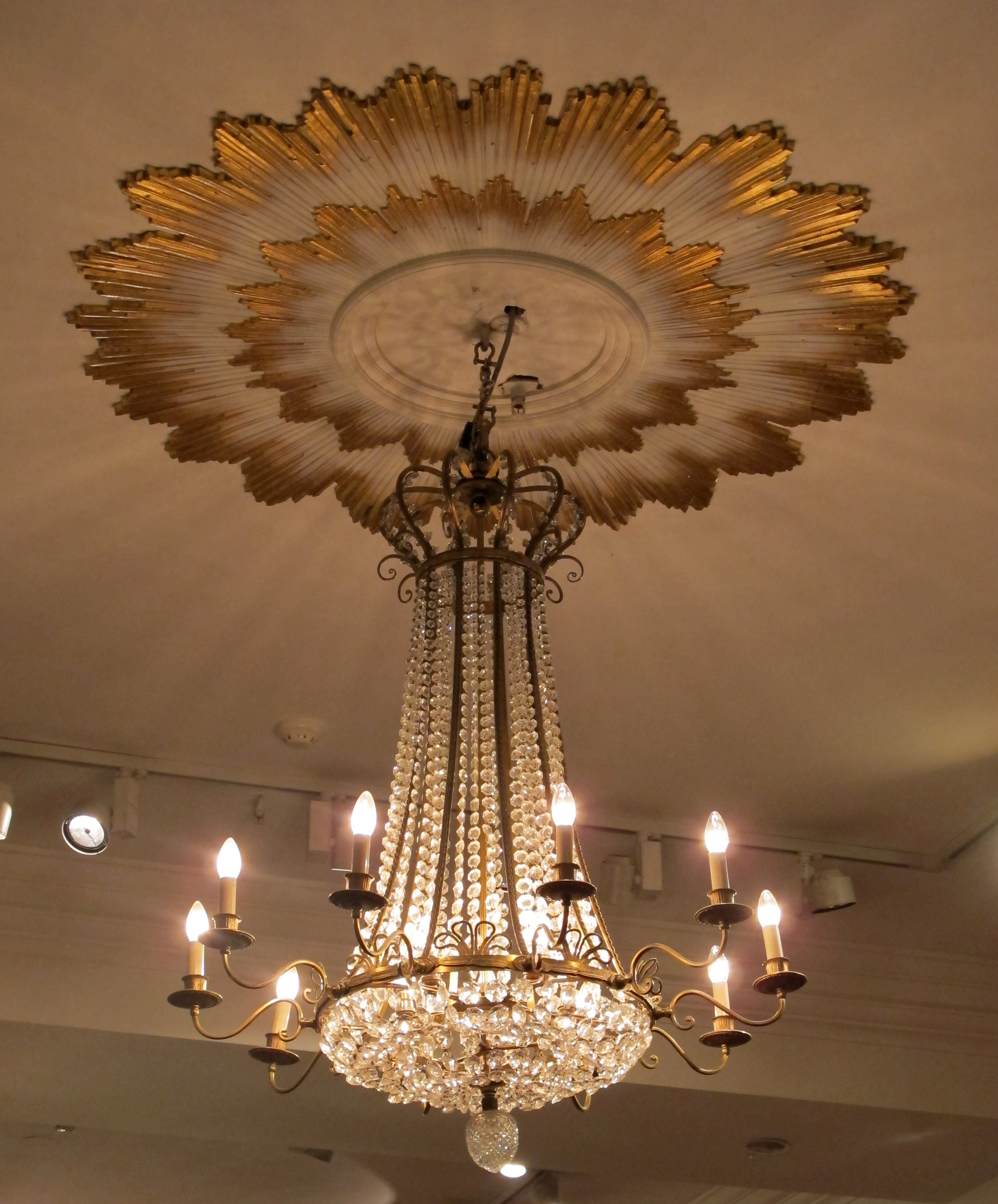
Beautiful crystal chandeliers provide light all over the store
They made a splash at the Great Exhibition in 1851 where they won first prize for their imported delectable desserts and dried fruits. In addition, when Henry Heinz (best known nowadays for ketchup) wanted to market his canned baked beans in the UK, he took his wares there. Within a few years, baked beans had become an important part of the British diet.
In literature, F&M are best known for their picnic hampers and several Victorian authors including Charles Dickens and Wilkie Collins made mention of their characters enjoying a luxurious feast. I am also reading The Difference Engine right now, and the day after snapping shots of the whimsical window displays below I read a passage where the protagonist passed by this prestigious store on his way to buy a wedding gift for his sister. Today, you can still visit and stroll through the heaps of lovely packages tied with bright ribbons and peruse the fanciful fudge of the dessert counter.
As with many luxury goods stores, the prices are steeper for things such as tea and cookies than at a normal grocer, but the ambience alone is worth a stop in at the store, or at least a meander by the window displays!


Steampunk Book Review: The Other Log of Phileas Fogg
Whenever I go a-searching for used science fiction books I run across several by Philip Jose Farmer, but I could never find any in his “Wold Newton” series. The books I could find seemed to be all about space travel and other worlds, but his Steampunk books take place in the alternative past right here at home. I eventually had to order The Other Log of Phileas Fogg online, and I was so excited when the new edition arrived at my door, especially because of the sweet airship on the cover. I am sad to report though that the dirigible of the futuristic past does not actually make an appearance anywhere in the story, and that is only one of several letdowns about this book.
I expected this story to be written like a series of journal entries, but rather it is through the lens of an “expert” interpreting a secret journal and often correcting Verne’s story as much as adding missing pieces. But, one thing Farmer does do is give Fogg his missing back-story. According to this book Fogg was the foster son of an alien and learned special abilities, like the trick of controlling his negative emotions, that aid him on his trek and go a long way to explaining the enigmatic Fogg.
For the past two hundred years there has been a secret war waged between two competing alien species and it is being fought right below the noses of the human race. Both sides have lost the ability to reproduce because their numbers are so few and their females dead, so they take in human foster children like Fogg and Passepartout on one side and Detective Fix and Captain Nemo on the other. The aliens have advanced technology to aid their surrogates and according to Farmer this foreign machinery is the origin of Nemo’s Nautilus. Fogg’s dash around the planet has nothing to do with a wager, but is actually in pursuit of a teleportation device that both sides need for their (apparently same) plots of benign sublimation for the human race.
As I said in my review of the original Around the World in 80 Days (read it here), there are many gaps in Verne’s story that are begging to filled and Farmer was certainly endeavoring to do so. Unfortunately, his approach reminded me of the worst kind of fan fiction where a story gets nit-picked apart to such an extent that it stops being fun to read. For instance, Farmer makes a point of saying something should only take 5 minutes when it took Fogg 10, and harps on the fact that Verne never specifically mentions that Fogg carries a watch.
And then, rather than offering interesting explanations or insights from the “other log,” Farmer commits that cardinal writing sin: the rhetorical question. There are sometimes 6 or more in a row! Maybe this is just me, but I was always told that an author should never, ever do this even once without immediately answering it, and even then it is considered lazy writing. Farmer also makes a point of saying that the book is not a novel, but then writes long stretches of dialog that would never have been recorded in a diary and so have no place in the narrator’s interpretation. I also felt that giving all the credit of the technological advancements to the aliens was a disservice to Verne’s characters and the ingenuity of inventors during the Industrial Revolution.
So in the end, I don’t think I’d recommend this book any more than I would the original in terms of pure literary delight, but it is a great example of Steampunk and someone having fun with classic literature of the Victorian era.
Have you read any Philip Jose Farmer? What did you think?
Steampunk at the Piccadilly Market

I admit, I was expecting something quite different when I walked through the ornate iron gates to St James Square. The Piccadilly Market is a more or less permanent, open-air marketplace that operates 6 days a week. There are merry striped tents and merchants selling their wares as one would expect, but I thought it was going to be bigger, especially because of the long list of traders on the market’s website. I was especially excited because there is a section of that website devoted to the Steampunk offerings there.
Different days have different themes, so I picked the day listed as the best for antiques. I don’t know if this means there are no antiques other days, but I was surprised to see that there really wasn’t much there in the way of vintage stuff. But, what was there was pretty awesome.
Annette Jones is a vintage trader and jewelry designer who is only at the market on Tuesdays. Usually she doesn’t allow photography, but she gave me permission to snap a couple shots of her lovely pieces on display. The average bauble was out of my price range (this pounds to dollar conversion is killing me!) but if you are looking for just the right cameo or vintage ring this is a great place to check out. I especially loved the addition of the lovely antique mirrors patrons could use when trying on the pretties


. You can check out her website for more information, http://www.annettejones.co.uk.
The best booth for Steampunk stuff was definitely one by Ahura Collectibles, which was more or less across the aisle from Annette Jones. The only sign on the booth is for kaleidoscopes, but the other half of the display featured gorgeous refurbished early telephones, leather-bound and wood-sheathed spyglasses and a wide array of vintage compasses. I picked up one of the beautiful compasses with a foldable sundial complete with wooden box for safe-keeping for 18 pounds. I had to think long and hard about which one I wanted because they are all unique, but I was especially drawn to this one because it had the word “London” on it so I thought it would make an especially good souvenir. I would have loved a spyglass as well to add to my Steampunk explorer ensemble I have started to compile, but I limited myself to a nautical keychain made of brass.


This booth is at the Piccadilly market Tuesday through Saturday, and at Covent Garden Sundays and Mondays. Find out more at the website, ahuracollectibles.co.uk
I thought I was going to be able to do a large photo spread about this trip to the marketplace, but because it was so small I didn’t really get as much as I’d hoped.
Can anyone tell me any other places like flea markets or vintage shops in London to visit in the next two weeks?
Oh the Horror!
I never thought of myself as technodependent, but now that I am trying to blog about Steam Tour I am starting to get it. The internet where I am staying has fallen and it can’t get up, so I am relegated to the tiny keyboard on my phone for the mo. The pain! The suffering! The sore thumbs!
I am trying to get as much reading, writing and photo editing done as possible today and maybe the interwebs will find a way to pull a Lazarus for me. Otherwise, to the cafe I go tomorrow to post about my first full day in London yesterday.
Thanks for your patience!
Steampunk Book Review: Around the World in 80 Days

I have been “poorly” as they say here in Britain, meaning that I have been under the weather for a few days, so I didn’t make it into the city yesterday as I had planned. But, with all the trains, planes and automobiles lately I have gotten plenty of reading done in anticipation of my upcoming articles for the ezine, so here is a book review to tide you over until I can start posting about London in earnest.
 I chose to do an in-depth article on Around the World in 80 Days mostly as an excuse to watch the 1956 movie again that I remembered from my childhood, but of course I needed to start with the text itself. I won’t go into a lengthy synopsis here because I will be doing that for my upcoming Sourcebook, so I’ll skip straight to the review.
I really expected to adore this book and it had all the makings of greatness, but all and all I’d say this one isn’t a must-read for a Steampunk or a Jules Verne fan. The voice of the narration is inconsistent and swings between third-person omniscient and totally opaque, especially when it comes to Detective Fix who is pursuing Fogg through his journey on suspicion of bank robbery. I also felt like the action, the real meat of the adventure, was often treated as a footnote with very little description whereas the reader must sit through several pages of Mormon history and detailed itineraries of exactly where their train is stopping. For instance, Passepartout is taken hostage by the Sioux during the trek across America, but all we know if the daring rescue is that Aouda and Fix paced a lot while waiting.
There are definitely gaps that would be fun for an author to try to fill, and indeed Philip Jose Farmer attempted to do just that in his novel The Other Log of Phileas Fogg, which is the next book I will review.
Wrapping up my Experience at Edinburgh Fringe Fest 2014

In all, the Mister and I saw 10 performances and went to one awesome whisky tasting during our time at Edinburgh Fringe Fest, but I couldn’t devote an entire article to each one. Some things were too short for their own post or fell short in terms of quality, and I didn’t want to devote entire posts to negative feedback. But, by putting everything on my posted itinerary it looks like I am endorsing it all, and I can’t say I’d recommend everything I saw during my week at the Fringe. So here is my final set of reviews for the rest of what I saw in the order that I saw them.
21st Century Poe: Moyamensing
I was excited for this hour-long performance that promised to explore Edgar Allan Poe’s imprisonment in the Moyamensing prison in 1849. Unfortunately, within the first 10 minutes I wished I had been one of the lucky ones who sneaked out while “Poe” was off stage. The entire tale was told at a decibel level that hurt my ears, and even though the one-man show was supposed to be told through several characters, the only thing that changed about the delivery were the hats he wore. I thought that I was going to get a piece of Poe-like story-telling, with suspense and just the right sprinkling of grotesque, but the delivery was off-putting and the story just plain gory.
City of the Dead: Haunted Graveyard Tour
There are a few different City of the Dead tours, and this one takes your group to Greyfriar’s cemetery. I love these kinds of tours and the guide was just as engaging as I’d hoped. There was just the right amount of humor to offset the truly horrific details of Edinburgh’s past and their dealings with their dead. If you like true stories of the darkest pieces of history, definitely check this one out.
Arthur  Conan Doyle Experience
The Arthur Conan Doyle Center is housed in a beautiful Victorian townhouse on a lovely street. The lecture took place in the sanctuary for the Edinburgh Association of Spiritualists, though the speaker was specifically not going to be talking about spiritualism. She focused instead on the time in Conan Doyle’s life that he lived and worked in Edinburgh and focused on trying to tell the audience things they might not already know. Unfortunately for me, I didn’t know much about his life at all to start with, so the lecture felt sort of scattered and there were many times when she started a sentence with “And as you already know” and ended with “so I won’t go into that.” So if you are looking for an intro to this amazing writer’s life, I’d start somewhere else. This was clearly meant for people who already had some background knowledge.
The Center itself is worth a quick look if you are in the area. The upper levels are accessible in all of their Victo rian splendor, and there is a gallery space that is lovely and bright. The Center offers yoga and other practices to enhance your mind-body connection, as well as studio space for artists. I thought there would perhaps be an exhibit or something about the man himself, but alas, there are just books in the gift shop. So don’t plan on spending more than a few minutes there if indeed you go at all for anything besides a lecture.
Dorian
This was a totally different way to present the tale of Dorian Gray from the manner of Victorian Vices. In this version the actors were all in black and white, including their painted faces. They never revealed the portrait to the audience, but used a large canvas on stage that was smeared with “blood” by Dorian’s victims after their deaths or ruination. The show moved far too quickly, even the lines were delivered rapid-fire, so it ended up feeling like the Cliff’s notes version of The Picture of Dorian Gray and lasted maybe 20 minutes total. But the proceeds go to a charity so if you are in the area and have half and hour to kill it is an interesting little show.
Lovecraft’s Monsters
I didn’t actually put this on my formal itinerary because it was an free, non-ticketed event and I wasn’t certain I’d make it there. The small but appreciative crowd assembled inside The Wee Pub in a wonderful little room complete with a beautiful old-timey fireplace and lights. Unfortunately, the large picture window overlooked Greenmarket Square and there was a lot of activity outside. The music of the street musicians really detracted from the tales of horror and made it difficult for the actor to build the kind of suspense that he was going for. David Crawford has a wonderful voice for telling scary stories, and I’d love to see him again in a different setting. He asked for suggestions after the show because he is planning to have some engagements in the US, so maybe you will get a chance.


 For Whom the Gear Turns